


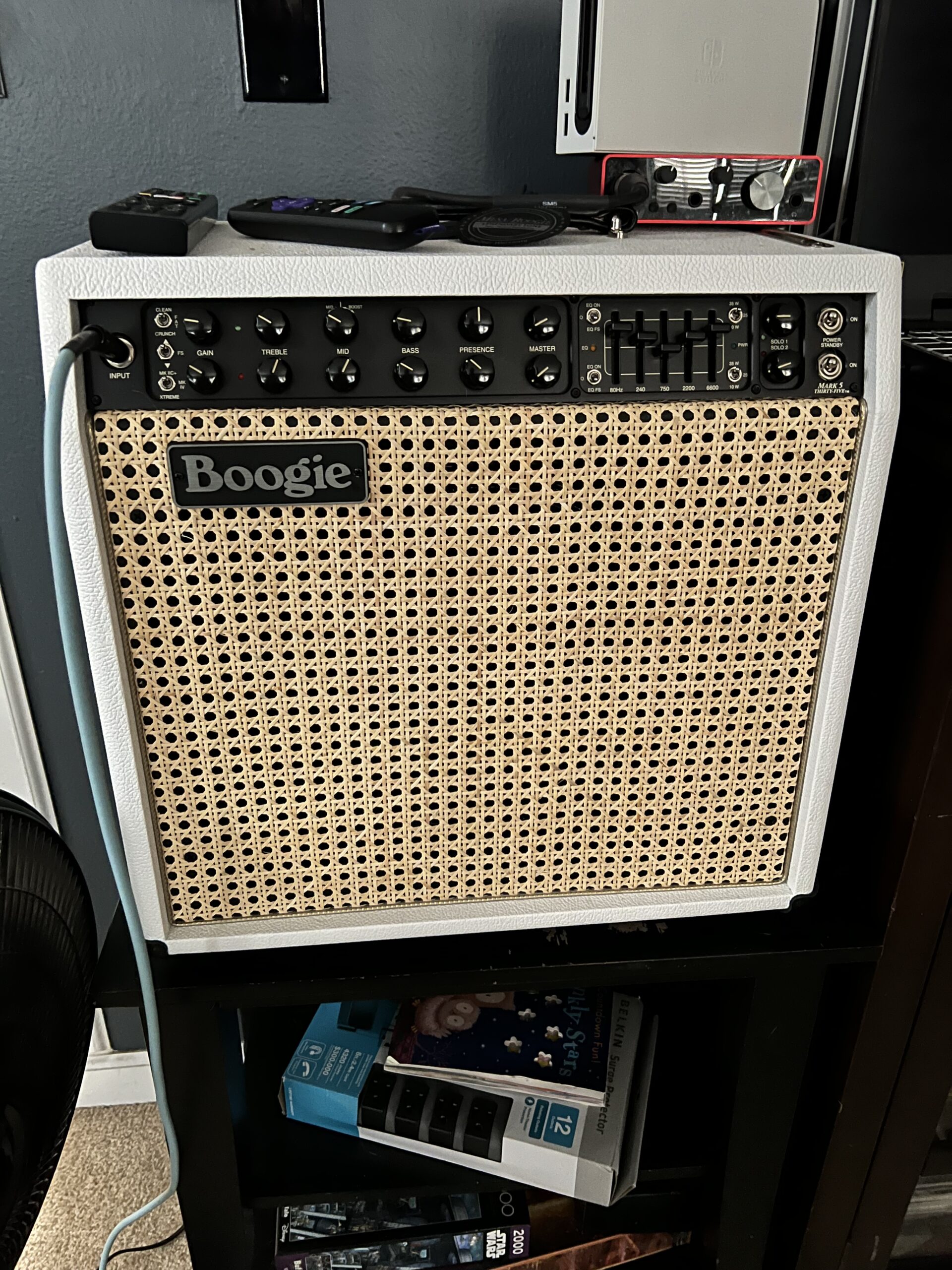
There are guitar amps you buy because you need an amp.
Then there are guitar amps that make you start wandering into the room for absolutely no reason, notice your guitar sitting there, and somehow lose the next 45 minutes.
The Mesa/Boogie Mark V:35 is that kind of amp.
I’ve owned mine long enough to get past the honeymoon period, and I still think it’s a downright lovely amplifier to own. Not because it does one spectacular trick, but because seemingly every time you think you’ve figured out what it’s good at, there’s another switch, mode, slider or jack sitting there waiting to prove you don’t know shit yet.
And strangely, the feature I may appreciate most isn’t even the fire-breathing Mark-series distortion.
It’s the clean channel.
The Clean Channel Is the Secret Weapon
The clean sound on the Mark V:35 is beautiful.
It’s clear, dimensional and extremely responsive to what you’re putting into it. There are plenty of amplifiers with technically “good” clean channels that feel like you’re playing into a piece of audio equipment. This one still feels like an instrument.
And if you own pedals, things get even better.
This is an exceptionally fun amplifier to use as the foundation of a pedalboard. Overdrives, fuzzes and boosts don’t feel like they’re fighting the amp. They become extensions of it.
That’s particularly wonderful if you enjoy the harmonic, touch-sensitive side of electric guitar. Hendrix-ish sounds, SRV territory, fuzzes starting to clean up from the guitar’s volume knob, an overdrive pushing something already flirting with breakup. This amp eats that stuff for breakfast.
The official design gives Channel 1 Clean, Fat and Crunch modes, along with Mesa’s Mid/Boost control, so even before reaching for a pedal you’re working with considerably more than one interpretation of “clean.” [legacy.mes…boogie.com]
And the harmonics are really where this amplifier starts showing off.
Hit a big chord, let it hang there and listen to everything happening around the fundamental notes.
There’s stuff in there.
Good stuff.
Crunch Is Basically the Overdrive Pedal Mesa Hid Inside the Amp
Then there’s Crunch.
Crunch mode is one of those features that initially sounds like another box on the brochure until you spend some time playing it.
It can function almost like having a really damn good overdrive built into the amplifier.
For blues, classic rock, dirty rhythm and that wonderful spot where a clean guitar sound has just begun behaving badly, Crunch is fantastic.
And because this is a tube amp with selectable power configurations rather than simply one enormous output section permanently waiting to remove the drywall, you can alter the character further with 35-, 25- and 10-watt settings. Mesa specifically describes those settings as having different sonic character, with the lower-power options producing a looser feel and more power-stage clipping. [legacy.mes…boogie.com]
That’s an important distinction.
Ten watts does not mean “quiet.”
Ten tube watts can still inform everyone else in the house that you have recently learned a Stevie Ray Vaughan lick.
And We Haven’t Even Gotten to the Ridiculous Channel Yet
Channel 2 gives you Mark IIC+, Mark IV and Xtreme modes. [legacy.mes…boogie.com]
This is where the polite little amplifier sitting in the corner reveals that it has another job.
The Mark sounds are tight, aggressive and enormously shapeable. There’s plenty of gain available, but what makes the amp interesting isn’t simply how much distortion it produces.
It’s what you can do with it afterward.
Because sitting in the middle of the amp are those five innocent-looking sliders.
The Five-Band EQ Is Not Decoration
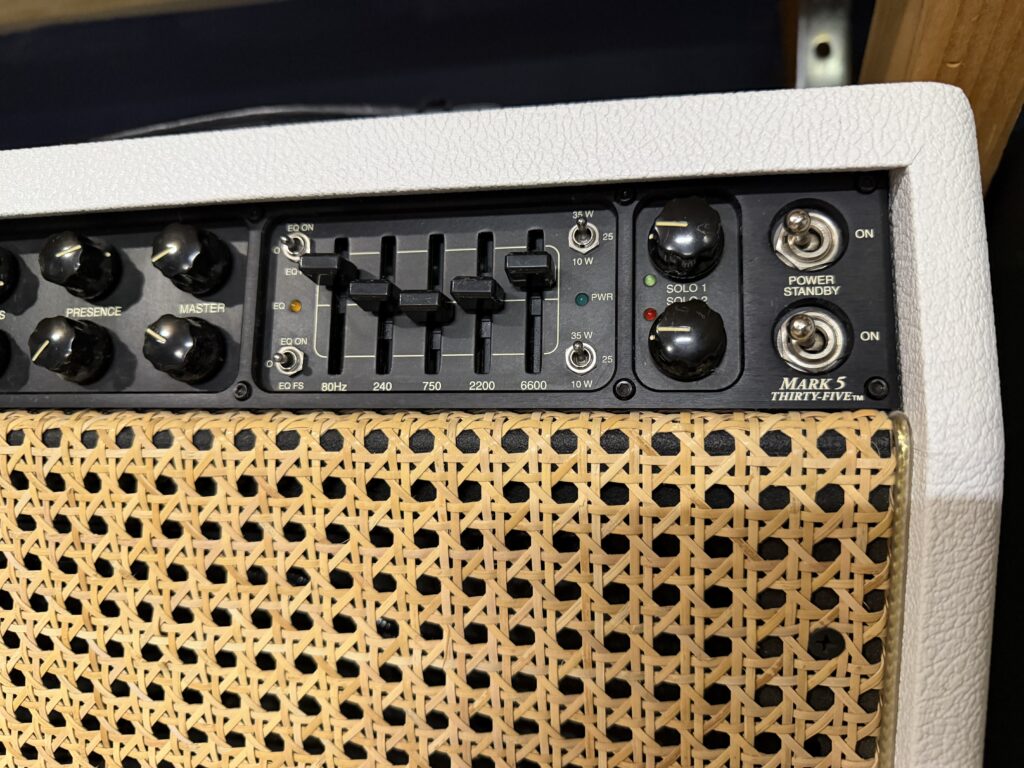
The five-band graphic EQ is one of the defining features of the Mark V:35, and learning to use it is part of learning the amplifier. [mesa-boogi….imgix.net], [legacy.mes…boogie.com]
At first it’s tempting to treat it like the EQ on a stereo.
Don’t.
The relationship between gain, normal tone controls and graphic EQ is a huge part of what makes this amplifier so adjustable.
It’s also one reason two people can plug into the same Mark V:35 and come away wondering whether they played the same amplifier.
Move a couple sliders and you’ve changed its personality.
Mess around with that famous Mesa V-shape and it’s immediately obvious why guitarists have been staring at these five sliders for decades.
But there’s an important warning here:
It is entirely possible to spend twenty minutes playing guitar and forty minutes moving EQ sliders approximately the width of a human hair.
That’s Mark-series ownership.
The Back of the Amp Is Almost Another Product
Then you turn the thing around.
Mesa somehow decided that simply building a small two-channel tube amplifier with six modes, three power settings, reverb and graphic EQ wasn’t enough.
So the back contains an effects loop, independent reverb controls, speaker outputs, headphone facilities and CabClone DI functionality. The CabClone section includes balanced XLR output, speaker simulation voicings and the ability to operate through the amp’s internal load with the speaker switched off. [mesa-boogi….imgix.net]
That opens up a ridiculous number of configurations.
Run effects through the loop.
Feed an interface or mixer.
Use headphones.
Run an external cabinet.
Use the combo as a self-contained rig.
For an analog tube amp rather than a modern digital modeling workstation, there’s a surprising amount of “What if I did this?” built into the back panel.
And Then There’s Actual Spring Reverb
Not “spring reverb” written on a software menu.
There’s an actual long-spring tank in there, with an all-tube reverb circuit and separate rear-panel control for the two channels. [mesa-boogi….imgix.net], [legacy.mes…boogie.com]
And it sounds gorgeous.
Used conservatively, it gives those clean sounds space without announcing itself.
Turn it up and you’re reminded why guitarists spent decades loving actual springs before we figured out how to mathematically recreate the sound of a metal box getting kicked down a staircase.
For bluesy, spacious, harmonic clean playing, it’s one of my favorite parts of the amplifier.
It Loves Pedals, But It Doesn’t Need Them
This is probably the greatest compliment I can give the Mark V:35.
My pedals make it better, but I never feel like I need pedals to rescue it.
That’s a meaningful difference.
Start with that beautiful clean foundation and build outward with pedals, or unplug the whole board and spend an evening exploring Crunch, Mark IIC+, Mark IV or Xtreme.
Either approach works.
The amp doesn’t dictate one philosophy.
There’s a Learning Curve
Of course there is.
Look at the damn thing.
This isn’t an amplifier where every control can be parked at noon and forgotten forever.
Mesa’s own manual spends substantial time explaining how the controls interact, including the particularly important relationship between Treble, Mid and Bass and the later five-band EQ. [mesa-boogi….imgix.net]
That’s simultaneously the Mark V:35’s biggest strength and one of its weaknesses.
If you’re the guitarist who wants:
Guitar → Amp → Good Sound
there are simpler amplifiers.
If you’re the guitarist who enjoys:
Guitar → Amp → Hmm → Turn This → Holy Shit → What If I Move This?
welcome home.
One Amp, an Almost Stupid Number of Personalities
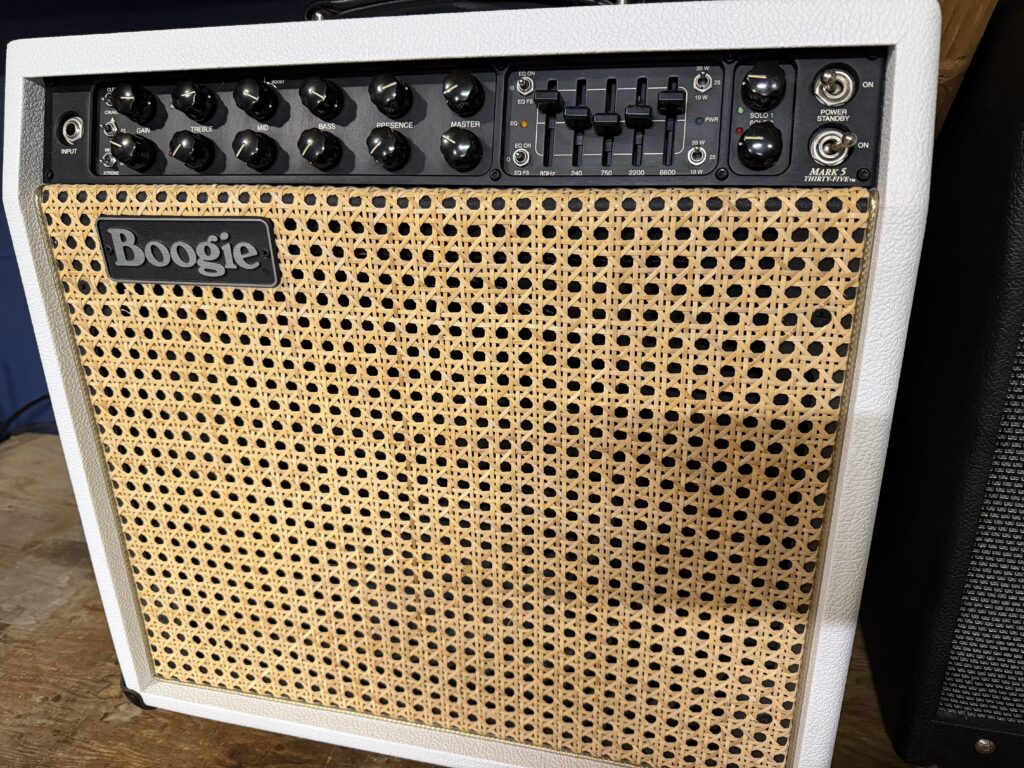
That’s ultimately what I enjoy about owning the Mesa/Boogie Mark V:35.
Some amplifiers are specialists.
This thing is more like a very small guitar laboratory somebody accidentally installed EL84s into.
It can be delicate.
It can be warm.
It can sparkle.
It can do that wonderfully harmonic blues-rock thing where notes seem to develop little halos around themselves.
It can crunch.
It can scream.
And if you decide everything has gotten altogether too tasteful, Channel 2 is standing by to correct the situation.
The remarkable part isn’t that the Mark V:35 contains two channels and six modes. That’s a specification. [legacy.mes…boogie.com]
The remarkable part is that after owning it, I actually use the damn things.
What I Love
- Gorgeous clean channel
- Exceptionally responsive to pedals
- Wonderful harmonics and touch sensitivity
- Clean, Fat and Crunch make Channel 1 much more versatile than “the clean side”
- Serious high-gain capability when wanted
- Five-band EQ dramatically expands the available sounds
- Actual long-spring reverb
- Effects loop
- 35/25/10-watt operation
- CabClone/XLR and headphone functionality
- An enormous amount of amplifier without resorting to modeling [mesa-boogi….imgix.net], [legacy.mes…boogie.com]
What I Don’t Love
- There is a learning curve
- It’s very easy to spend more time tweaking it than playing it
- Six modes don’t mean six instantly footswitchable sounds
- Players who want one great sound and three knobs are paying for an awful lot of stuff they may never use
- Ten watts is still tube-amp ten watts. Your family will remain aware of your hobbies.
The Verdict
The Mesa/Boogie Mark V:35 has become one of those rare pieces of guitar equipment that I don’t think much about replacing.
There are amps with more power. There are simpler amps. There are modern modeling systems offering hundreds or thousands of sounds.
But the Mark V:35 occupies a wonderful middle ground.
It’s a real tube amp with genuinely different personalities, an absurd amount of tone shaping, terrific spring reverb, useful modern connectivity and, most importantly, a basic sound that makes you want to keep playing.
Its high-gain heritage may be what gets it into the brochure.
For me, though?
Give me that beautiful clean channel, a favorite overdrive or fuzz, a little spring reverb and enough volume to let the harmonics start doing their thing.
Then come back in an hour.
Actually, make it two.
