


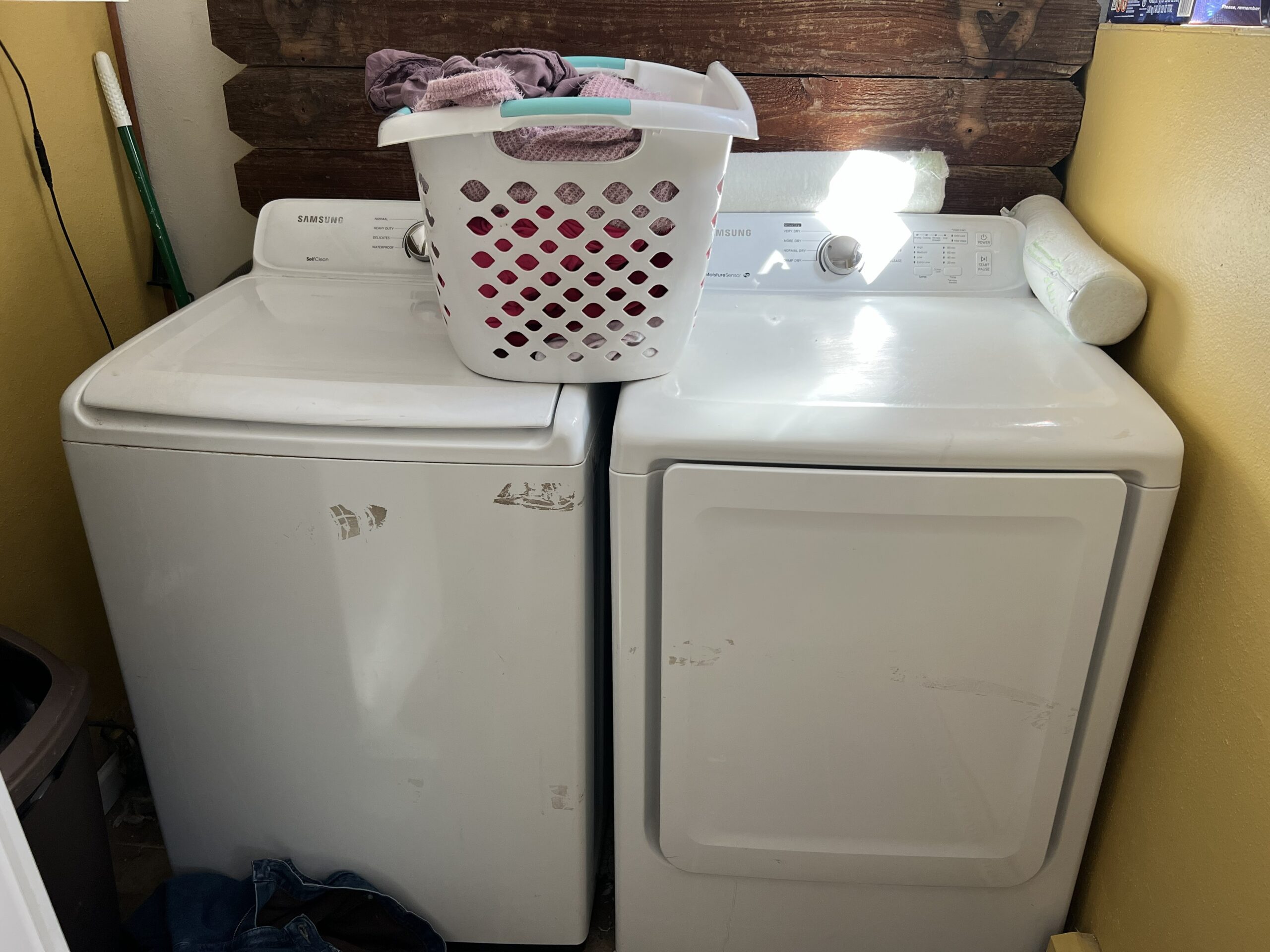
Our late-2010s Samsung dryer lasted 6½ years, survived a dead heating element, processed mountains of dog hair, and generally did what dryers are supposed to do. It just wasn’t always particularly interested in determining when the clothes were actually dry.
The matching dryer that accompanied our late-2010s Samsung WA45-series washer was, for the most part, a pretty decent appliance.
Our closest reference model is the Samsung DVE45N5300W, a 7.5-cu.-ft. electric dryer sold with features including Sensor Dry, 10 preset drying cycles, four temperature settings, Multi-Steam, and Samsung Smart Care. [ajmadison.com]
On paper, that’s a fairly impressive list.
In our house, however, the feature that eventually got the most use was considerably less sophisticated:
Set a time and make the bastard hot.
Sometimes technology reaches its ultimate form through simplicity.
First, the Good News: It Dried Clothes
I know. Hold your applause.
But after owning enough appliances, I’ve learned not to dismiss basic competence.
For roughly 6½ years, this Samsung dryer handled the same demanding household laundry workload as its matching washer.
Clothes.
Towels.
Sheets.
Dog bedding.
Blankets.
Comforters.
And enough dog hair to assemble several replacement dogs.
For ordinary loads, the Samsung generally did its job.
It wasn’t constantly breaking.
We weren’t nursing it along from one repair to another.
It was a fundamentally solid dryer.
But larger loads revealed some weaknesses.
The Washer Could Hold It, and the Dryer Would Eventually Dry It
The companion washer had a giant tub, which encouraged us to wash correspondingly giant loads.
Unfortunately, laundry appliances operate as a team.
If the washer says:
“Look how much crap I can hold!”
the dryer better be prepared for what happens next.
The reference Samsung DVE45N5300W had a substantial 7.5-cu.-ft. drum. [ajmadison.com]
Large loads fit.
That wasn’t the problem.
The problem was that large loads could take a long damn time to actually dry.
And if we’d just spent half the day negotiating with a soaking comforter that refused to balance in the washer, we’d sometimes get the privilege of spending an equally intimate amount of time with it in the dryer.
At some point the convenience of washing giant bedding at home begins resembling a part-time job.
Sensor Dry: Great Idea, Our Machine Just Wasn’t Great at It
Samsung’s Sensor Dry system was designed to use moisture sensors to determine when laundry had reached the appropriate dryness level and automatically stop the dryer. [ajmadison.com]
That’s exactly the sort of feature you want.
Put clothes in.
Push button.
Technology figures out the rest.
Except our experience with the sensors wasn’t particularly impressive.
Too frequently, the machine’s opinion of dry and our opinion of dry seemed to have been developed by two entirely separate committees.
So eventually we did what humans have done throughout history when sophisticated technology becomes irritating:
We bypassed the clever shit.
Timed Dry ruled the day.
Was that the most energy-efficient way of drying everything?
Probably not.
Was it technologically impressive?
Absolutely not.
Did we know what was going to happen when we told the dryer to run for a specific amount of time?
Yep.
Sometimes boring wins.
Then the Heating Element Died
Here’s where our relationship with the dryer became significantly more personal.
About a month after the warranty expired, the heating element failed.
Perfect.
Absolutely beautiful timing.
The documentation for the Samsung DVE45N5300W reference model lists a one-year limited warranty on parts and labor. [images.thdstatic.com]
Our heating element apparently had a calendar.
Fortunately, this wasn’t the end of the dryer.
I decided to repair it myself.
And honestly, that’s one thing in the Samsung’s favor. A failed heating element didn’t turn the entire appliance into scrap metal.
Unfortunately, before fixing the Samsung, I first had to survive Amazon.
The Amazon School of Appliance Repair
I found the replacement part online.
The listing indicated it was the correct part.
I ordered it.
It arrived.
It wasn’t the correct fucking part.
Nothing enhances the pleasure of taking apart a broken appliance quite like discovering that the replacement component sitting beside you doesn’t belong in it.
Eventually I tracked down the correct part, replaced the failed element, put everything back together and returned the Samsung to service.
And to its credit:
It kept going.
The dryer didn’t enter a cascade of failures afterward.
The repair bought us years of additional service until we ultimately retired the set at about 6½ years old after the washer’s pump failure made replacement of the pair more appealing.
So while the heating element failure pissed me off, I’m reluctant to call the dryer unreliable solely because of it.
I fixed it.
It survived.
That’s worth something.
Then There Was the Dog Hair
Any dryer entering our house unknowingly enrolls in an advanced graduate program in pet-hair management.
We have multiple dogs.
Dog hair isn’t something we occasionally encounter.
It’s a renewable resource.
You can vacuum Monday and by Wednesday wonder whether someone shaved a German shepherd directly onto the carpet.
The Samsung did collect lint.
What it wasn’t particularly good at, in our experience, was catching all of the lint and dog hair before sending it elsewhere.
Our patio can testify.
The exhaust vent occasionally looked like the dryer was attempting to return our dogs to nature one follicle at a time.
Interestingly, the specifications for the reference Samsung DVE45N5300W explicitly list“Extra Large Lint Filter: No.” [ajmadison.com]
That isn’t necessarily a criticism by itself.
In a normal household, perhaps nobody cares.
In ours?
We would’ve appreciated a lint filter approximately the size of Utah.
Was It a Bad Dryer?
Again, no.
And just like the washer review, I don’t want hindsight turning a decent appliance into something it wasn’t.
This dryer gave us roughly 6½ years of service.
It handled an enormous amount of laundry.
It dried ordinary loads reliably enough.
It survived a heating-element failure because the failed component was repairable.
After I fixed it, the dryer went right back to work.
Those aren’t the characteristics of an awful appliance.
But neither was it great.
The sensor system never earned our trust.
Large loads could take too long.
Lint and dog-hair capture left something to be desired.
And having the heating element give up shortly after warranty coverage expired was an especially charming little kick in the nuts.
Would We Buy It Again?
If the price were right, I wouldn’t tell somebody to run screaming from one.
But after living with ours for 6½ years, I wouldn’t particularly seek another one out either.
That’s probably the fairest description of our entire Samsung laundry experience.
They weren’t garbage.
They weren’t disasters.
They were decent mass-market appliances that accumulated enough little compromises over the years that, when replacement time finally arrived, we wanted something different.
The dryer taught us something especially important:
Fancy features only have value if you trust them enough to use them.
A moisture sensor can sound fantastic on the showroom floor.
If you eventually stop using it because telling the dryer “run for 60 minutes and don’t ask questions” produces more predictable results, the feature has largely become decoration.
💩💩 The Crap Rating: 2/4 Poops
Decent, capable, repairable, but definitely flawed.
I actually give the dryer essentially the same rating as its washer companion, albeit for different reasons.
It performed its basic job.
It lasted 6½ years in a demanding household.
When the heating element failed, I repaired it and got years more use rather than sending the entire machine to the landfill.
That’s meaningful.
But the lousy experience with Sensor Dry, slow performance on large loads, mediocre lint and dog-hair capture, and that suspiciously well-timed heating-element failure are enough to keep it firmly out of one-poop territory.
💩💩 2/4 Poops.
Not full of crap.
Not something we’d rush out to buy again.
And if you’re wondering whether all that dog hair actually disappeared after every load, feel free to ask the patio.

1 Comment
Pingback: Major Household Appliance Reviews: Expensive Crap That Better Last - ShouldIBuyThisCrap.com