


Every now and then a product comes along that makes you stop, look at the price tag again, and ask:
“Wait… this costs HOW much?”
That was pretty much my reaction to the Epiphone Inspired by Gibson Custom 1957 SJ-200.
Because I was expecting a very nice Epiphone.
What I wasn’t expecting was to pick it up and immediately start wondering what kind of black magic Epiphone used to get this much guitar into this price range without somebody from Gibson accounting showing up and shutting the whole operation down.
This isn’t one of those guitars that’s “good for the money.”
I hate that phrase.
Half the time, good for the money is reviewer code for:
“It’s not complete shit as long as you continually remind yourself that it was cheap.”
That’s not what we’ve got here.
The 1957 SJ-200 is simply a really damn good guitar.
It looks expensive.
It feels expensive.
It sounds expensive.
And then you remember what the Gibson version of this general idea costs and suddenly the Epiphone starts looking like somebody misplaced a decimal point.
First Impressions: Holy Shit, That’s a Big Guitar

Let’s get something out of the way immediately.
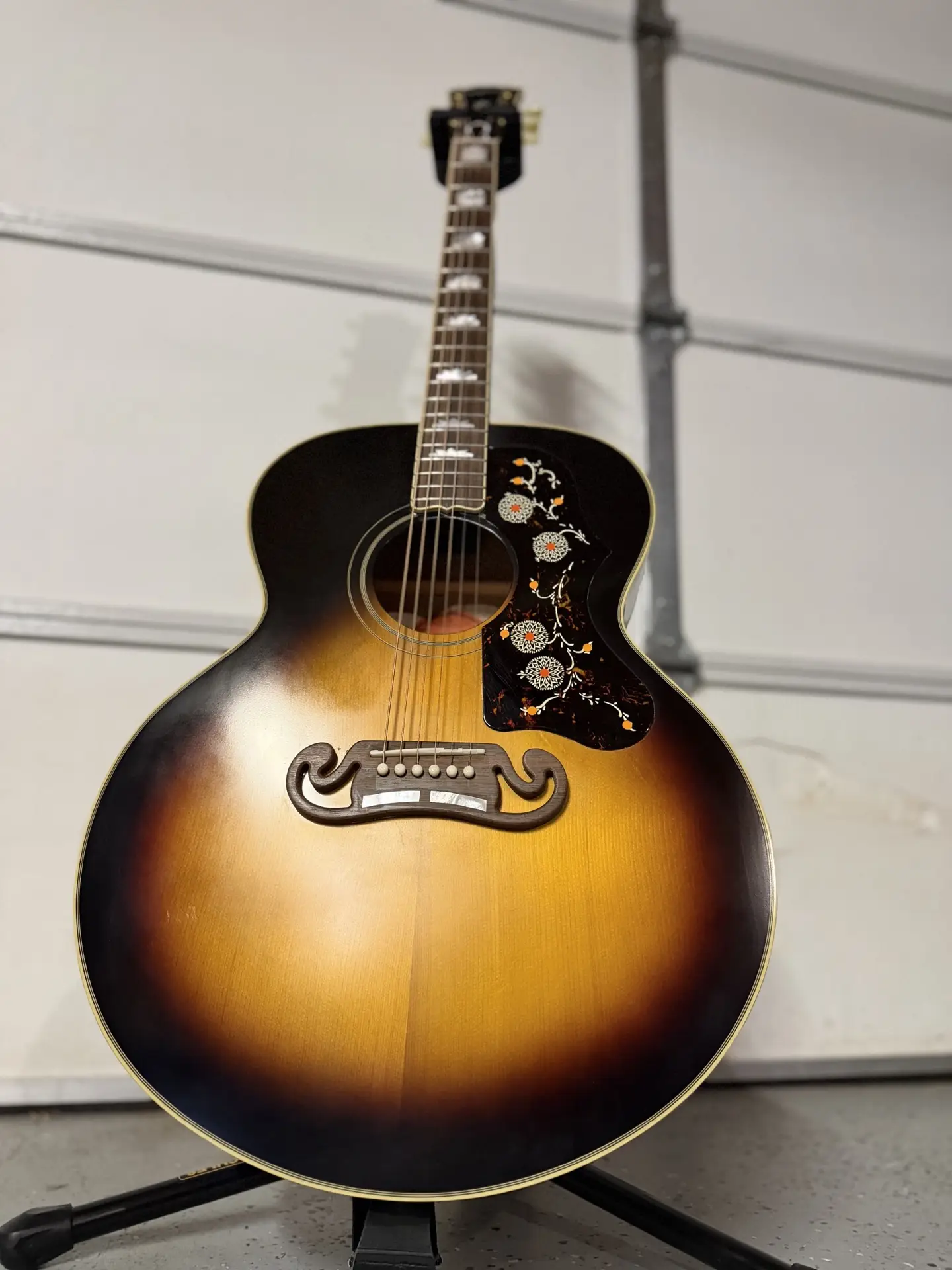
This guitar is gorgeous.
Not tasteful little hints of elegance.
Not understated sophistication.
Nope.
This thing walks into the room wearing cowboy boots, a rhinestone jacket, and enough jewelry to make Elvis ask it to tone things down.
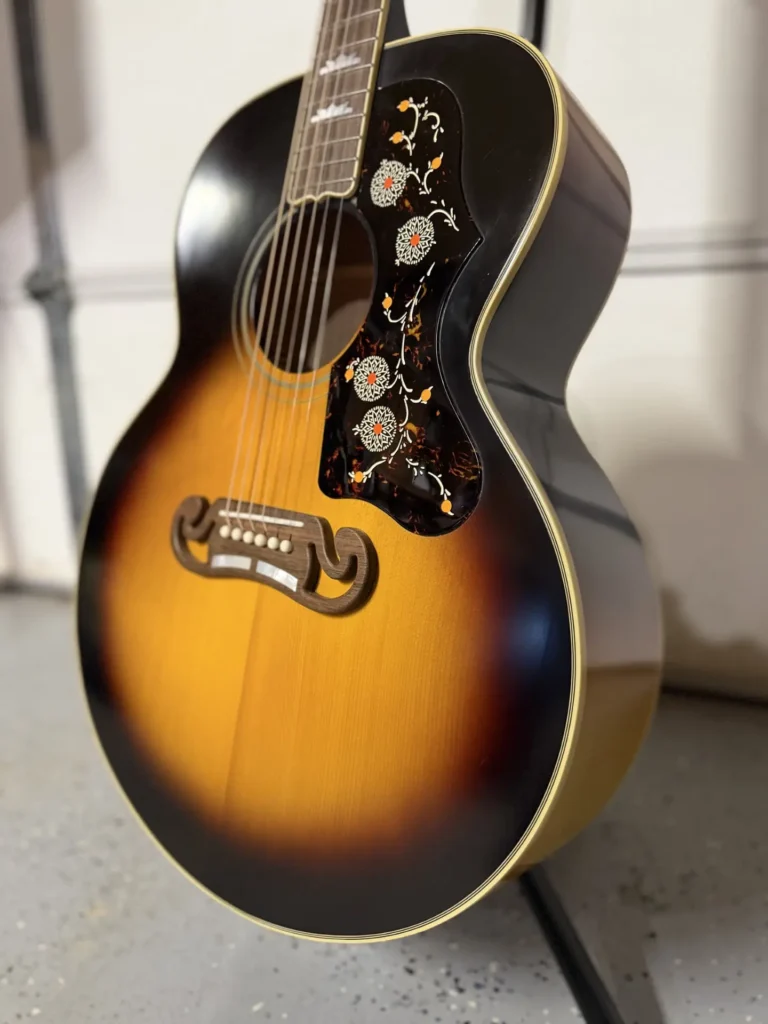
You’ve got the enormous Super Jumbo body.
The ornate pickguard.
The gold hardware.
The crown inlays.
The moustache bridge.
The figured maple back and sides.
There’s shit happening everywhere.
And somehow it works.
An SJ-200 isn’t the kind of guitar you buy because you want something subtle hanging in the corner.
It’s the acoustic equivalent of pulling up to dinner in a vintage Cadillac.
Nobody needed you to make that kind of entrance.
But they’re damn sure going to notice when you do.
And the Epiphone absolutely captures that part of the SJ-200 experience.
But Is It Just a Pretty Face?

Here’s where things get interesting.
It would have been really easy to build a guitar that looked like an SJ-200, slap some fancy appointments on it, cut costs everywhere underneath, and call it a day.
The guitar industry has certainly done that before.
That’s not what Epiphone did here.
The 1957 SJ-200 brings some legitimately serious hardware and construction to the party:
- Solid thermally aged Sitka spruce top
- Solid figured maple back and sides
- Scalloped X-bracing
- Maple neck
- Bone nut
- Bone saddle
- Bone bridge pins
- L.R. Baggs electronics
That’s a hell of a specification sheet.
More importantly, the expensive-looking exterior isn’t hiding a glorified plywood box underneath.
This is an all-solid-wood acoustic with the construction you’d expect to find on an instrument that’s trying to be taken seriously.
And that’s really where the whole personality of this guitar starts to make sense.
It isn’t pretending to be fancy.
It actually is pretty fancy.
Then I Played the Damn Thing
Looks are nice.
But I’ve played beautiful guitars that sounded like somebody stretched strings across a coffee table.
Thankfully, the SJ-200 doesn’t have that problem.
The first word that comes to mind is:
Big.
Which probably isn’t shocking considering the guitar itself is approximately the size of a studio apartment.
But there’s a difference between big and boomy.
This thing is big.
Strum a full open chord and it has authority.
Dig into it with a pick and it responds.
Flatpicking has punch.
Individual notes still have definition.
Back off for fingerstyle playing and there’s enough clarity that everything doesn’t collapse into one giant maple-flavored fart cloud.
That’s important.
A giant acoustic guitar that’s simply loud isn’t particularly impressive.
A giant acoustic that can sound huge without turning into mud is much more interesting.
And that’s what impressed me here.
It sounds like an expensive guitar.
So Does It Sound Exactly Like a Gibson SJ-200?
No.
Let’s not get stupid.
The expensive Gibson exists for a reason.
When you start spending that kind of money, you’re paying for materials, construction details, finishing, labor, selection, and the little incremental improvements that become increasingly expensive as you climb the guitar ladder.
A high-end Gibson can have more projection, complexity, refinement, and that difficult-to-describe quality guitar nerds will happily argue about for 37 pages on a forum.
But I think asking whether the Epiphone is identical misses the entire point.
The better question is:
Does this thing get close enough to the SJ-200 experience that you’re going to give a shit about the difference every time you pick it up?
For a whole lot of players?
Probably not.
And that’s where this guitar becomes dangerous.
The Financially Irresponsible Part
Because eventually you’re going to start comparing prices.
Don’t do that.
Actually, do.
That’s the whole damn point.
The Gibson SJ-200 is an aspirational guitar for a lot of players. It’s beautiful, iconic, historic, and expensive enough that buying one may require the sort of household discussion that begins with:
“So honey, before you get mad…”
The Epiphone changes that equation.
You get much of what makes an SJ-200 an SJ-200:
The imposing body.
The maple construction.
The visual excess.
The jumbo sound.
The moustache bridge.
The fancy appointments.
The feeling that you should probably own a rhinestone suit.
But you don’t have to enter financially irresponsible Gibson Custom territory to get it.
That’s what makes this particular Epiphone so damn compelling.
It’s not about proving that the cheaper guitar is secretly better than the expensive guitar.
That would be bullshit.
It’s about asking how much extra you’re willing to pay for the remaining differences.
And this guitar makes that question uncomfortably difficult.
Playing a Small Wooden Building
There’s no way around this part.
The SJ-200 is huge.
They don’t call it a Super Jumbo because “Moderately Large Guitar” didn’t test well with the marketing department.
If you’re accustomed to smaller acoustics, this can feel like someone handed you a dining-room table and asked you to play an E chord on it.
Smaller players especially may want to sit down with one before ordering.
The 25.5-inch scale contributes to a slightly firmer feel and gives the strings some nice snap and clarity.
The neck also isn’t trying to impersonate a paper-thin electric guitar neck.
Personally, I think that suits the instrument.
Everything about an SJ-200 feels substantial.
It would be weird if this enormous cowboy chandelier of a guitar came with a neck that felt like an Ibanez shred machine.
Spend a little time with it and the size becomes part of the experience.
Of course, if you’re coming from a parlor guitar, the experience may initially involve wondering whether you should have received a boating license with the case.
Plugging It In
The onboard L.R. Baggs electronics are another area where Epiphone didn’t decide to save fifteen bucks by installing something you’d immediately want to rip out.
And I appreciate that.
I’m also a fan of acoustic electronics that don’t require scrolling through menus, pairing an app, creating an account, downloading firmware, or sacrificing a chicken under a full moon just to make your guitar louder.
Plug it in.
Make your adjustments.
Play the damn guitar.
Call me old-fashioned.
Long-Term Ownership: Here’s Where I’m Not Going to Bullshit You
This model arrived in 2024.
That means anybody confidently explaining how these guitars hold up after 15 or 20 years has apparently discovered time travel.
We don’t know yet.
That’s not criticism.
It’s reality.
What we can say is that the construction gives the guitar everything it should need to become a long-term instrument if it’s cared for properly.
And the important phrase there is:
cared for properly.
Because this is an all-solid-wood acoustic guitar.
Which means its greatest natural predator isn’t Gibson.
It’s your furnace.
Humidity: The Boring Shit That Actually Matters
You know what’s less exciting than talking about figured maple, thermally aged spruce, and giant cowboy guitars?
Humidity.
You know what can screw up your expensive solid-wood acoustic?
Also humidity.
Wood moves.
That’s what wood does.
Let an acoustic become excessively dry and you’re asking for problems. The exact symptoms vary, but none of them are things you’re going to enjoy discovering on a guitar you love.
So keep the environment reasonably stable.
Use a humidification system when conditions require it.
Keep an eye on the guitar.
And don’t store the damn thing next to a heater.
This isn’t exciting guitar advice.
It also might save you from eventually typing:
“EPIPHONE QUALITY CONTROL SUCKS!!!”
into a guitar forum when the actual culprit has been your Colorado furnace slowly turning the living room into the Mojave Desert.
Maintenance Is Pretty Simple
Fortunately, once you get past proper humidity management, owning one isn’t particularly complicated.
Change the strings.
Clean it occasionally.
Keep an eye on humidity.
Don’t leave it baking in a hot car.
Don’t lean it against a radiator.
Don’t knock it over.
Don’t use it as a canoe paddle.
You know.
Guitar shit.
The included hardshell case is also a very welcome addition, especially for a guitar this large.
Finding some random spare gig bag in the closet for an SJ-200 isn’t happening.
Unless that gig bag previously contained a cello.
A Little History Before We Get Carried Away
Part of the appeal here comes from the fact that the SJ-200 isn’t just a big fancy acoustic someone dreamed up last Tuesday.
Its family tree stretches back to 1937, when Gibson introduced what became its flagship jumbo flat-top.
Over the decades, the SJ-200 became one of the most visually recognizable acoustic guitars around, appearing in the hands of major musicians including Elvis Presley, Bob Dylan, George Harrison, Jimmy Page, and Emmylou Harris.
And it’s not difficult to understand why.
Put an SJ-200 on stage and people can see the damn thing from the parking lot.
Its oversized body, elaborate bridge and pickguard, maple construction, and huge visual presence became part of the identity.
The Epiphone Inspired by Gibson Custom 1957 SJ-200 isn’t interesting because it’s pretending that decades of guitar history never happened.
It’s interesting because it gives ordinary players access to an awfully convincing helping of that experience without requiring them to sell a kidney behind Guitar Center.
That’s a much better proposition.
What I Love
There’s a lot.
The construction is serious.
This isn’t decorative lipstick smeared across bargain-basement bones.
The sound matches the appearance.
It’s big, powerful, clear, and fun as hell to strum.
The electronics make sense.
No bullshit required.
The case is included.
Which shouldn’t feel like a luxury, but apparently we’ve reached a stage of civilization where buying an expensive instrument and receiving something to safely put it in deserves applause.
And it looks fantastic.
Seriously.
If you don’t like ornate guitars, you probably stopped reading 800 words ago.
If you do like them, this thing is guitar porn.
What I Don’t Love
First:
It’s enormous.
That’s not Epiphone’s fault. It’s an SJ-200. Complaining that it’s big is like buying a Suburban and bitching about the parking situation.
But it matters.
For smaller players, it could legitimately be uncomfortable.
The neck may also feel substantial if your idea of perfection is a skinny electric neck.
And no, buying this doesn’t secretly get you a Gibson Custom for Epiphone money.
There are still differences.
The problem for Gibson isn’t that Epiphone eliminated those differences.
The problem is that Epiphone made you start calculating how much those differences are worth to you.
That’s a much more dangerous question.
The Other Problem
There is one additional side effect that Epiphone fails to mention in the owner’s literature.
You may start looking at other guitars.
This one is particularly dangerous because you buy it thinking you’ve made the sensible financial decision.
Then you start thinking:
“Well, if this Inspired by Gibson Custom is this good…”
Stop.
Put the phone down.
Close Reverb.
You already bought a guitar.
Nobody needs another guitar.
Anyway, I’ll probably see you there later.
The Shitty Verdict
This is exactly the kind of product I love reviewing.
Not because it’s cheap.
It isn’t.
And not because it somehow destroys the expensive instrument that inspired it.
It doesn’t.
I love it because it lands in that wonderful sweet spot where you can clearly see where your money went.
The materials are there.
The construction is there.
The looks are definitely there.
And most importantly, the sound is there.
Every time I pick this thing up, I come back to the same thought:
“This guitar has no business being this damn good for the money.”
That’s the review.
I could probably have saved everybody a few thousand words.
If you’ve always wanted the giant, ridiculous, beautiful SJ-200 experience but can’t convince yourself that buying the Gibson version is a sound financial decision, the Epiphone Inspired by Gibson Custom 1957 SJ-200 deserves a very serious look.
Just understand what you’re getting into.
It’s gigantic.
It’s flashy.
It’s completely unnecessary.
And you’ll probably stare at it after you’re done playing.
In other words, it’s a guitar.
Final Shit Rating: 💩 1 out of 4
Excellent crap.
One poop on the Should I Buy This Crap? scale because there’s surprisingly little here for me to bitch about.
It’s a giant, gorgeous, room-filling acoustic with serious construction, legitimate stage-ready hardware, and a price that makes its much more expensive relatives slightly uncomfortable.
Is it a Gibson Custom SJ-200?
No.
Does it need to be?
That’s the problem.
I’m not sure it does.
And in the guitar world, that’s some seriously good shit.

1 Comment
Pingback: All the News That’s Barely Fit to Print - ShouldIBuyThisCrap.com