


Major appliances occupy a special category of consumer spending.
Nobody wakes up Saturday morning thinking:
“You know what would really make this weekend exciting? Spending $2,000 on a refrigerator.”
You buy these things because somewhere in your house sits an expensive box that performs a basic function you’d very much like to continue having.
Keep the food cold.
Wash the clothes.
Dry the clothes.
Clean the dishes.
Cook dinner.
Pretty simple.
And yet somehow we’ve managed to turn shopping for appliances into an exercise involving Wi-Fi connectivity, touchscreens, proprietary filters, seventeen wash modes and enough marketing terminology to make you wonder whether you’re buying a dishwasher or commissioning a nuclear submarine.
Welcome to the Should I Buy This Crap? Major Household Appliance Reviews.
This section exists because appliances are expensive, annoying to replace and increasingly complicated.
If we’re spending that kind of money, the damn things better work.
What We Actually Care About
You can find specification sheets anywhere.
They’ll tell you dimensions.
Capacity.
Cycle counts.
Energy ratings.
Motor types.
Whether the refrigerator can send your phone a notification because somebody left the door open.
Cool.
We’ll cover specifications when they’re useful.
But that’s not really what we want to know.
We want answers to questions like:
Does the damn thing actually work?
Is it annoying to own?
Does it perform its basic job well?
Are the fancy features genuinely useful, or are they brochure filler?
Is it easy to maintain?
When something eventually breaks, does repairing it make sense?
And perhaps most importantly:
Are we buying something we’ll still want to own after the warranty expires?
That’s the stuff that matters.
Laundry Appliances
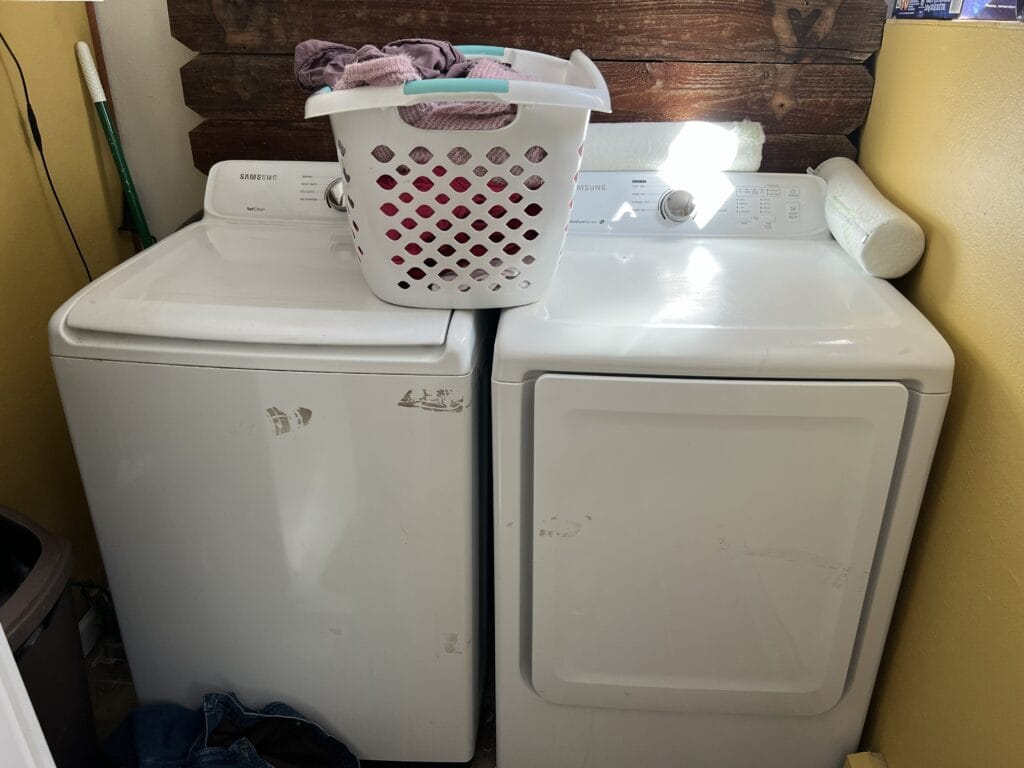
Let’s start with the appliances currently getting the most abuse in our house.
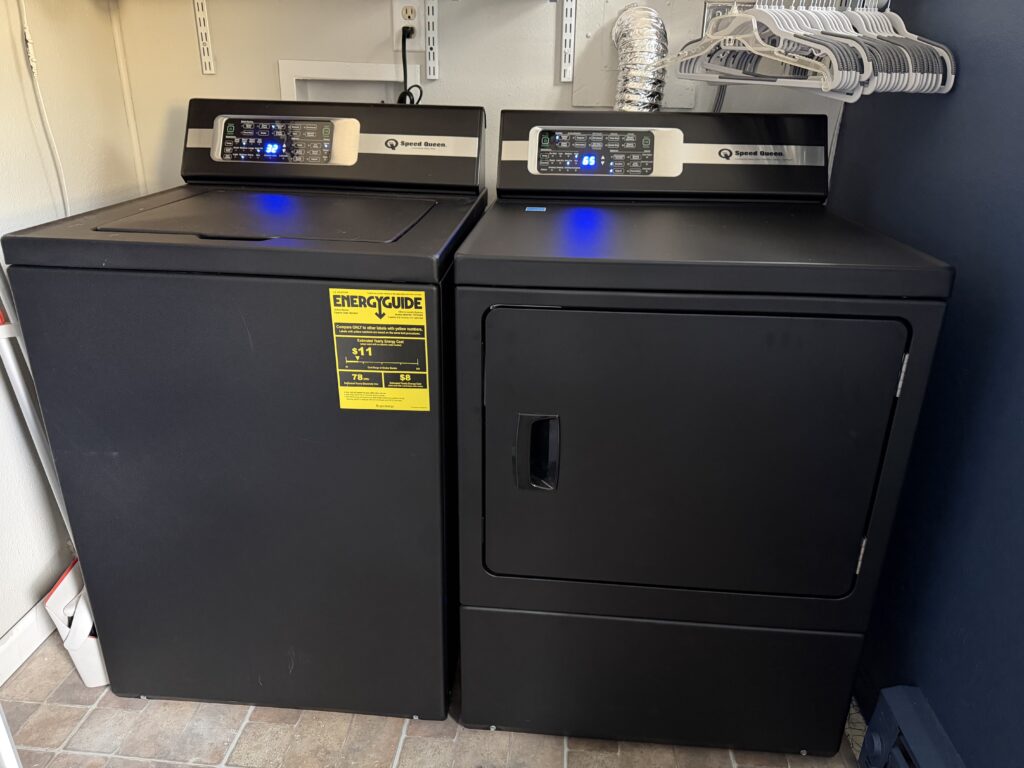
We recently replaced our washer and dryer with a Speed Queen TR7 and matching Speed Queen DR7 electric dryer.
The TR7 has a 3.2-cu.-ft. tub, while the DR7 has a 7.0-cu.-ft. dryer cylinder. Both currently carry seven-year warranties. Speed Queen also describes the TR7 as built for 25 years of life in the average home. [speedqueen.com], [speedqueen.com]
We bought them with a very specific philosophy:
Buy the expensive bastards.
Maintain the expensive bastards.
Repair the expensive bastards.
Keep the expensive bastards.
Whether that works remains to be seen.
But that’s what makes these ownership reviews interesting.
Speed Queen TR7 Washer Review
The washer that’s apparently in a hurry to finish our laundry.
The Speed Queen TR7 has a relatively modest 3.2-cu.-ft. tub, but that hasn’t been nearly as limiting in our house as I expected. Speed Queen lists 16 preset cycles, a stainless wash tub, 1-HP variable-speed motor and Perfect Wash system. [speedqueen.com]
In actual ownership?
We love it.
It’s fast.
It’s quiet.
Our fabrics feel noticeably soft.
It handles our normal laundry easily, and even thinner king-size blankets have worked fine for us.
I wouldn’t cram a giant king comforter into it unless I was actively trying to piss off a $1,700 washing machine.
Our biggest complaint is that it finishes loads faster than we can fold and put away the previous one.
→ Read our full Speed Queen TR7 review
Speed Queen DR7 Electric Dryer Review
Come for the fast drying. Stay because it actually removes some of the goddamn dog hair.
The matching Speed Queen DR7 gives us a 7.0-cu.-ft. cylinder plus Pet Plus, moisture sensing, steam functions and wrinkle-oriented features including Extended Tumble. [speedqueen.com]
The pet features have been legitimately useful in our house.
We’re seeing less dog hair survive the laundry process.
The dryer is extremely fast.
And one of the biggest surprises has been our permanent-press clothing.
Shirts and other items come out looking remarkably smooth, sometimes almost like they just came back from the cleaners.
That means less wrinkling.
Less screwing around with clothes before folding them.
And generally less bullshit.
→ Read our full Speed Queen DR7 electric dryer review
Speed Queen TR7 + DR7 Set Review
The approximately $3,500 question: was buying the pair worth it?
This is where things get interesting.
Reviewing the washer and dryer individually only tells part of the story.
Together, we’ve found that our fabrics feel softer after washing, permanent-press items come out with dramatically fewer wrinkles, there’s less dog hair making it through the complete process, and the whole operation moves ridiculously quickly.
The machines have basically identified us as the bottleneck.
The bigger question is longevity.
We didn’t spend premium money merely because we wanted nice appliances in 2026.
We’re hoping to maintain, service and repair these machines for decades.
Will that work?
We have no idea yet.
That’s why we’re documenting it.
→ Read our Speed Queen TR7 and DR7 ownership review
Refrigerators & Freezers
Refrigerators have one job that’s particularly difficult to negotiate around:
Don’t let the food rot.
Everything after that is secondary.
Ice makers, water dispensers, convertible drawers and whatever computerized wizardry manufacturers come up with can absolutely be useful.
But they’re competing for attention with more important questions:
How consistently does it maintain temperature?
How usable is the space?
Is it obnoxiously loud?
Are frequently used parts accessible?
What needs regular maintenance?
And when something eventually goes wrong, are you repairing a refrigerator or replacing an enormous computer that happens to contain milk?
Future refrigerator and freezer reviews will live here.
Dishwashers
A dishwasher has one especially important performance metric:
Are the dishes clean when it stops?
If I need to thoroughly wash the plate before putting it into the machine that’s supposedly washing the plate, we’ve added an unnecessary employee to the kitchen.
We’ll be looking at:
- Cleaning performance
- Drying performance
- Cycle times
- Noise
- Rack design
- Loading flexibility
- Filter and maintenance requirements
- Reliability
- Repairability
- Long-term ownership costs
And the eternal dishwasher question:
Do I really need to rinse this shit first?
Ranges, Ovens & Cooktops
Cooking appliances are another category where feature lists can get silly very quickly.
What matters is whether they’re good to cook with.
Does the oven hold temperature consistently?
How evenly does it cook?
Do the burners provide useful control?
Are the controls intuitive?
Is the surface miserable to clean?
Does that fancy cooking mode actually improve anything?
And after several years of splattered grease, spilled sauce and Thanksgiving abuse:
Does the damn thing still work?
Those are the questions we’ll concentrate on.
Microwaves & Combination Ovens
Microwaves range from glorified leftover heaters to elaborate multicooking contraptions with convection, sensors and enough buttons to launch a weather satellite.
We want to know which features matter.
Because if 97% of your interaction with a $700 microwave consists of pressing:
ADD 30 SECONDS
somebody should probably mention that before you buy it.
Major Home Systems
Eventually this section can extend beyond kitchen and laundry appliances into the expensive mechanical stuff that quietly keeps the house functional.
That includes things like:
- Water heaters
- HVAC equipment
- Whole-house humidifiers
- Air conditioners
- Evaporative coolers
- Water softeners and filtration systems
These aren’t exciting purchases either.
But when one stops working, holy shit do you suddenly care about it.
For equipment like this, installation, maintenance, operating cost and serviceability matter just as much as the shiny box itself.
What Makes a Good Appliance?
There’s no universal answer.
But our philosophy is becoming fairly clear.
We value appliances that:
Do their primary job exceptionally well.
This sounds obvious.
Apparently it needs saying.
Make everyday life noticeably easier.
A feature that saves us time or frustration is worth more than ten features we never touch.
Can be maintained.
Throwaway design isn’t especially appealing when we’re spending four figures.
Can be repaired when something wears out.
Failure doesn’t automatically need to mean replacement.
Don’t demand unnecessary attention.
The best appliance might be the one you eventually stop thinking about.
Hold up over time.
This is the big one.
We’re Playing the Long Game
The appliance industry loves reviewing products shortly after they launch.
That’s useful.
But I think there’s another question that’s arguably more important:
How’s the damn thing doing ten years later?
That’s what we eventually want these reviews to answer.
For products we actually own, we’ll be able to update the reviews as they age.
What broke?
What didn’t?
What maintenance did we perform?
What did repairs cost?
Would we buy it again?
Did our opinion improve?
Did it completely go to shit?
That means a glowing review today isn’t a lifetime pardon.
If something we praised falls apart prematurely, the review should change.
Likewise, if an expensive appliance quietly survives years of abuse and turns out to be worth every penny, that deserves recognition too.
Expensive Doesn’t Automatically Mean Good
This is worth saying explicitly.
We aren’t automatically impressed by premium appliances.
A $2,000 washing machine doesn’t get bonus points simply for costing $2,000.
The price actually raises the standard.
If something costs twice as much, there had better be a convincing reason.
Performance.
Construction.
Features we’ll actually use.
Repairability.
Longevity.
Something.
We don’t care if the control knob was hand-polished by monks in the Swiss Alps.
Does the damn thing work, and are we going to regret buying it?
That’s the question.
Our Appliance Review Philosophy
The purpose of Should I Buy This Crap? isn’t to convince everybody to buy the products we own.
That’s useless.
The job is figuring out who should buy them and who shouldn’t.
Sometimes an expensive product makes sense.
Sometimes the cheap one is perfectly good.
Sometimes the supposedly premium option is an overpriced pile of shit.
And sometimes spending substantially more upfront might actually save money if you maintain the product and keep it long enough.
That’s what we’re trying to figure out.
One appliance at a time.
So, Should You Buy This Crap?
Maybe.
That’s why we’re here.
We’ll keep adding major household appliance reviews, long-term ownership updates, buying guides and comparisons as we actually gain experience with the products.
No pretending we’ve owned something for ten years when we’ve had it for three weeks.
No awarding durability points for decades that haven’t happened yet.
No declaring every expensive product an investment because that sounds nicer than admitting we just spent several thousand dollars at an appliance store.
Just the basic question:
Is this crap actually worth buying?
And, eventually:
Was it worth keeping?