Category: Music

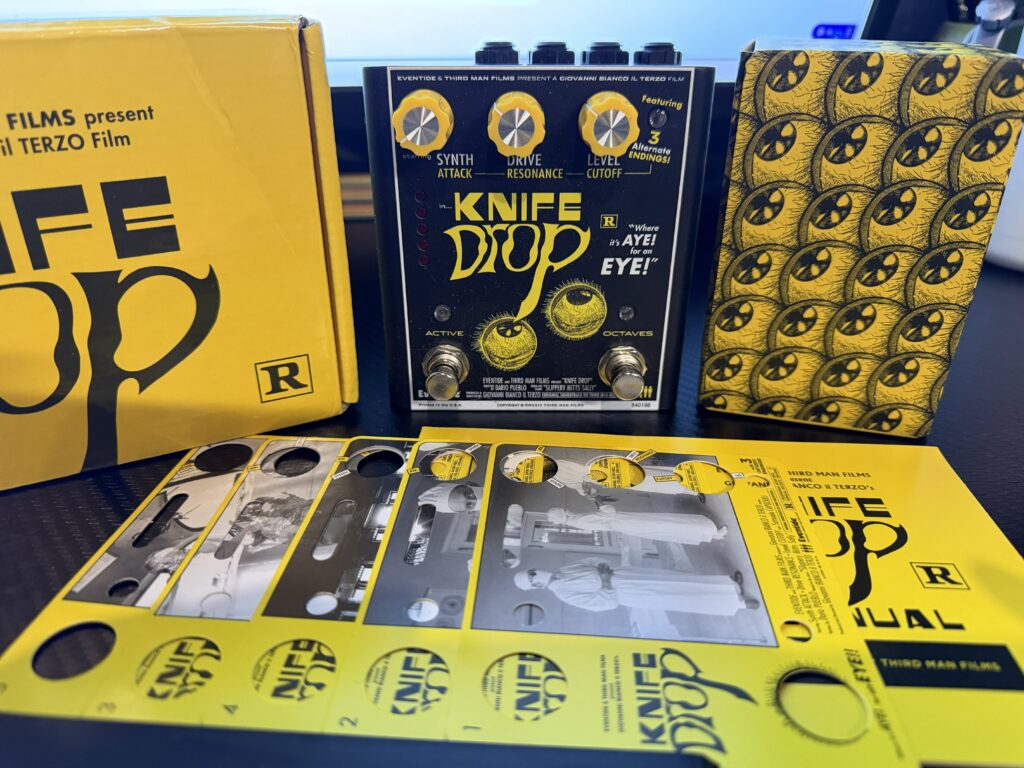
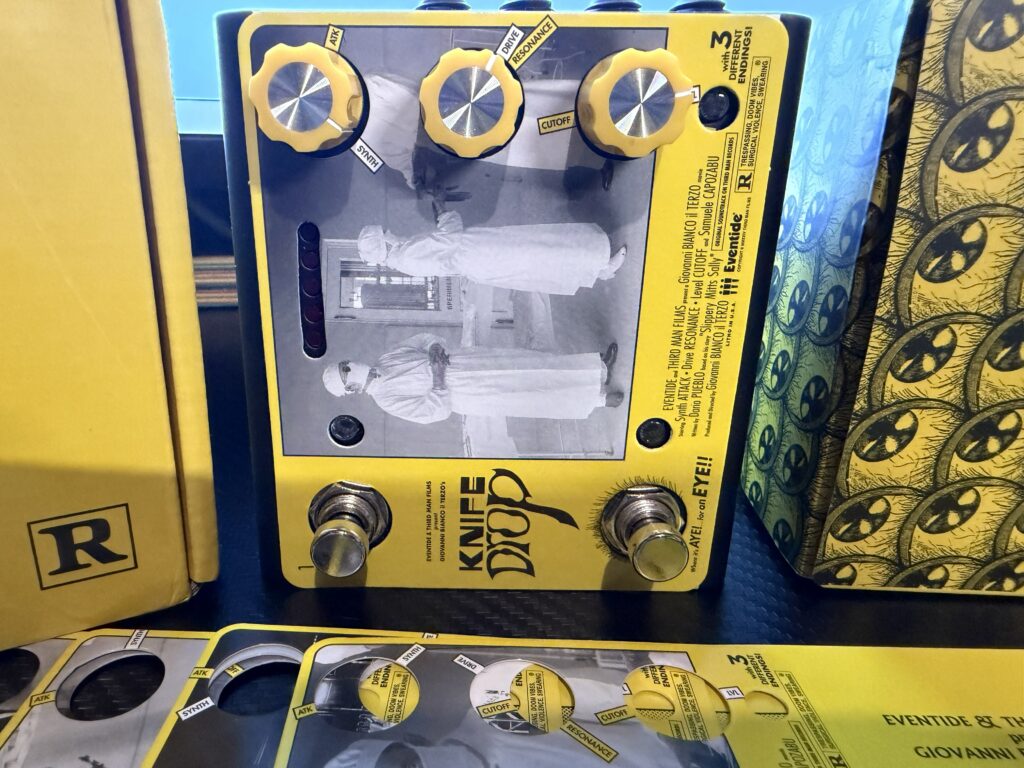
  • Eventide Knife Drop – Fuzz Pedal Review

    Eventide Knife Drop
    Eventide Knife Drop

    Some pedals give you a better version of your existing tone.

    The Eventide Knife Drop does not care about your existing tone.

    The Knife Drop looks at your carefully crafted guitar sound, laughs, and asks:

    “Would you like to sound like a broken Nintendo, an angry synthesizer, a spaceship landing in a junkyard, or perhaps all three simultaneously?”

    This thing is ridiculous.

    And I mean that as a compliment.

    It can do fuzz.

    It can do octaves.

    It can do synth sounds.

    It can do weird glitchy noises.

    It can do sounds that make other guitar players wander over and ask:

    “Okay, seriously… what the hell is that thing?”

    The Knife Drop is less of a guitar pedal and more of a creativity machine.

    I’ve owned pedals that improved my tone.

    I’ve owned pedals that improved my versatility.

    The Knife Drop improves my ability to waste an entire afternoon making noises instead of practicing.

    And honestly?

    That’s worth something.


    💩 1 Poop

    Really Good crap.

    Not because it isn’t amazing.

    It’s amazing.

    But this is specialty-grade weirdness.

    Some people want a screwdriver.

    The Knife Drop is a Swiss Army knife that occasionally catches fire and begins speaking in robot noises.


    Why This Review Matters

    If you’re researching:

    • Eventide Knife Drop Review
    • Knife Drop pedal
    • Eventide fuzz pedal
    • Jack White pedal
    • Best synth pedal
    • Fuzz octave pedal
    • Weird guitar pedals

    This review combines research with actual owner impressions from someone who thinks musical chaos is a feature and not a bug.


    More Fun Than A Jack-In-The-Box

    I don’t say this lightly.

    This pedal is more fun than a jack-in-the-box was when I was three years old.

    Every knob adjustment feels like opening a surprise.

    Sometimes the surprise is:

    “Wow, that’s a beautiful vintage fuzz tone.”

    Sometimes the surprise is:

    “I appear to have accidentally summoned a robot bee.”

    Either way, you’re having a good time.

    The Knife Drop rewards experimentation more than almost any pedal I’ve played.


    It’s Not Really A Fuzz Pedal

    Technically?

    Sure.

    It contains fuzz.

    But calling the Knife Drop a fuzz pedal is like calling a Leatherman a screwdriver.

    Yes.

    One is in there somewhere.

    That isn’t the whole story.

    You get:

    • Fuzz
    • Octaves
    • Synth voices
    • Envelope filtering
    • Expression control
    • Presets
    • MIDI
    • Stereo operation

    This thing sits somewhere between a guitar pedal and a small science project.


    Nintendo Tones

    Let’s get the important stuff out of the way.

    Can it make Nintendo noises?

    Absolutely.

    The good kind.

    The sounds of discovering a secret level at 2 AM while your parents were telling you to go to bed.

    The synth engine and octave options can create wonderfully video-game-like textures that don’t sound like traditional guitar at all.

    Sometimes that’s exactly what you want.


    Cream, Classic Rock, and Real Guitar Sounds

    Thankfully, it also understands restraint.

    You don’t have to use it exclusively for intergalactic nonsense.

    Dial things back and there’s plenty of classic musical territory available.

    Cream-inspired fuzz lines?

    Absolutely.

    Vintage lead tones?

    Yep.

    Classic rock riffs?

    No problem.

    A lot of wild pedals eventually become one-trick ponies.

    The Knife Drop stays useful because it still knows how to sound like a guitar.

    It just also knows how to sound like several things that aren’t guitars.


    The Octave Madness

    This is where things start getting dangerous.

    The octave section can completely change the way you think about riffs.

    Suddenly you’re hearing notes in new places.

    New harmonics appear.

    New textures emerge.

    The pedal keeps presenting ideas you wouldn’t normally play.

    And that’s one of its greatest strengths.

    The best gear isn’t always the gear that sounds best.

    Sometimes it’s the gear that inspires you to play differently.

    The Knife Drop absolutely does that.


    Chords? Uh… Maybe.

    Let’s talk about the reality.

    The synth engine is monophonic.

    It likes clean notes.

    It likes intentional playing.

    It likes cooperation.

    If you start throwing giant jazz chords and sloppy muting at it, things can become… creative.

    Sometimes extremely creative.

    Personally, I think that’s part of the fun.

    But if you’re expecting perfect polyphonic synth tracking, you should probably look elsewhere.


    Built For Tinkerers

    The Knife Drop feels like it was designed by people who genuinely enjoy twisting knobs just to see what happens.

    Every control changes the personality of the pedal.

    Move the synth.

    Adjust the filter.

    Change the resonance.

    Add an octave.

    Flip the processing order.

    Suddenly you’re somewhere completely different.

    This is not a pedal for people who want:

    One sound.

    Three knobs.

    The end.

    This is for people who enjoy happy accidents.


    The Learning Curve

    I do have one criticism.

    The pedal isn’t always intuitive.

    There are secondary functions.

    Hidden features.

    Preset systems.

    Routing options.

    And enough flexibility to occasionally make your brain hurt.

    A simple Tube Screamer can be understood in thirty seconds.

    The Knife Drop wants a longer conversation.

    Fortunately, the conversation is usually entertaining.


    Guitar Players Beware

    This pedal can create a dangerous condition.

    The condition goes something like:

    “I’ll just try one more setting.”

    Three hours later:

    “What time is it?”

    The Knife Drop excels at making you lose track of time.

    You start looking for a tone.

    You end up discovering five tones.

    Then an alien invasion soundtrack.

    Then a sound that resembles an 8-bit chainsaw.

    Then a fuzz tone that makes you immediately play White Room for twenty minutes.

    It’s a journey.


    Durability

    Like most Eventide gear, the build quality is excellent.

    The enclosure feels substantial.

    The switches feel solid.

    The controls inspire confidence.

    Nothing about it feels cheap.

    This is professional-grade hardware disguised as a toy factory.


    Who Should Buy One?

    Buy a Knife Drop if:

    • You love experimentation
    • You enjoy synth sounds
    • You want fuzz plus much more
    • You love octaves
    • You already own several conventional pedals
    • You want inspiration as much as tone
    • You’re the person everybody calls “the gear guy”

    Skip it if:

    • You want simple operation
    • You need predictable behavior at all times
    • You only want traditional overdrive
    • You hate menus, presets, or deeper functionality

    Pros & Cons

    ✅ Pros

    • Exceptionally creative
    • Fantastic fuzz sounds
    • Excellent octave effects
    • Convincing synth textures
    • Inspires new playing ideas
    • Presets and MIDI support
    • Stereo operation
    • Great build quality
    • Covers an enormous amount of sonic territory
    • Can sound like things that shouldn’t legally come from a guitar

    ❌ Cons

    • Learning curve
    • Not always intuitive
    • Monophonic synth tracking has limitations
    • Chords can get weird
    • Far more complex than a traditional fuzz
    • May dramatically reduce your actual practice time
    • Makes normal pedals seem a little boring afterward

    Final Verdict

    The Eventide Knife Drop isn’t a pedal you buy because you need it.

    It’s a pedal you buy because you’re curious.

    Then that curiosity turns into fascination.

    And then somehow it’s midnight and you’ve spent four hours making sounds that range from Cream to Castlevania.

    This isn’t the pedal I would recommend to every guitarist.

    It’s the pedal I’d recommend to every guitarist who misses the feeling of discovery.

    Because that’s what the Knife Drop does best.

    Every time you step on it, there’s a chance you’ll find something you weren’t looking for.

    And those are usually the best tones anyway.


    Final Poop Score

    💩💩 1/4 Poops

    Good crap.

    A fuzz pedal.

    A synth pedal.

    An octave pedal.

    A creativity machine.

    And possibly the most fun I’ve had with a little metal box since discovering that guitar pedals were a thing.

    The Eventide Knife Drop proves an important truth:

    Sometimes the best gear doesn’t help you sound like your heroes.

    Sometimes it helps you sound like absolutely nobody else. 🎸💩👾🎮

  • Guitar Gear, Tone Chasing, and Other Financial Mistakes

    guitar maintenance
    Cleaning day and new strings

    Welcome to the Gear Section of Should I Buy This Crap?

    If you’ve made it here, there’s a good chance you play guitar.

    And if you play guitar, there’s also a good chance you’ve convinced yourself at least once that the next piece of gear would finally make you sound like your favorite guitarist.

    How’d that work out?

    Yeah.

    Me too.

    Welcome to the wonderful world of G.A.S.

    Not the digestive kind, although guitar players are certainly old enough for that to become a concern too.

    I’m talking about Gear Acquisition Syndrome.

    The incurable condition where a guitarist with six guitars believes seven would be the correct number.

    The illness where someone with twelve overdrive pedals suddenly becomes convinced that pedal number thirteen possesses magical properties unavailable to modern science.

    The disorder that causes otherwise rational adults to explain to their spouses why they absolutely needed a guitar stand made from aircraft-grade unobtainium instead of the perfectly functional one already sitting in the corner.

    This section is dedicated to all of that wonderful nonsense.


    The Search For Tone

    Every guitarist eventually learns a difficult truth.

    The perfect tone doesn’t exist.

    Oh sure.

    You can get close.

    Really close.

    Then you’ll hear somebody on YouTube playing through a guitar you’ve never heard of, into an amp you can’t afford, through a pedal that was discontinued three years ago and now costs more used than it did new.

    Then the cycle begins again.

    The pursuit of tone is a lot like chasing a squirrel.

    You might catch it.

    But then you’ll immediately notice another squirrel.


    The Guitar Hierarchy Of Needs

    Most guitar players follow a surprisingly predictable path.

    Phase 1

    “I just need a guitar.”

    Phase 2

    “I should probably get an amp.”

    Phase 3

    “Maybe one overdrive pedal.”

    Phase 4

    “Well, technically this fuzz pedal is completely different.”

    Phase 5

    “These seven pedals all serve unique purposes.”

    Phase 6

    “I can quit buying gear anytime I want.”

    Phase 7

    Researching custom-shop instruments at three in the morning while pretending it’s educational.


    What’s Actually Worth Buying?

    One thing I’ve learned over the years is that not all guitar gear is created equal.

    Some products genuinely improve your playing experience.

    Some products solve real problems.

    Some products become trusted companions you use for decades.

    Other products exist primarily to separate guitar players from money.

    I’ll do my best to help you identify which is which.

    Every review in this section comes from actual ownership, actual use, and actual experience.

    That means you’ll get:

    • The good stuff
    • The bad stuff
    • The weird stuff
    • The stuff manufacturers would rather nobody mention

    If something is great, I’ll tell you.

    If something is overrated crap, I’ll tell you that too.


    My Philosophy On Guitar Gear

    The best gear isn’t always the most expensive.

    The best gear is the gear that makes you want to play.

    That’s it.

    A $500 guitar that makes you pick it up every day is better than a $10,000 guitar that spends its life decorating a wall.

    A simple overdrive pedal that inspires you is worth more than a boutique pedalboard full of confusion.

    And a reliable guitar stand that doesn’t eat your finish is worth its weight in gold.

    I’m far more interested in equipment that survives years of ownership than equipment that impresses somebody during a ten-minute demo.


    Some Hard Truths

    Let’s save everyone some time.

    You Probably Don’t Need Another Guitar.

    You probably want another guitar.

    Those are not the same thing.

    Nobody In The Audience Cares About Your Pickups.

    They care whether the song sounds good.

    Practicing Frequently Beats Buying Gear Frequently.

    Unfortunately, that advice is free and therefore unpopular.

    One More Pedal Will Not Turn You Into Jimmy Page.

    Trust me.

    Many of us have conducted extensive and expensive research on this topic.


    Reviews You’ll Find Here

    This section includes reviews and ownership reports covering:

    Electric Guitars

    Because apparently one Les Paul is never enough.

    Acoustic Guitars

    The instruments we buy to play quietly and somehow end up buying microphones for.

    Amplifiers

    Big boxes that transform electricity into happiness.

    Pedals

    Tiny boxes that transform happiness into empty bank accounts.

    Accessories

    Stands, straps, tuners, picks, cases, and all the other things we swear we’ll stop buying someday.


    Official Guitar Dad Disclaimer

    ShouldIBuyThisCrap.com cannot be held responsible for:

    • Additional guitar purchases
    • Unexpected amplifier acquisitions
    • Pedalboard growth
    • Obsessive tone chasing
    • Learning about discontinued gear you now desperately want
    • Sudden urges to play AC/DC riffs for two hours
    • Explaining Reverb purchases to your spouse

    If symptoms persist for more than four hours, purchase another guitar and call it a collection.


    Final Thought

    At the end of the day, gear isn’t the goal.

    Music is.

    The gear is just the fun pile of crap we accumulate along the way.

    So grab a guitar.

    Play something badly.

    Then play it a little better tomorrow.

    And if a cool piece of gear helps you enjoy the journey, well…

    That’s exactly the kind of crap we’re here to talk about.

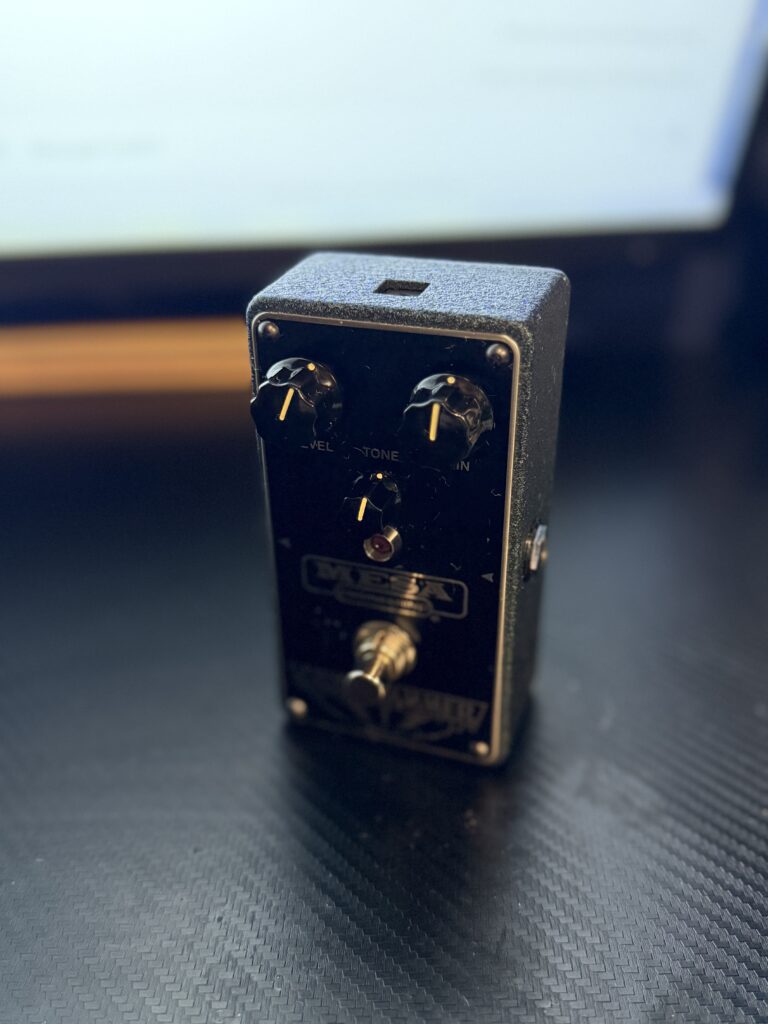
  • Mesa/Boogie Grid Slammer Review

    Mesa/Boogie Grid Slammer
    Mesa/Boogie Grid Slammer

    The Mesa Grid Slammer was my gateway drug.

    Not to anything illegal.

    Just to guitar pedals.

    Before this little metal box showed up, I was firmly in the camp of:

    “I already have a dirty channel on my amp. Why do I need another dirty channel in a box?”

    Then I plugged in the Grid Slammer.

    Turns out the answer was:

    Because pedals do things amps can’t.

    Or at least not the same way.

    You can have twelve knobs.

    You can have a graphic EQ.

    You can have multiple gain channels.

    You can spend an entire afternoon trying to dial in the perfect tone.

    Then you step on the Grid Slammer and suddenly your amp starts making noises it never made before.

    I’m convinced the amount of fun produced by a handful of switches and electronic components in this little enclosure would be considered contraband in at least a few authoritarian countries.


    💩 Poop Rating

    💩💩 2 Poops

    Good crap.

    Not because it isn’t fantastic.

    It’s fantastic.

    The only reason it doesn’t earn a perfect one-poop score is because it’s a specialized flavor of awesome rather than a universal recommendation for every guitarist on earth.

    For blues, classic rock, and pushing an already good amp into greatness?

    This thing absolutely slaps.


    Why This Review Matters

    If you’re researching:

    • Mesa Grid Slammer Review
    • Mesa Boogie Grid Slammer
    • Grid Slammer vs Tube Screamer
    • Best overdrive for Les Paul
    • Mesa pedal review
    • Blues overdrive pedal
    • Classic rock overdrive pedal

    this review combines long-term ownership with current market research.


    My Introduction To Pedal Mania

    The Grid Slammer was the first pedal that made me understand why guitar players end up with giant pedalboards that resemble NASA mission control centers.

    Before this pedal, I thought overdrive was overdrive.

    After this pedal, I understood that there’s a whole world of gain textures, clipping characteristics, frequencies, boosts, saturation, and tone shaping hidden beneath the surface.

    It’s a dangerous realization.

    The Grid Slammer wasn’t just a pedal purchase.

    It was the beginning of a very expensive education.


    What Does It Actually Sound Like?

    Mesa describes the Grid Slammer as their take on the classic Screamer-style overdrive, and that’s true as far as it goes.

    But that description feels incomplete.

    The Grid Slammer doesn’t sound like somebody photocopied a Tube Screamer and painted it silver.

    It sounds bigger.

    More open.

    More aggressive in the upper mids.

    More vocal.

    More willing to step forward and announce its presence.

    When you hit a note, it wants people to hear it.

    That upper-mid push makes solos jump out of a mix beautifully.

    It’s one of those pedals that can make a guitar sound like it suddenly found confidence.


    Les Paul Owners, Pay Attention

    This pedal absolutely loves a Les Paul.

    Mine certainly does.

    The Grid Slammer takes that thick humbucker growl and gives it extra attitude.

    The low strings become more focused.

    Single notes start barking.

    Lead lines gain sustain and presence without turning into mush.

    A good Les Paul already sounds mean.

    The Grid Slammer sounds like it’s encouraging bad behavior.

    And I mean that as a compliment.


    Blues And Classic Rock Heaven

    This is where I think the pedal shines brightest.

    Blues.

    Classic rock.

    Roots rock.

    Hard rock.

    Anything that benefits from touch sensitivity and dynamic response.

    Roll back your guitar volume and it cleans up beautifully.

    Dig in with the pick and it growls back.

    That’s one of my favorite things about it.

    The Grid Slammer doesn’t feel like you’re switching between clean and distortion.

    It feels like you’re controlling the personality of the amp with your hands.


    “But I Already Have A Dirty Channel”

    I did too.

    That’s what makes this pedal so impressive.

    Most people assume a gain pedal is simply another version of a dirty channel.

    The reality is much more interesting.

    The Grid Slammer can add characteristics your amp never had.

    Different attack.

    Different compression.

    Different midrange focus.

    Different response to picking dynamics.

    It doesn’t replace the amp.

    It changes the conversation.

    And that’s why pedals continue to exist despite modern amplifiers becoming increasingly sophisticated.


    Built Like A Tank

    Mesa didn’t exactly build this thing to survive life in a display case.

    The enclosure is solid.

    The switching feels substantial.

    The controls feel sturdy.

    And perhaps most importantly:

    Mine still works exactly like it did when I bought it.

    No weird noises.

    No intermittent switches.

    No failing pots.

    No mysterious electronic drama.

    Just years of reliable service.

    That’s what I expect from Mesa, and the Grid Slammer delivers.


    The Value Situation Has Changed

    This is one area where I disagree with some of the market assessments.

    A lot of valuation guides still treat the Grid Slammer like a fairly ordinary used overdrive pedal.

    That may have been true once.

    I’m not convinced it’s true now.

    The pedal has become increasingly difficult to find through normal retail channels.

    It’s sold out nearly everywhere.

    And as availability has dried up, used prices have started climbing.

    I’ve personally seen examples listed on Reverb in the $270–$300 range, which would have sounded insane a few years ago.

    Now?

    Not so much.

    Would I tell someone to pay that much if they’re simply looking for a practical overdrive?

    No.

    There are other excellent options.

    But if someone specifically wants a Grid Slammer?

    The market appears to have noticed they’re not getting easier to find.

    The funny part is that some used examples are now worth more than the original new retail price.

    That’s not something you see every day with guitar gear.


    How It Compares To The Competition

    The Grid Slammer lives in a crowded category.

    You have:

    • Tube Screamers
    • Maxon OD808s
    • BOSS SD-1s
    • EarthQuaker Plumes
    • Dozens of boutique clones

    Most of them are good.

    Some of them are excellent.

    What keeps the Grid Slammer relevant is that it doesn’t sound generic.

    It’s got that Mesa personality.

    The upper-mid focus.

    The openness.

    The ability to push an amp without turning everything into compressed fuzz paste.

    It’s not necessarily better than every alternative.

    It’s just distinctly itself.

    And in a pedal market flooded with copycats, that’s valuable.


    Who Should Buy One?

    Buy a Grid Slammer if:

    • You play blues
    • You play classic rock
    • You play hard rock
    • You own a Les Paul
    • You love expressive overdrive
    • You want to push an amp harder
    • You enjoy dynamic, touch-sensitive pedals
    • You appreciate Mesa build quality

    Look elsewhere if:

    • You need metal distortion from the pedal alone
    • You want a transparent boost
    • You need extensive EQ controls
    • You want the cheapest Screamer-style pedal possible

    Pros & Cons

    ✅ Pros

    • Fantastic blues and classic rock tones
    • Excellent with Les Pauls and humbuckers
    • Great dynamic response
    • Strong upper-mid presence
    • Cuts through a mix beautifully
    • Built like a tank
    • Made in the USA
    • True bypass
    • Works as both overdrive and boost
    • Still performs flawlessly after years of ownership
    • Makes you want to buy more pedals

    ❌ Cons

    • Increasingly difficult to find
    • Used prices keep climbing
    • Limited tone-shaping controls
    • Not a high-gain monster
    • Can become mid-heavy in the wrong rig
    • May start an expensive pedal addiction

    Final Verdict

    The Mesa Grid Slammer wasn’t just my introduction to pedals.

    It was the pedal that taught me why pedals matter.

    It sounds fantastic.

    It’s built exceptionally well.

    It has survived years of use without complaint.

    And it continues to do things my amplifier simply can’t reproduce by itself.

    That’s not because the pedal is replacing the amp.

    It’s because it’s expanding what the amp can become.

    If you love blues, classic rock, expressive lead work, and the unmistakable sound of a guitar pushing back when you dig into it, the Grid Slammer remains one of Mesa’s best pedal designs.

    Even all these years later.


    Final Poop Score

    💩💩 2/4 Poops

    Good crap.

    A little metal box full of fun, sustain, growl, and questionable financial decisions.

    The pedal that taught me a simple truth:

    You don’t buy your first overdrive pedal because you need it.

    You buy your tenth one because of your first. 🎸💩

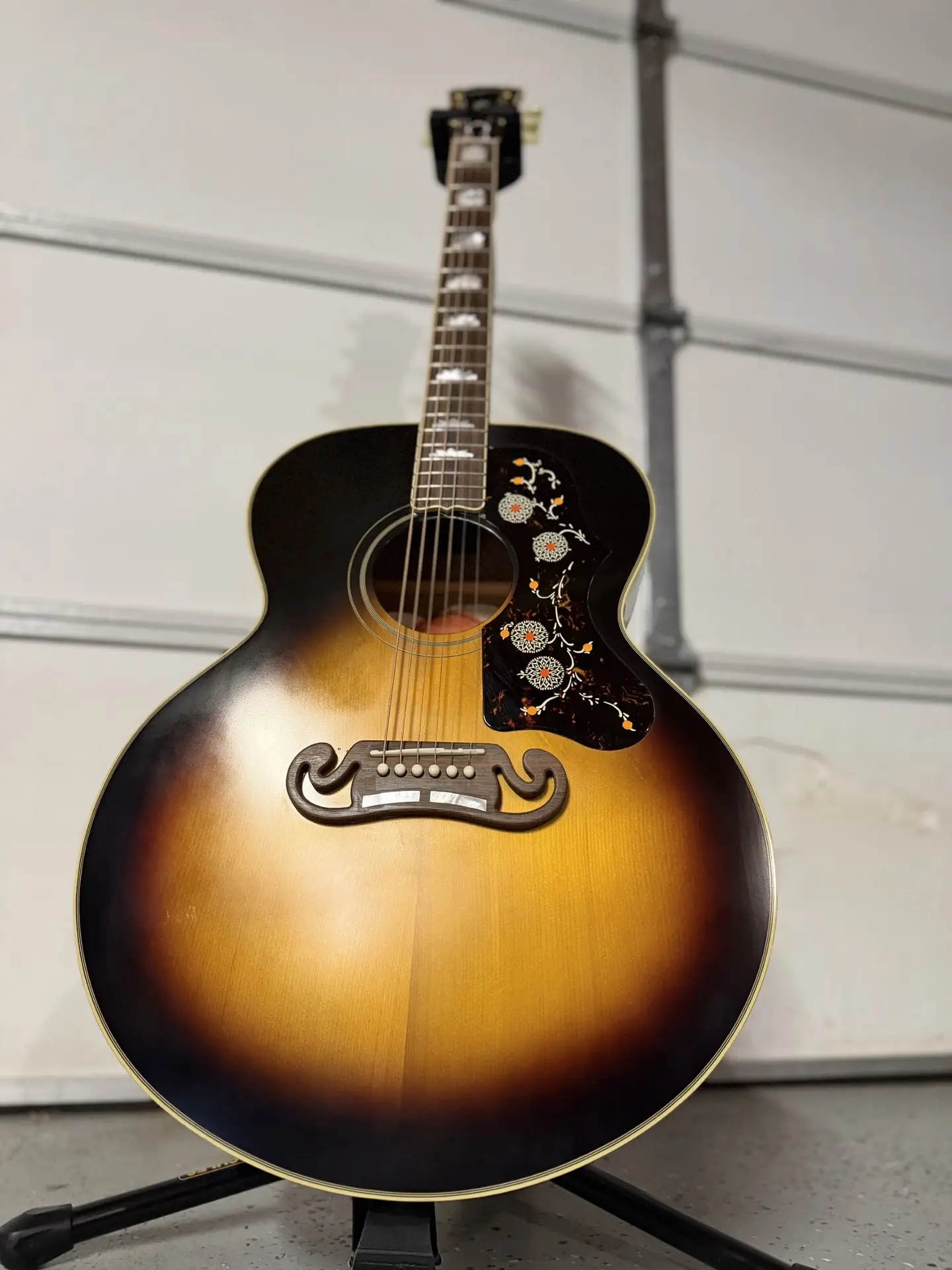
  • Epiphone Inspired by Gibson Custom 1957 SJ-200 Review:

    Epiiphone inspired by Gibson Custom 1957 SJ-200

    Every now and then a guitar comes along that makes you stop and ask:

    “Wait… this costs HOW much?”

    That was my reaction to the Epiphone Inspired by Gibson Custom 1957 SJ-200.

    This isn’t one of those budget guitars that’s “good for the money.”

    I hate that phrase.

    Usually “good for the money” means:

    “It’s not completely terrible if you squint hard enough and lower your expectations.”

    The 1957 SJ-200 is different.

    It’s simply a good guitar.

    Period.

    It looks expensive.

    It feels expensive.

    It sounds expensive.

    Then you look at the price tag and discover it costs significantly less than the Gibson version that inspired it.

    The result is one of the strongest values currently available in the acoustic guitar world.


    💩 Poop Rating

    💩 1 Poop

    Excellent crap.

    This guitar delivers so much of the SJ-200 experience that it makes you seriously question how much money you’d need to spend to gain a meaningful improvement.


    Why This Review Matters

    If you’re researching:

    • Epiphone Inspired by Gibson Custom 1957 SJ-200 Review
    • Epiphone SJ-200 vs Gibson SJ-200
    • Best acoustic guitar under $2,000
    • Is the Epiphone 1957 SJ-200 worth it?
    • Epiphone Inspired by Gibson Custom review
    • Best value jumbo acoustic guitar

    this review combines research, owner experiences, and real-world impressions.


    First Impressions

    Let’s get the obvious thing out of the way.

    This guitar is gorgeous.

    Absolutely gorgeous.

    The huge Super Jumbo body.

    The ornate pickguard.

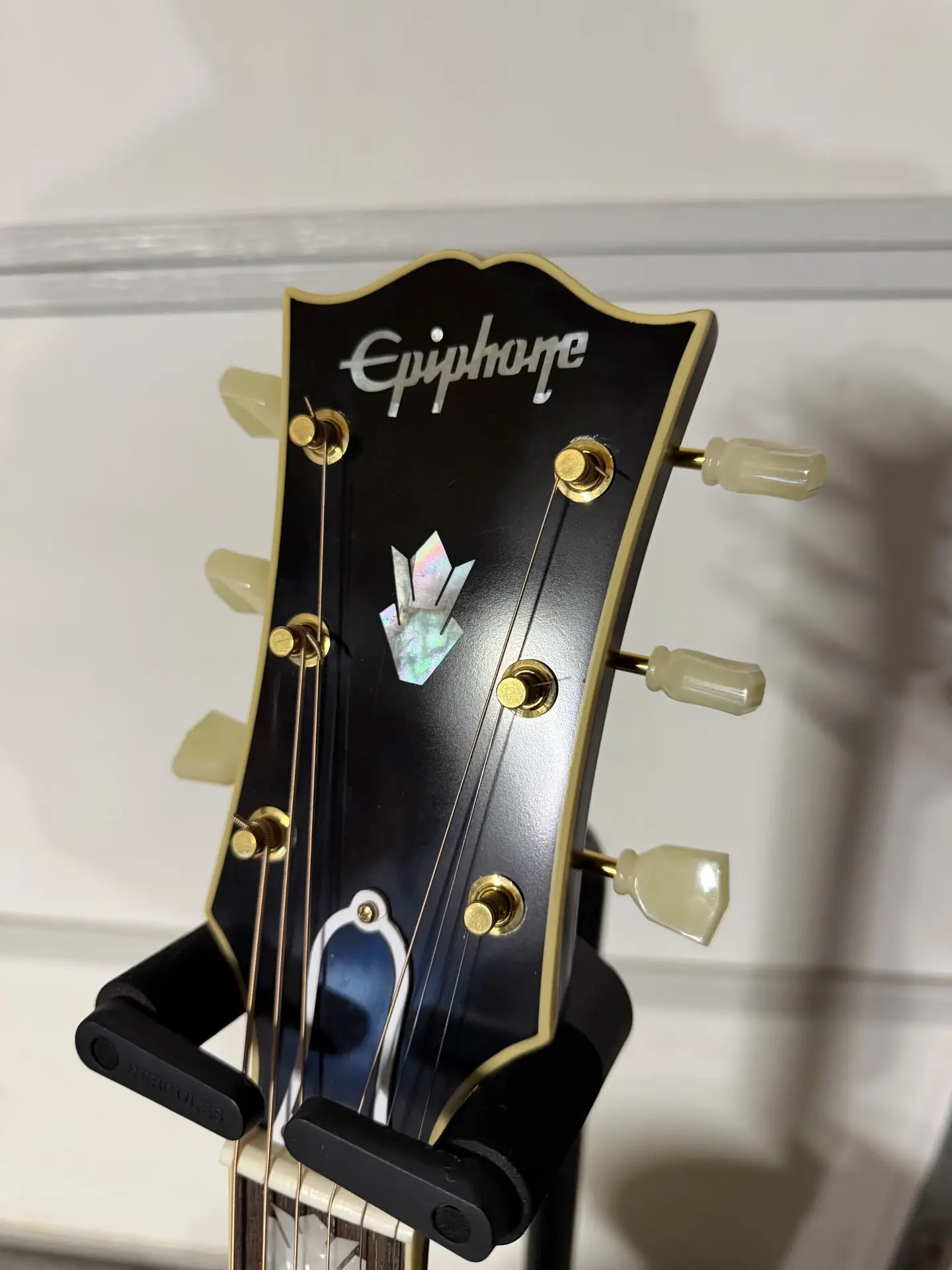
    The gold hardware.

    The crown inlays.

    The moustache bridge.

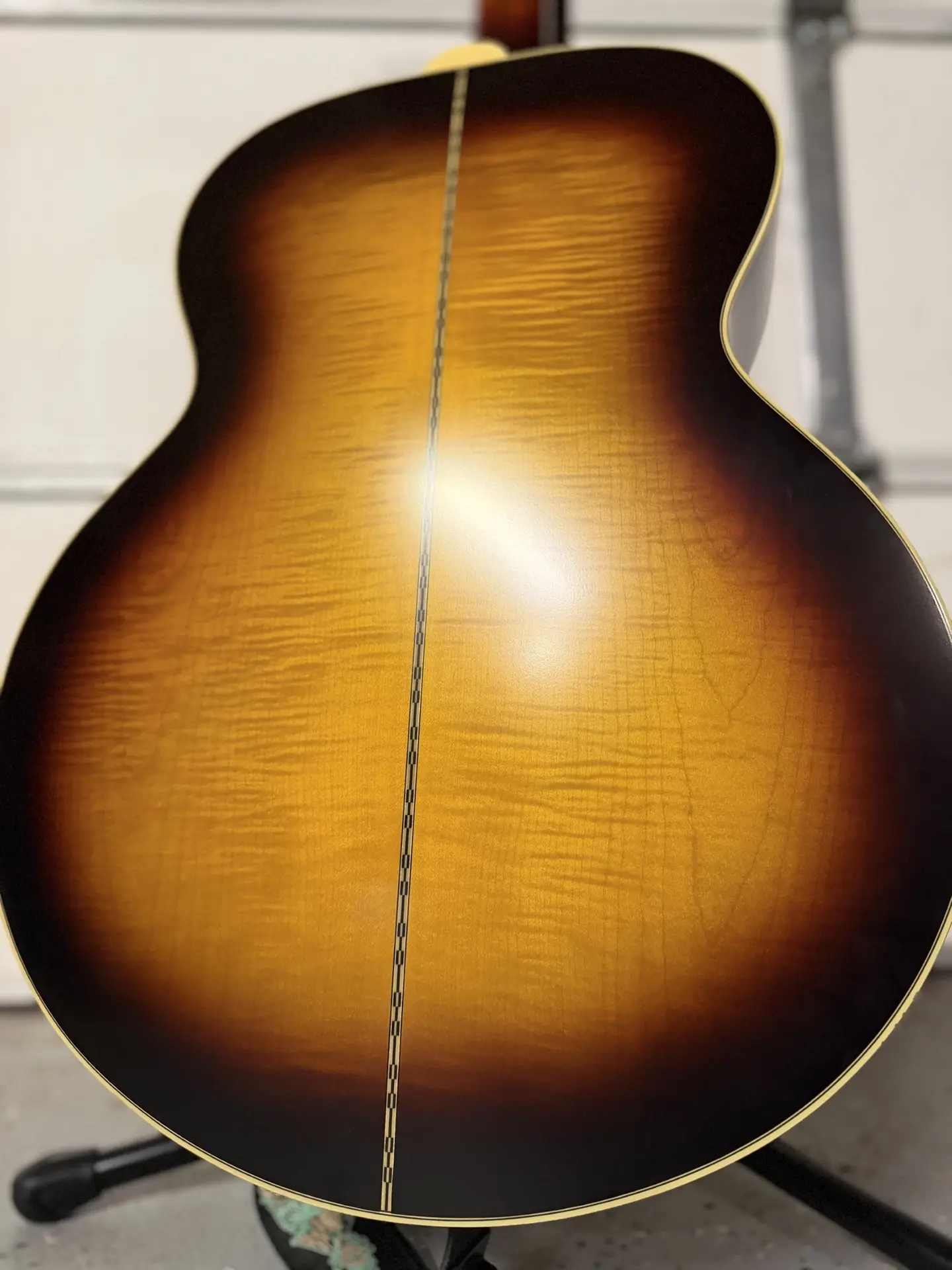
    The figured maple back and sides.

    This is not a subtle guitar.

    This is the acoustic equivalent of showing up to a black-tie event in a classic Cadillac.

    You don’t buy an SJ-200 because you’re trying to be invisible.

    You buy an SJ-200 because they’re beautiful.

    The Epiphone absolutely captures that vibe.


    Build Quality

    This isn’t a cheap plywood box wearing fancy makeup.

    The 2024 model features:

    • Solid thermally-aged Sitka spruce top
    • Solid figured maple back and sides
    • Scalloped X-bracing
    • Bone nut
    • Bone saddle
    • Bone bridge pins
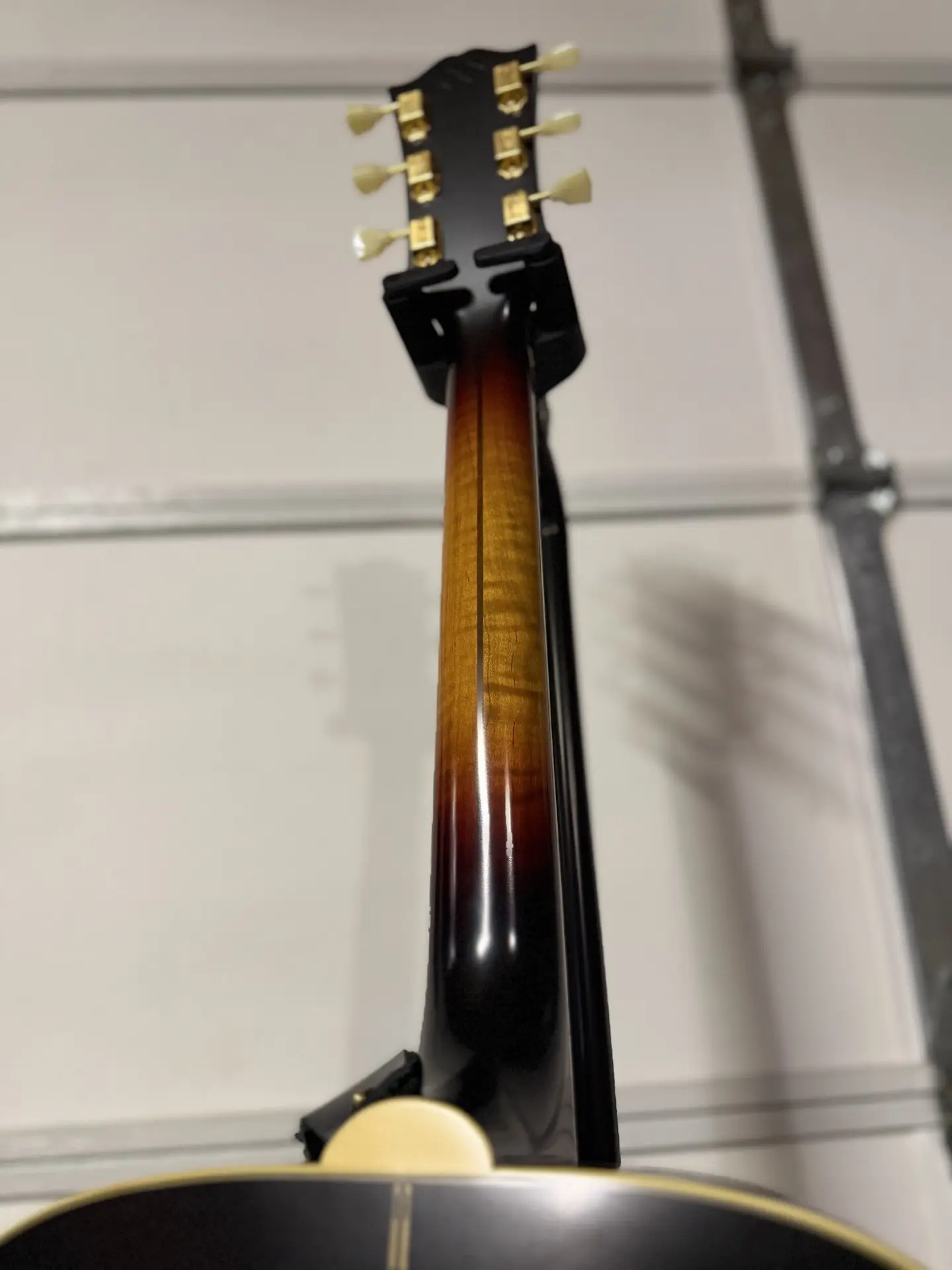
    • Maple neck
    • L.R. Baggs electronics

    That’s an impressive specification sheet at any price.

    It’s downright ridiculous at this price.

    One of the biggest reasons this model has created so much excitement is because Epiphone didn’t cheap out on the important stuff.

    The expensive look isn’t hiding a bargain-bin construction.

    The build is genuinely serious.


    Sound

    This is where the guitar won me over.

    Some guitars look incredible and sound disappointing.

    Some sound incredible and look boring.

    The SJ-200 manages both.

    The best word I can use is:

    Big.

    Not boomy.

    Not muddy.

    Big.

    Strumming chords fills a room.

    Open chords have authority.

    Flatpicking has punch.

    Fingerstyle passages still maintain clarity.

    It sounds like a guitar that should cost substantially more than it does.

    Is it identical to a Gibson Custom SJ-200?

    No.

    Of course not.

    The Gibson projects harder, has a little more complexity, and benefits from construction details that cost real money.

    But that’s not the right question.

    The right question is:

    Does it sound close enough that you’ll smile every time you pick it up?

    Absolutely.


    Playability

    The scale length is a full 25.5 inches, so there’s a little more string tension than some Gibson acoustics.

    That gives notes a nice snap and clarity.

    The neck profile may feel a little substantial for players who prefer thin electric-style necks.

    Personally, I thought it matched the character of the instrument.

    An SJ-200 isn’t supposed to feel tiny.

    The biggest adjustment for some players is simply the size of the body.

    This thing is enormous.

    If you’re smaller in stature or spend most of your time on parlor guitars, the SJ-200 can feel like parking a school bus in your lap.

    For everyone else, that’s part of the charm.


    The Value Proposition

    This is where the guitar becomes a superstar.

    Every reviewer always wants to compare it to a Gibson SJ-200.

    Which is understandable.

    But here’s what matters:

    You can buy this guitar without having to explain a second mortgage to your spouse.

    That’s incredibly important.

    The Gibson version is fantastic.

    It should be.

    It costs several times more.

    The shocking thing is how much of the visual appeal, feel, and tonal character survived the trip down to the Epiphone price bracket.

    This isn’t a budget imitation.

    It’s more like getting 85–90% of the experience for a fraction of the cost.

    And that’s where the value becomes extraordinary.


    Long-Term Ownership

    Because these weren’t released until 2024, nobody can honestly tell you what ownership looks like in twenty years.

    Anyone claiming otherwise is full of crap.

    What we do know is:

    • Build quality appears consistently strong
    • Structural complaints are very rare so far
    • Electronics have a good reputation
    • The included hardshell case is excellent
    • Owners are overwhelmingly happy

    The biggest enemy isn’t the guitar.

    It’s humidity.

    Like every solid-wood acoustic, this thing wants stable humidity levels.

    Treat it properly and it’ll likely reward you.

    Ignore humidity and you’ll eventually be posting angry messages on guitar forums blaming the factory for what your furnace did.


    Maintenance

    The good news?

    There isn’t much to do.

    Keep it humidified.

    Change strings.

    Clean it occasionally.

    Don’t leave it in a hot car.

    Don’t leave it next to a heater.

    Don’t use it as a canoe paddle.

    Basic acoustic guitar ownership stuff.

    The included Baggs pickup system is also refreshingly simple compared to many onboard systems.

    If you perform live, it’ll do its job without requiring a PhD in menu navigation.


    A Brief History of the SJ-200

    The SJ-200 lineage goes all the way back to 1937.

    It was designed as Gibson’s flagship flat-top acoustic.

    Over the decades, it became associated with artists including:

    • Elvis Presley
    • Bob Dylan
    • George Harrison
    • Jimmy Page
    • Emmylou Harris

    The model became famous for combining huge visual presence with huge sound.

    The Epiphone version isn’t pretending to be a forensic recreation of every detail from the original.

    Instead, it captures what players actually love about the SJ-200:

    • The maple construction
    • The giant Super Jumbo body
    • The visual style
    • The projection
    • The feel

    And honestly, that’s what most people are after anyway.


    Pros & Cons

    ✅ Pros

    • Outstanding value
    • Gorgeous appearance
    • All-solid wood construction
    • Huge, rich acoustic sound
    • High-quality Baggs electronics
    • Comfortable modern playability
    • Excellent hardware package
    • Includes hardshell case
    • Feels much more expensive than it is
    • One of the best-looking guitars Epiphone has ever produced

    ❌ Cons

    • Very large body size
    • May be uncomfortable for smaller players
    • Neck may feel chunky to some players
    • Not a perfect Gibson Custom replacement
    • Long-term durability history is still developing
    • Can trigger dangerous thoughts like buying more guitars

    Final Verdict

    The Epiphone Inspired by Gibson Custom 1957 SJ-200 is exactly the sort of product I love reviewing.

    It doesn’t rely on hype.

    It doesn’t rely on gimmicks.

    It simply delivers far more guitar than its price tag suggests.

    It’s beautiful.

    It’s fun to play.

    It sounds fantastic.

    And every time I pick it up, I find myself thinking:

    “This thing had no business being this good for the money.”

    If you’re shopping for a premium jumbo acoustic without entering financially irresponsible Gibson Custom territory, this guitar deserves a spot near the top of your list.


    Final Poop Score

    💩 

    Excellent crap.

    A giant, gorgeous, room-filling acoustic guitar that sounds like it costs far more than it actually does.

    In the guitar world, that’s some seriously good shit. 🎸💩

    Epiiphone inspired by Gibson Custom 1957 SJ-200 hs Epiiphone inspired by Gibson Custom 1957 SJ-200 back Epiiphone inspired by Gibson Custom 1957 SJ-200 neck
  • Hercules GS412B Plus Auto Grip Guitar Stand – Hercules Stands

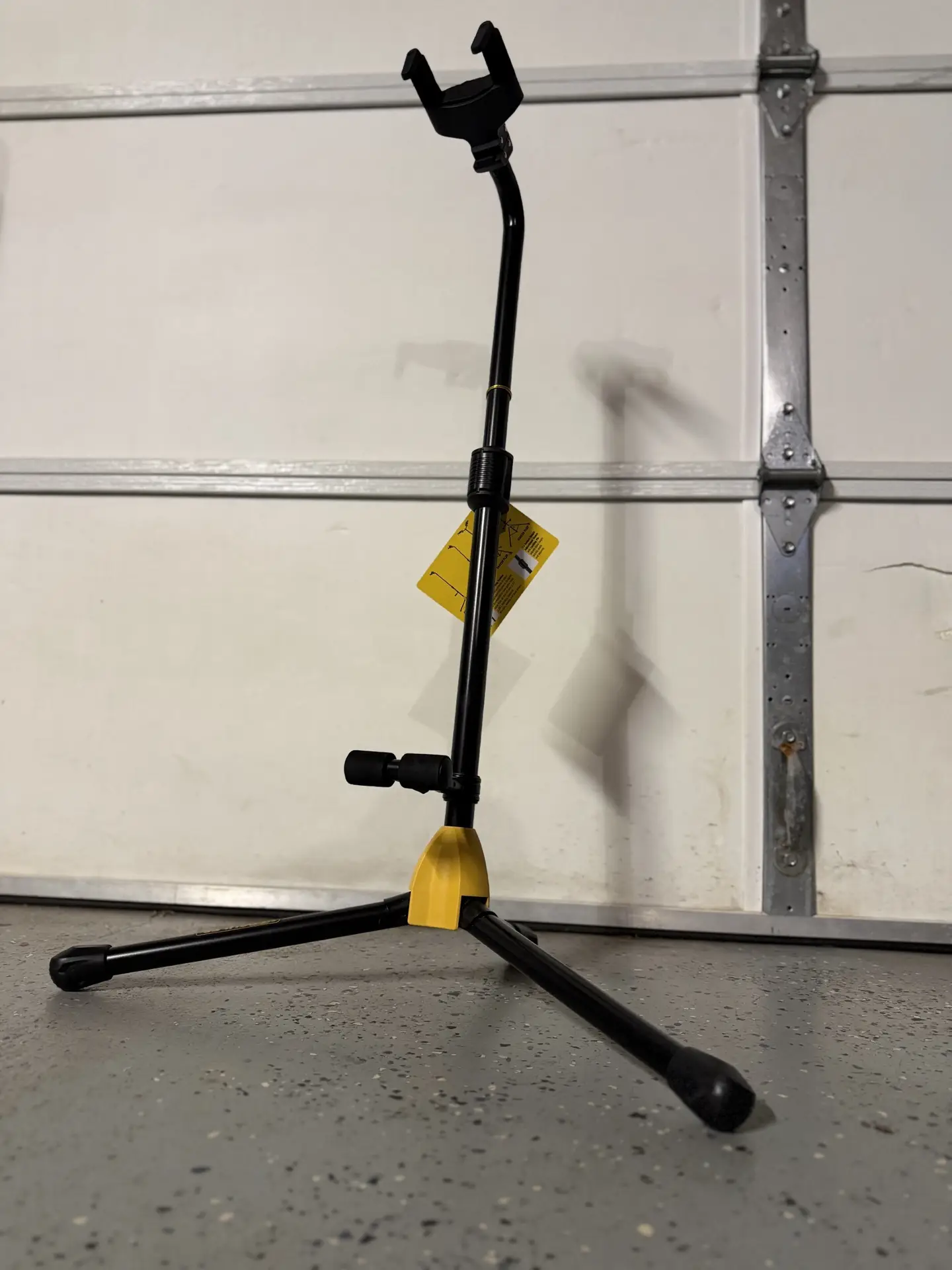
    Hercules Autogrip Freestanding Guitar Stand

    Some products disappear into the background so completely you barely think about them.

    That’s probably the highest compliment a guitar stand can receive.

    A guitar stand has one job:

    Don’t drop my expensive crap.

    The Hercules GS412B Plus manages that while also being portable, easy to use, surprisingly sturdy, and perhaps most importantly for guitar owners, remarkably kind to guitar finishes.

    I’ve owned cheaper stands.

    I’ve owned questionable stands.

    I’ve owned stands that made me wonder whether the engineer’s design process consisted primarily of shrugging and hoping for the best.

    This isn’t one of those stands.

    The Hercules is the stand I trust with guitars I actually care about.

    And that’s saying something.


    💩 Poop Rating

    💩 1 Poop

    Excellent crap.

    This is the kind of product that solves problems instead of creating them.

    No drama.

    No tip-overs.

    No mystery scratches.

    No finish damage.

    Just a stand quietly doing its damn job.


    Why This Review Matters

    If you’re researching:

    • Hercules GS412B review
    • best guitar stand
    • guitar stand for acoustic guitars
    • guitar stand for electric guitars
    • safest guitar stand
    • guitar stand for expensive guitars

    This review combines real-world ownership with technical research and long-term owner experiences.


    Build Quality

    The GS412B Plus isn’t trying to reinvent the wheel.

    It’s a tripod stand.

    But it’s an exceptionally well-executed tripod stand.

    You get:

    • Auto Grip neck retention system
    • Tripod base
    • Adjustable backrest
    • One-hand height adjustment
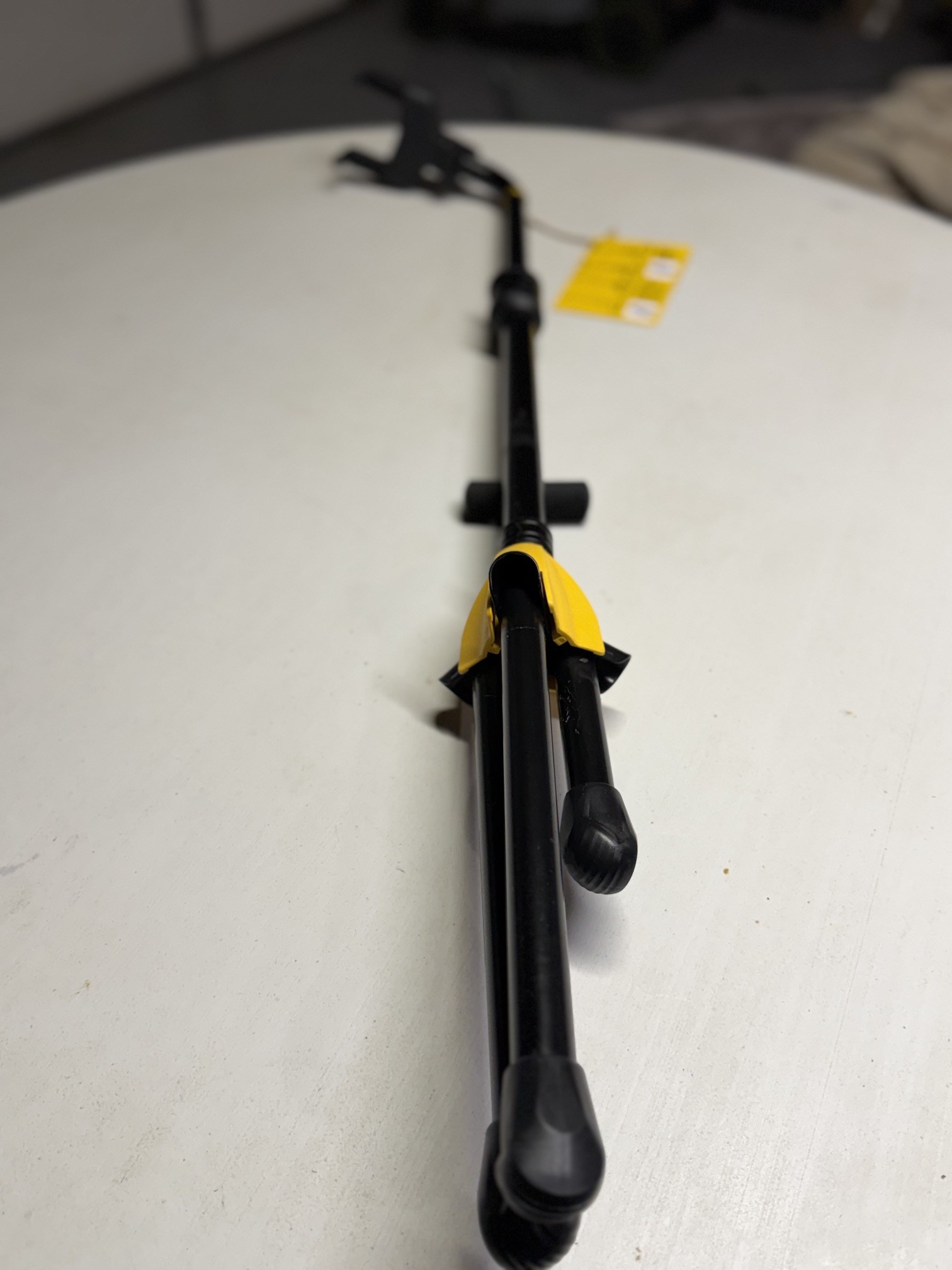
    • Folding design
    • 33-pound weight capacity

    The result feels substantially better built than the bargain-bin stands hanging next to starter packs in music stores.

    When you place a guitar into the stand, the neck yoke automatically closes around it.

    There’s something incredibly satisfying about that.

    Like the stand is saying:

    “Relax, I’ve got this.”


    My Favorite Feature: Finish Safety

    This is why I originally bought it.

    And why I’m still using it.

    Many guitar players eventually discover a terrifying fact:

    Not all guitar stands are friendly to guitar finishes.

    Certain stand materials can leave impressions, discoloration, chemical reactions, or ugly marks on delicate finishes over time.

    That’s annoying on a cheap guitar.

    It’s absolutely bowel-loosening on a guitar worth several thousand dollars.

    The Hercules stand uses specialized foam contact surfaces designed to minimize finish reactions.

    My own experience has been outstanding.

    I’ve never had this stand leave marks, stains, impressions, discoloration, or damage on any of my guitars.

    Considering how much time some of them spend hanging on the stand, that’s worth every penny.


    The Nitrocellulose Discussion

    If you’re a Gibson owner, you’ve probably heard the horror stories.

    Nitrocellulose finishes can react with:

    • Stands
    • Wall hangers
    • Straps
    • Rubber
    • Vinyl
    • Random objects that apparently exist solely to ruin your day

    The reality is that no manufacturer can realistically guarantee compatibility with every nitrocellulose finish ever created.

    My advice?

    For modern polyurethane and polyester finishes, I wouldn’t lose any sleep.

    For a rare vintage Gibson worth more than my car, I’d still inspect occasionally because that’s simply good practice.

    The stand has been completely trouble-free in my experience, but expensive nitro guitars always deserve extra caution regardless of who made the stand.


    Stability

    A guitar stand that collapses is basically a guitar catapult.

    Fortunately, that’s not what we have here.

    The Hercules feels extremely stable.

    The Auto Grip system keeps the guitar secure.

    The tripod base feels planted.

    The guitar simply stays where it’s supposed to stay.

    I’ve never looked at this stand and thought:

    “Well, that’s concerning.”

    I have definitely had that thought with cheaper stands.

    Not with this one.


    Portability

    Another thing I love about this stand is how easy it is to transport.

    It folds down quickly.

    It’s lightweight.

    It takes up very little space.

    Whether you’re moving between rooms, heading to a rehearsal, going to a gig, or just looking for something that won’t clutter the house, the GS412B Plus is incredibly convenient.

    Good stands disappear when you need to carry them.

    This one does.


    Long-Term Reliability

    The long-term owner feedback on these stands is overwhelmingly positive.

    Owners repeatedly praise:

    • Stability
    • Build quality
    • Ease of use
    • Neck security
    • Versatility

    My own experience matches that perfectly.

    It’s one of those purchases you make and then basically stop thinking about for years.

    You set your guitar down.

    You pick it back up.

    The stand works.

    Day after day.

    Year after year.

    Honestly, that’s exactly what I want from gear.


    A Brief History of Guitar Stands

    Before modern guitar stands, musicians mostly leaned instruments against walls and prayed to whatever deity protects expensive musical equipment.

    Early stands focused primarily on support.

    Then came portability.

    Then came locking and retention systems.

    The Hercules Auto Grip design represents one of the biggest leaps in stand design because it actively helps keep the guitar from falling.

    Instead of relying entirely on balance, the weight of the guitar automatically closes the retaining arms around the neck.

    Humanity has accomplished many great things.

    Preventing guitars from face-planting into hardwood floors ranks surprisingly high on that list.


    Pros & Cons

    ✅ Pros

    • Extremely stable
    • Auto Grip system works beautifully
    • Portable and lightweight
    • Easy one-handed operation
    • Safe on all of my guitars so far
    • Works with acoustic, electric, bass and classical guitars
    • Excellent build quality
    • Great for oddly shaped guitars
    • Folds quickly for transport
    • Gives me confidence leaving valuable guitars out

    ❌ Cons

    • Costs more than cheap guitar stands
    • More moving parts than basic stands
    • Nitrocellulose compatibility can never be guaranteed
    • Replacement parts can be difficult to find
    • Once you buy one, all your cheap stands suddenly feel terrible

    Final Verdict

    The Hercules GS412B Plus is one of those rare products that earns a recommendation without a bunch of caveats attached.

    It’s portable.

    It’s sturdy.

    It’s thoughtfully designed.

    It protects guitars instead of endangering them.

    Most importantly, it doesn’t leave nasty marks on my guitars, which is one of the biggest reasons I continue using it.

    I’ve trusted it with instruments I genuinely care about, and it’s never given me a reason to regret that decision.

    If you’re looking for a guitar stand that’s secure, compact, finish-friendly, and built by people who clearly understand what guitar players worry about, this is excellent crap.


    Final Poop Score

    💩 1/5 Poops

    Excellent crap.

    Because the only thing that should be dropping is your jaw when you play the guitar… not the guitar itself. 🎸💩

    Hercules Autogrip Freestanding Guitar Stand
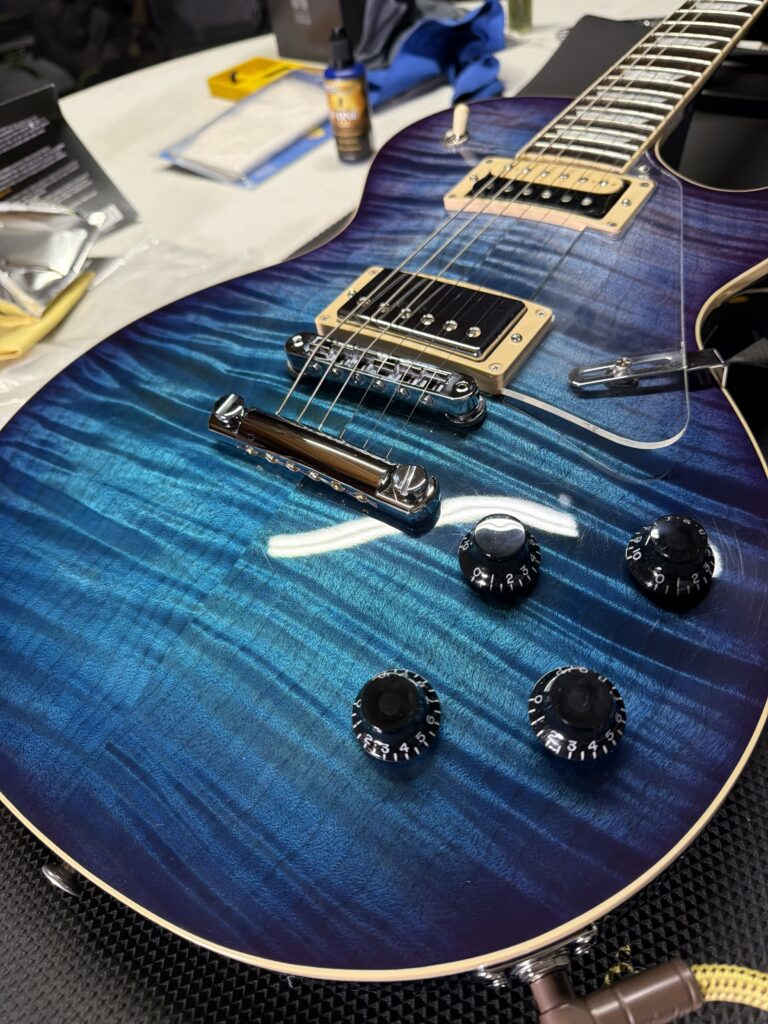
  • Gibson Les Paul Trad Pro V: AAA Blueberry Burst

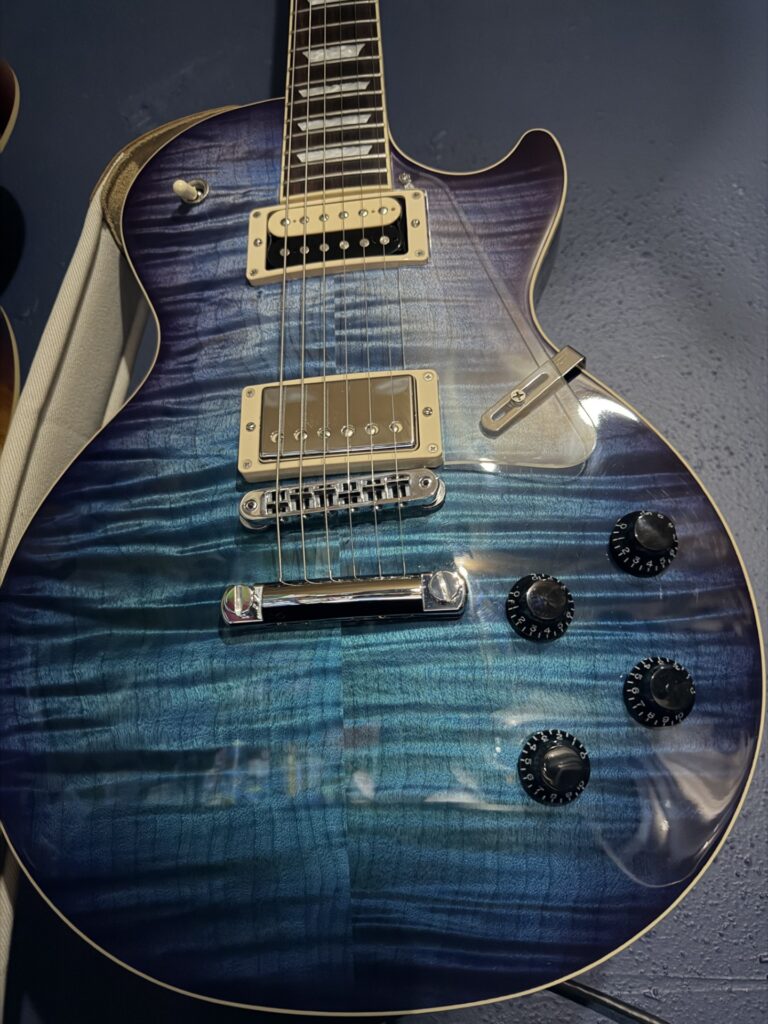
    Gibson Les Paul Trad Pro V AAA Blueberry Burst

    Gibson Les Paul Traditional Pro V AAA Flame Top — Blueberry Burst

    Excellent Crap for Players Who Want Options


    🎸 Overview — The Crap at a Glance

    The Gibson Les Paul Traditional Pro V AAA Flame Top in Blueberry Burst is one of those rare guitars that looks like a classic Les Paul but behaves like a modern performance machine. Underneath the carved AAA maple top and glossy nitro finish is a surprisingly advanced set of electronics, a compound‑radius fingerboard, an asymmetrical neck, and enough switching options to wake the neighbors.

    From the background report:

    “The result is essentially a high-performance Les Paul disguised as a traditional one.”

    This is excellent crap — the kind that makes you grin every time you plug it in.


    🧑‍🔧 Overall Impression

    This guitar is built like Gibson wanted to prove something. It’s solid, resonant, comfortable, and capable of an enormous range of tones. The only real gripe is that Gibson reserves the long tenon neck joint for Custom Shop models — but even with the standard tenon, this thing is a tank.

    If you want a Les Paul that can cover classic rock, blues, metal, funk, studio work, and experimental tones without switching guitars, this is the crap you buy.


    🔬 Construction & Build Quality — What This Crap Is Made Of

    Mahogany Body + AAA Flame Maple Top

    The classic Les Paul recipe remains intact.

    “Mahogany body + carved figured maple top… AAA is primarily a visual grading designation.”

    Every top is different — some wildly flamed, some subtle — so buyers should always inspect the actual guitar.

    Traditional Nine‑Hole Weight Relief

    Not Ultra‑Modern, not chambered — just the classic nine‑hole pattern.

    “The strongest period and inspection-based evidence supports nine-hole Traditional weight relief.”

    It still weighs around nine pounds. This is a Les Paul, not a feather.

    Gloss Nitrocellulose Finish

    Beautiful, but high‑maintenance.

    “Over time it can develop… fine scratches, polishing swirls, dulling, yellowing, edge wear, small dents, finish checking…”

    Nitro lovers call this “character.” Perfectionists call it “stress.”

    Asymmetrical Neck + Compound Radius

    One of the standout features.

    “Owners frequently describe the asymmetrical profile and compound-radius board as unusually comfortable.”

    It’s a modern neck wearing vintage clothes — fast, ergonomic, and great for bending.

    Plek’d Frets

    Factory Plek leveling helps, but setup still varies.

    “Final playability still depends on… nut slot depth, neck relief, bridge height, fret finishing…”

    Some examples are perfect out of the box. Others need a little love.


    🔌 Electronics — The Secret Weapon of This Crap

    Tradbucker Pickups

    Alnico V magnets, underwound neck, overwound bridge.

    “The neck pickup is deliberately underwound… the bridge pickup is deliberately overwound.”

    They’re versatile, punchy, and not the same as BurstBuckers.

    HP‑4 Electronics System

    This is where the guitar becomes a Swiss Army Knife.

    “All four knobs are push/pull controls… inside the control cavity is a bank of five DIP switches.”

    You get:

    • Coil split

    • Coil tap

    • Phase reversal

    • Inner/outer coil selection

    • High‑pass filtering

    • Transient suppression

    This is a ridiculous amount of tonal flexibility for a passive Les Paul.

    Coil Split vs Coil Tap

    The guitar can do both — correctly.

    “A coil split disables one coil… a coil tap accesses a different point in the pickup winding.”

    Most guitars only pretend to offer this level of control.


    🔩 Hardware — The Practical Crap

    Locking Grover Tuners

    Fast restringing, stable tuning.

    Nashville Tune‑o‑matic + Aluminum Stopbar

    Classic Gibson hardware with a lighter tailpiece.

    PCB + Quick‑Connect Wiring

    Easy to configure, harder to repair.

    “It is more complicated to troubleshoot or modify than a conventional four-pot Les Paul harness.”

    Great for players, less great for modders.


    👍 What’s Good — Polished Turd Qualities

    • Excellent neck design

      “The asymmetrical carve and compound-radius board are among the most consistently praised features.”

    • Huge tonal range

    • Strong traditional foundation

    • Distinctive Blueberry Burst AAA top

    • Useful weight relief without hollowing

    • Locking tuners + solid hardware

    • Great recording versatility

    This is the kind of crap that makes you want to play longer.


    👎 What Sucks — The Steaming Bits

    • Weight — many examples are still around nine pounds

      “Many examples remain around nine pounds or more.”

    • Factory consistency varies

    • Electronics complexity can overwhelm some players

    • Nitro finish requires care

    • Headstock impact vulnerability

      “A hard impact behind the headstock can produce a fracture…”

    • Not ideal for vintage purists

    None of these are deal‑breakers — just things to know before you buy.


    🔍 Buying Advice — Inspect This Crap Carefully

    Because individual examples vary, buyers should check:

    • Headstock area for cracks

    • Nut slot depth and spacing

    • Fret wear and buzz

    • DIP switch presence

    • Original Tradbuckers

    • Finish condition (especially stand burns)

    • Actual weight

    • Top figuring

    From the report:

    “Two apparently identical Trad Pro Vs can feel surprisingly different.”

    This is a guitar where the specific example matters.


    💰 Value of the Crap

    The Trad Pro V AAA Flame Top is one of the most feature‑rich Les Pauls Gibson USA has ever produced. It’s not a Custom Shop guitar, but it punches far above its weight in versatility, playability, and tone.

    If you want a Les Paul that can do everything short of making coffee, this is excellent crap worth owning.


    💩 Poop Score: 1 Poop — Excellent Crap

    Why: The Les Paul Trad Pro V AAA Flame Top is beautifully built, tonally flexible, comfortable to play, and visually stunning. Its only real “crappy” traits are the usual Gibson nitro quirks and the lack of a long tenon — but everything else is top‑tier.

    This is excellent crap — the kind you keep forever.


    Here’s the raw research MS Copilot pulled together: 

    Gibson Les Paul Traditional Pro V: AAA Flame Top — Blueberry Burst

    Circa-2020 Buyer’s, Owner’s, and Collector’s Background Report

    Executive summary

    The Gibson Les Paul Traditional Pro V AAA Flame Top in Blueberry Burst is an unusual Les Paul because its appearance is rooted firmly in the classic carved-maple-top Les Paul tradition, while much of its engineering is decidedly modern.
    Introduced in late 2019 and sold through Guitar Center as the fifth generation of the Gibson/Guitar Center Traditional Pro collaboration, the Trad Pro V combines:
    • A mahogany Les Paul body
    • AAA figured maple top
    • Blueberry Burst gloss nitrocellulose finish
    • Traditional nine-hole weight relief
    • Set mahogany neck
    • Bound rosewood fingerboard
    • Asymmetrical neck profile
    • Compound-radius fingerboard
    • Locking Grover tuners
    • Nashville Tune-o-matic bridge
    • Aluminum stopbar tailpiece
    • Gibson Tradbucker pickups
    • Four push/pull controls
    • Five internal DIP switches
    • Coil splitting, coil tapping, phase reversal, coil selection, high-pass filtering, and transient suppression
    The result is essentially a high-performance Les Paul disguised as a traditional one.
    Its strongest qualities are its neck and playability, attractive figured maple top, broad tonal range, solid traditional Les Paul construction, and unusually sophisticated electronics.
    Its principal weaknesses are the normal vulnerabilities of a nitro-finished Les Paul—finish wear and headstock impact sensitivity—combined with variable factory setup/QC on individual examples and greater electronic complexity than a conventional Les Paul.
    For someone considering a used example today, the most important advice is simple:
    Evaluate the individual guitar rather than buying solely on the model name.
    Top figuring, weight, nut work, setup, finish execution, and overall feel vary enough between examples that two apparently identical Trad Pro Vs can feel surprisingly different.

    1. What exactly is the Traditional Pro V?

    The model is properly identified as the:
    Gibson Les Paul Traditional Pro V AAA Flame Top
    The documented Blueberry Burst model code is:
    LPTP19B9CH3
    The generation appeared in late 2019, with a documented release date of October 7, 2019, and was actively promoted by Guitar Center during 2020. Guitar Center described it as the fifth generation of a Gibson/Guitar Center collaboration that began in 2008. [forum.gibson.com]
    That distinction matters because several similarly named guitars exist.

    Traditional Pro V AAA Flame Top

    This is the premium gloss version associated with Blueberry Burst.
    It has:
    • AAA flame maple top
    • Gloss nitro finish
    • Mahogany body
    • Nine-hole weight relief
    • Tradbucker pickups
    • HP-4 electronics
    • Asymmetrical neck
    • Compound-radius rosewood fingerboard
    • Locking Grovers

    Traditional Pro V Satin

    A less-expensive version was offered with a plain top and satin finish.
    Although much of the electronics and neck specification was shared, it should not be confused with the gloss AAA Flame Top model. [ithinkdiff.com]

    Traditional Pro V Mahogany Top

    A further 2020 variation used a mahogany rather than figured maple top.
    Again, this is a different instrument despite carrying the Traditional Pro V name. [applescoop.org]

    Earlier Traditional Pro models

    The Traditional Pro family goes back to approximately 2009.
    Earlier generations used different pickups, electronics, neck specifications, finishes, and hardware combinations. The original Traditional Pro, for example, used a ’57 Classic neck pickup and BurstBucker 3 bridge pickup, rather than Tradbuckers. [stewmac.com]
    Consequently, specifications from a Traditional Pro II, III, or IV should not automatically be applied to a Pro V.

    2. Construction and materials

    Body

    The Blueberry Burst AAA Flame Top version uses the classic Les Paul material combination:
    Mahogany body + carved figured maple top
    The maple is visually graded AAA.
    The body is not completely solid internally. Gibson uses its traditional nine-hole weight-relief pattern, in which nine large holes are drilled into the mahogany before the maple cap is attached. [forum.gibson.com], [inc42.com]
    This is important because some later advertisements incorrectly describe the model as using Ultra-Modern weight relief.
    The strongest period and inspection-based evidence supports nine-hole Traditional weight relief.
    That means the guitar retains considerably more internal mahogany than Gibson’s more aggressively chambered designs.

    3. The AAA flame maple top

    The figured maple top is one of the defining features of the Blueberry Burst version.
    AAA is primarily a visual grading designation.
    It does not guarantee:
    • Identical flame width
    • Perfect symmetry
    • Perfect bookmatching
    • Identical figuring from every viewing angle
    • Absence of mineral streaks
    • Identical flame intensity between guitars
    Consequently, individual Trad Pro V tops can look dramatically different.
    Some have broad, highly three-dimensional flame.
    Others have tighter figuring.
    Some appear extremely symmetrical from directly in front but change considerably when viewed from an angle.
    This variation is normal for figured wood and is one reason buyers should inspect photographs of the actual guitar, rather than relying on catalog photography.

    4. Blueberry Burst finish

    The Blueberry Burst version uses a gloss nitrocellulose lacquer finish. [macworld.com], [gibson.com]
    The finish allows the maple figure to remain visible beneath a blue/purple perimeter burst.
    Unlike an opaque finish, the appearance therefore depends heavily on the individual maple top underneath it.
    Nitrocellulose lacquer is also an important part of long-term ownership because it behaves differently from modern polyurethane and polyester finishes.
    Over time it can develop:
    • Fine scratches
    • Polishing swirls
    • Dulling
    • Yellowing
    • Edge wear
    • Small dents
    • Finish checking
    • General patina
    Gibson itself describes these characteristics as part of the way nitrocellulose ages. [pricerunner.com]
    For some owners this aging is desirable.
    For someone trying to preserve a pristine Blueberry Burst, however, nitro requires more care than many modern guitar finishes.

    5. Neck construction

    The Trad Pro V uses a set mahogany neck glued into the body in traditional Gibson fashion. [wccftech.com], [inc42.com]
    Scale length is:
    24.75 inches
    Nut width is approximately:
    1.69 inches / 43 mm
    The neck is one of the most distinctive parts of the model.
    Rather than using a symmetrical 1950s or 1960s Gibson profile, the Trad Pro V has an asymmetrical neck carve.
    Guitar Center described the concept as having more material supporting the palm on one side while becoming slimmer toward the finger side. The result is a neck that feels noticeably different from a conventional Les Paul.

    6. Compound-radius rosewood fingerboard

    The fingerboard is bound rosewood with:
    • 22 frets
    • Trapezoid inlays
    • Compound radius
    A compound-radius board gradually becomes flatter toward the upper frets.
    In practical terms, this attempts to combine:
    • Comfortable chord playing lower on the neck
    • Easier bending higher on the neck
    • Lower upper-register action without fretting out
    This feature, combined with the asymmetrical neck, is one of the reasons owners frequently describe the Trad Pro V as unusually easy-playing for a Les Paul.
    Exact published starting and ending radius figures are difficult to establish from reliable period documentation, so claims assigning precise compound-radius numbers should be treated cautiously.

    7. Frets and factory fretwork

    The guitar has 22 frets generally described as modern or medium-jumbo-class fretwire. [forum.gibson.com], [inc42.com]
    Gibson’s Nashville production process during this period included Plek fret leveling.
    Gibson documented the process at its USA factory in 2020, showing instruments being machine-measured and leveled before final setup. [notebookcheck.net]
    Plek processing does not guarantee that every guitar leaves a retailer perfectly adjusted.
    Final playability still depends on:
    • Nut slot depth
    • Neck relief
    • Bridge height
    • Fret finishing
    • Climate
    • Shipping conditions
    • Dealer setup
    This distinction helps explain why some owners report excellent factory fretwork while others report fret buzz or setup issues.

    8. Nut

    The exact nut material is one area where documentation is inconsistent.
    A documented 2020 Gibson MOD evaluation identifies:
    Tektoid
    while a later professional Trad Pro V review lists:
    GraphTech NuBone
    This could represent:
    • A production change
    • Supplier variation
    • Different terminology
    • Specification changes later in the model run
    Therefore, the safest conclusion for a circa-2020 guitar is:
    The model used a synthetic self-lubricating-style nut material, but the exact material should be verified on the individual instrument rather than assumed from later specifications.
    Nut workmanship is more important to actual performance than the brand name of the material.

    9. Tradbucker pickups

    The Trad Pro V introduced proprietary Gibson Tradbucker pickups.
    These are not BurstBucker Pros, despite some later used-guitar listings incorrectly identifying them that way.
    Both pickups use Alnico V magnets.
    The neck pickup is deliberately underwound.
    The bridge pickup is deliberately overwound.
    Guitar Center’s 2020 feature explains that Gibson developed several pickup versions before selecting the final Tradbucker combination. Measured examples have been approximately:
    These should be treated as representative measurements rather than exact factory targets.

    10. Why the pickups were originally uncovered

    The factory Trad Pro V presentation used open zebra-coil Tradbuckers.
    Guitar Center specifically noted that uncovered zebra pickups had become a visual theme of the Traditional Pro series. This gives the guitar a slightly more aggressive appearance than a conventional covered-humbucker Les Paul.
    Pickup covers can be fitted later, but a covered pickup should not automatically be assumed to be factory original when evaluating a used Trad Pro V.

    11. The HP-4 electronics system

    This is arguably the most unusual feature of the guitar.
    At first glance the controls look like a normal Les Paul:
    • Two volume knobs
    • Two tone knobs
    • Three-way pickup selector
    But all four knobs are push/pull controls.
    Inside the control cavity is a bank of five DIP switches.
    The system is commonly referred to as Gibson’s HP-4 High Performance circuit. [applescoop.org], [apfeltalk.de]

    12. What the controls actually do

    The two volume controls can operate their respective pickups as either:
    • Coil split
    or
    • Coil tap
    depending on the internal DIP-switch configuration.
    The neck/rhythm tone push-pull provides:
    Phase reversal
    The bridge/treble tone push-pull can select:
    Inner or outer coils
    when operating in split mode.
    The internal DIP switches configure:
    1. Neck pickup — tap or split
    2. Bridge pickup — tap or split
    3. Neck volume — high-pass filter on/off
    4. Bridge volume — high-pass filter on/off
    5. Transient suppression on/off
    This makes the Trad Pro V one of the most electronically configurable production Les Pauls.

    13. Coil split versus coil tap

    These terms are often incorrectly used interchangeably.
    A coil split disables one coil of a humbucker.
    A coil tap accesses a different point in the pickup winding.
    The Trad Pro V allows the player to configure which behavior the push/pull volume controls perform.
    That is considerably more sophisticated than the simple coil-split circuit found on many guitars.

    14. Phase switching

    The phase function becomes particularly noticeable when both pickups are selected.
    Reversing the electrical phase relationship causes frequencies common to both pickups to partially cancel.
    The resulting sound is typically:
    • Thinner
    • More nasal
    • Hollow
    • Mid-focused
    It recalls the famous accidental out-of-phase sound associated with certain vintage Les Pauls.

    15. Inner and outer coil selection

    When the pickups are split, the Trad Pro V can determine which coils remain active.
    This allows combinations involving:
    • Inner coils
    • Outer coils
    • Mixed coil relationships
    This produces noticeably different attack and frequency balance.
    It is one reason the guitar can cover a much broader tonal range than its traditional appearance suggests.

    16. High-pass filters

    Two DIP switches control high-pass filtering associated with the volume controls.
    Their purpose is to retain more high-frequency information as volume is reduced.
    Without such a circuit, rolling down a passive guitar volume control often darkens the sound.
    The high-pass option allows the Trad Pro V to maintain more clarity at reduced volume.

    17. Transient suppression

    The fifth DIP switch controls a transient-suppression circuit.
    This should not be confused with an active boost.
    The circuit reduces extreme signal peaks somewhat like a mild limiter, which can be useful when recording directly into digital equipment. [inc42.com]
    No battery is required for normal operation.

    18. Electronics construction

    The Trad Pro V uses a printed circuit board and quick-connect wiring system rather than completely traditional point-to-point Les Paul wiring.
    Surviving HP harnesses show:
    • Four long-shaft push/pull potentiometers
    • PCB construction
    • Quick-connect pickup wiring
    • Five-position DIP block
    Some documented harnesses identify CTS potentiometers. [apfeltalk.de]

    Advantage

    The system allows an enormous number of switching functions in a relatively organized package.

    Disadvantage

    It is more complicated to troubleshoot or modify than a conventional four-pot Les Paul harness.
    A traditional Les Paul circuit can often be repaired with generic pots, capacitors, wire, and a soldering iron.
    The HP-4 system contains more specialized components.

    19. Bridge and tailpiece

    The guitar uses a:
    Nashville Tune-o-matic bridge
    with an:
    Aluminum stopbar tailpiece
    The Tune-o-matic provides individual saddle adjustment for intonation.
    The aluminum tailpiece reduces some mass compared with heavier zinc-based tailpieces.
    Both are conventional, proven Gibson hardware designs.

    20. Tuners

    Factory tuners are locking Grovers with tulip-style buttons. [forum.gibson.com], [inc42.com]
    Locking tuners primarily make restringing faster and reduce the amount of string wrapped around the tuner post.
    They do not automatically solve tuning problems.
    On a Les Paul, tuning instability is frequently associated with:
    • Nut-slot friction
    • Improper string installation
    • Poor setup
    • String stretching
    • Saddle problems
    rather than tuner failure.

    21. Weight

    Despite weight relief, the Trad Pro V should not automatically be considered a lightweight guitar.
    Documented 2020 Blueberry Burst examples include approximately:
    • 9.0 lb
    • 9.4 lb
    Other examples can fall outside that range.
    Wood density varies naturally, so two guitars built to identical specifications can differ noticeably in weight.
    This is another reason buyers should obtain the actual weight of a used guitar rather than relying on catalog specifications.

    22. Workmanship and factory quality

    Gibson’s Nashville manufacturing process combines machine operations with substantial handwork.
    Documented factory processes include:
    • Rough body milling
    • Neck shaping
    • Fingerboard installation
    • Fret installation
    • Neck fitting
    • Gluing the neck into the body
    • Plek fret leveling
    • Hand binding scraping
    • Nitrocellulose spraying
    • Buffing
    • Pickup winding
    • Hardware installation
    • Electronics installation
    • Final setup
    This means two guitars built to the same specification can still show small differences.

    23. Quality-control experience

    The evidence suggests that Trad Pro V workmanship can be excellent, but individual inspection remains worthwhile.
    A professional review found generally excellent construction and setup, while noting only very minor cosmetic imperfections such as a small binding ledge and slight finish texture near the heel. [inc42.com]
    Owner reports also include examples with:
    • Excellent fretwork
    • Excellent nut work
    • Very good factory setup
    • Strong resonance
    • Clean finish execution
    But recurring complaints include occasional:
    • Poorly cut nuts
    • Fret buzz
    • Setup problems
    • Finish blemishes
    • Hardware alignment issues
    Guitar Center’s review aggregation lists craftsmanship as the most frequently selected negative category, although positive reviews greatly outnumber negative ones. [forum.gibson.com]
    The correct interpretation is not that Trad Pro Vs have poor quality control.
    Rather:
    Factory consistency is not perfect, so the individual instrument matters.

    24. Long-term owner experience

    The most consistent long-term praise concerns the neck.
    Owners frequently describe the asymmetrical profile and compound-radius board as unusually comfortable.
    Other recurring positives include:
    • Strong full-humbucker tones
    • Excellent versatility
    • Comfortable upper-register playing
    • Good tuning performance after proper setup
    • Attractive figured tops
    • Useful locking tuners
    • Good sustain
    • Broad recording usefulness
    The electronics are particularly appreciated by players who want one guitar capable of covering many sounds.

    25. Recurring owner complaints

    The most common reservations are:

    Weight

    Even with nine-hole relief, many examples remain around nine pounds or more.

    Setup variation

    Some guitars require nut or setup work before performing at their best.

    Electronics complexity

    Some owners love the HP-4 system.
    Others eventually settle on one configuration and rarely touch the DIP switches again.

    Too many options

    The guitar can encourage constant experimentation rather than simply playing.
    A professional reviewer specifically identified this as the potential downside of having so many switching possibilities. [inc42.com]

    Traditional in name only

    Some Les Paul enthusiasts dislike the model name because the guitar contains numerous modern features.
    That criticism is understandable.
    The Trad Pro V is arguably better described as a modern player’s Les Paul wearing traditional clothing.

    26. Nitrocellulose finish aging

    The gloss Blueberry Burst finish deserves special attention.
    Gibson uses nitrocellulose lacquer, which ages differently from thick polyurethane finishes.
    Over time it may develop:
    • Fine checking
    • Yellowing
    • Polishing swirls
    • Small dents
    • Edge wear
    • Dulling
    • Hand-contact wear
    • General patina
    These changes do not necessarily indicate poor workmanship.
    They are characteristic of the finish system.

    27. Guitar stands can damage the finish

    This is one of the most important ownership warnings.
    Gibson specifically cautions that some rubber and synthetic materials used on guitar stands can react chemically with nitrocellulose lacquer.
    Possible results include:
    • Softening
    • Discoloration
    • Permanent staining
    • Finish damage
    Gibson recommends covering questionable stand-contact surfaces with soft cotton and using stands primarily for temporary storage. [gibson.com]
    Nitro-safe stands are preferable.

    28. Temperature changes and finish checking

    Rapid temperature changes can cause nitrocellulose lacquer to crack.
    A classic example is bringing a very cold guitar indoors during winter and immediately opening the case.
    The wood and lacquer expand at different rates.
    Gibson recommends allowing a cold instrument to warm gradually inside its closed case before exposing it to warm room air. [gibson.com], [guitarelec…ronics.com]
    Finish checking generally does not indicate structural damage, but it permanently changes the appearance.

    29. Hardware aging

    Chrome hardware is relatively durable but not immune to wear.
    Perspiration contains salts and acids that can eventually affect:
    • Bridge
    • Tailpiece
    • Pickup covers if fitted
    • Screws
    • Tuner surfaces
    Gibson recommends wiping the instrument and hardware after playing. [gibson.com]
    Players with particularly acidic perspiration may see hardware aging much faster than others.

    30. Fret durability

    There is no convincing evidence of a Trad Pro V-specific fret-wear problem.
    Fret life depends primarily on:
    • Playing hours
    • String material
    • String gauge
    • Fretting pressure
    • Bending technique
    Used examples show everything from minimal fret wear to ordinary player wear.
    That variation is expected.

    31. Electronics durability

    No convincing evidence emerged of a widespread Trad Pro V electronics failure problem.
    However, the HP-4 system contains more components than a conventional Les Paul.
    Potential service points include:
    • Four push/pull pots
    • PCB
    • Quick-connect plugs
    • DIP switches
    • Pickup selector
    • Output jack
    The disadvantage is therefore not necessarily poor reliability.
    It is repair complexity.
    A conventional Les Paul harness is simpler to diagnose and rebuild.

    32. The Les Paul headstock issue

    The most important structural vulnerability is not unique to the Trad Pro V.
    It is inherent to traditional Gibson construction.
    The guitar uses:
    • Mahogany neck
    • Angled headstock
    • Truss-rod access cavity
    A hard impact behind the headstock can produce a fracture near the nut/truss-rod area.
    Professional repair shops report Gibson headstock repairs frequently, and Gibson itself warns owners to protect the headstock from impacts. [Re: 603402…576A9.jpeg | Outlook], [gibson.com]
    This does not mean the neck spontaneously breaks.
    Under normal use it is perfectly durable.
    The danger is impact.
    A Les Paul falling backward from a stand is considerably more serious than an ordinary cosmetic bump.

    33. Strap security

    Because a Les Paul is relatively heavy and vulnerable to headstock impact, strap security deserves attention.
    Check periodically that:
    • Strap buttons remain tight
    • Strap holes are not badly stretched
    • Screws remain secure
    A strap-retaining system can be sensible for stage use.

    34. Where was it made?

    The Traditional Pro V was built by Gibson USA in Nashville, Tennessee.
    Gibson has manufactured instruments in Nashville since 1975. [etsy.com]
    The Nashville factory performs major operations including:
    • Body construction
    • Neck work
    • Neck fitting
    • Binding
    • Finishing
    • Fret processing
    • Electronics installation
    • Hardware installation
    • Setup
    Gibson also documents pickup winding at Gibson USA. [forums.macrumors.com]

    35. Where did the materials come from?

    This is much harder to establish accurately.
    The model documentation identifies:
    • Mahogany
    • Maple
    • Rosewood
    • Aluminum
    • Chrome-plated hardware
    • Alnico V pickup magnets
    But it does not provide serial-number-level sourcing information for the wood.
    Therefore it is unsafe to claim that every 2020 Trad Pro V used mahogany, maple, or rosewood from one particular country.
    Wood sourcing can change between production batches.
    Likewise, the exact manufacturing origin of:
    • Grover tuner components
    • Bridge components
    • Tailpiece
    • Plastics
    • Capacitors
    • PCB components
    cannot reliably be determined from the model specification alone.

    36. Serial numbers and dating

    Gibson changed its USA serial-number format again in 2019.
    Gibson’s official serial-number guide states that Gibson USA returned to a post-2005-style production-number system beginning in 2019. [applescoop.org]
    Because Gibson model years and actual production dates do not always align perfectly, a guitar advertised as a “2020 model” should ideally be evaluated using:
    • Serial number
    • Original sales receipt
    • Factory paperwork
    • Model code
    • Pot/component dates where relevant
    rather than relying solely on a seller’s description.

    37. History of the Les Paul

    The Gibson Les Paul Model debuted in 1952.
    Its development was not the work of one person alone.
    Les Paul had experimented extensively with solidbody electric guitars, most famously his homemade “Log.”
    Gibson, under president Ted McCarty, developed the commercial instrument using Gibson’s carved-top design language.
    The resulting construction combined:
    Mahogany body + carved maple top
    Gibson’s own historical account says Les Paul favored the maple/mahogany combination as a compromise between sustain and weight. [gibson.com], [youtube.com]

    38. The humbucker connection

    Gibson engineer Seth Lover developed Gibson’s humbucking pickup.
    Humbuckers appeared on Les Pauls in 1957.
    Their two-coil design reduces electromagnetic hum while producing the powerful midrange-rich sound that became strongly associated with rock guitar. [gibson.com]
    The Tradbuckers in the Trad Pro V are descendants of that basic Gibson humbucker architecture, but with modern four-conductor wiring that enables the Pro V’s switching system.

    39. Why “Burst” matters

    The famous Les Paul sunburst appeared on the Standard beginning in 1958.
    Those 1958–60 instruments later became some of the most valuable electric guitars ever produced. [youtube.com]
    Blueberry Burst takes the same basic visual idea—
    transparent color surrounding visible figured maple
    —and interprets it using blue and purple rather than the traditional cherry/red/amber palette.
    It is therefore visually connected to the historic Les Paul Burst tradition without pretending to be a vintage reproduction.

    40. Traditional Pro history

    The Traditional Pro concept began as a collaboration between Gibson and Guitar Center around 2008–09.
    The idea was essentially to retain recognizable Les Paul construction while adding player-oriented features.
    By the fifth generation, the concept had evolved considerably.
    The Trad Pro V added:
    • Proprietary Tradbuckers
    • Asymmetrical neck
    • Compound-radius board
    • Locking tuners
    • Extensive push/pull switching
    • Internal DIP configuration
    Ironically, the fifth-generation model is arguably one of the least traditionally specified guitars ever to carry the Traditional Pro name.

    41. What to inspect when buying a used one

    A prospective buyer should check the following.

    Headstock

    Look carefully around:
    • Back of headstock
    • Nut area
    • Truss-rod cavity
    • Neck/headstock transition
    Check for repaired cracks or finish lines.
    A professionally repaired Gibson headstock can be structurally sound, but it should always be disclosed.

    Nut

    Check:
    • String spacing
    • Slot depth
    • Tuning after bends
    • Ping noises while tuning
    Poor nut work is one of the more credible recurring setup complaints.

    Frets

    Check for:
    • Excessive wear
    • High frets
    • Buzz
    • Dead notes
    • Poor fret-end finishing

    Neck

    Verify that the truss rod functions normally and that reasonable relief can be achieved.

    Electronics

    Test every push/pull control.
    Then remove the control cover and verify that the DIP-switch block is present.
    At least one documented 2020 guitar apparently left the factory without the expected DIP-switch assembly. [tecnobits.com]

    Pickups

    Original Tradbuckers should be four-conductor Gibson pickups compatible with the HP-4 system.
    Factory appearance was uncovered zebra coils.

    Hardware

    Check:
    • Locking Grovers
    • Nashville bridge
    • Aluminum stopbar
    • Strap buttons

    Finish

    Look for:
    • Stand burns
    • Chemical reactions
    • Checking
    • Buckle rash
    • Neck wear
    • Overspray
    • Repair evidence

    Weight

    Ask for the actual weight.
    Do not assume that nine-hole relief means the guitar will be light.

    Top

    Evaluate the actual guitar rather than the catalog photograph.
    AAA grading does not make every flame top visually identical.

    42. Overall strengths

    Excellent neck design
    The asymmetrical carve and compound-radius board are among the most consistently praised features.
    Very broad tonal range
    Few Les Pauls offer this much passive switching flexibility.
    Strong traditional foundation
    Despite the electronics, it remains fundamentally a mahogany/maple, set-neck, dual-humbucker Les Paul.
    Distinctive appearance
    Blueberry Burst over AAA figured maple is immediately recognizable.
    Good hardware package
    Locking Grovers, Nashville bridge, and aluminum stopbar are practical upgrades.
    Useful weight relief
    Nine-hole relief removes some mass without turning the body into a heavily chambered structure.
    Recording versatility
    Phase, split, tap, coil selection, high-pass filtering, and transient suppression make the guitar unusually adaptable in a studio.

    43. Overall weaknesses

    Weight can still be substantial
    Many examples remain around nine pounds or more.
    Factory consistency varies
    Nut work, setup, finish details, and cosmetic execution should be inspected individually.
    Electronics are complicated
    The HP-4 system is powerful but less straightforward to repair or modify.
    Nitro requires care
    Stand reactions, checking, scratches, and aging are realistic ownership considerations.
    Headstock impact vulnerability
    The traditional Gibson angled mahogany headstock requires sensible handling.
    Not ideal for strict vintage purists
    The compound board, asymmetrical neck, locking tuners, PCB, DIP switches, and extensive switching are deliberately modern.

    44. Evidence-quality caveats

    High-confidence specifications

    Strong period or manufacturer/retailer evidence supports:
    • Late-2019 introduction
    • Blueberry Burst model code
    • AAA flame maple top
    • Mahogany body
    • Nine-hole weight relief
    • Mahogany neck
    • Rosewood fingerboard
    • Compound radius
    • Asymmetrical neck
    • Tradbucker pickups
    • Alnico V magnets
    • HP-4 electronics
    • Five DIP switches
    • Locking Grovers
    • Nashville bridge
    • Aluminum stopbar
    • Gloss nitro finish
    • USA manufacture
    • Hardshell case

    Moderate-confidence details

    Documentation is less consistent regarding:
    • Exact nut material during every production period
    • Exact fret dimensions
    • Exact compound-radius measurements
    • Knob variations
    • Truss-rod-cover variations
    • Some hardware-finish terminology
    These details may have changed during the production run.

    Information that should not be stated as fact without inspecting the individual guitar

    • Exact wood species/subspecies
    • Country where its particular wood was harvested
    • Exact component suppliers
    • Exact pickup resistance
    • Exact weight
    • Exact neck thickness
    • Exact top-matching quality
    • Exact production date based solely on seller description

    Final assessment

    The circa-2020 Gibson Les Paul Traditional Pro V AAA Flame Top Blueberry Burst occupies an interesting place in Gibson history.
    It looks immediately recognizable as a Les Paul, but underneath the figured maple and traditional four-knob layout is one of Gibson’s more ambitious attempts to modernize the instrument without radically changing its appearance.
    Its identity can almost be summarized as:
    1950s Les Paul architecture, modern ergonomic neck design, and unusually sophisticated passive electronics.
    For players, its greatest strengths are the neck, Tradbuckers, tonal flexibility, figured maple top, and familiar Les Paul foundation.
    For collectors and long-term owners, the important considerations are nitro aging, originality of the specialized electronics, factory configuration, headstock condition, and the considerable variation that naturally exists between individual examples.
    For prospective buyers, the Trad Pro V is therefore a model where buying the individual guitar matters more than buying the specification sheet.
    A particularly good example—with a strong top, well-cut nut, clean fretwork, comfortable weight, healthy HP-4 electronics, and no structural repairs—can be an unusually capable Les Paul: traditional enough to deliver the fundamental character people expect from the design, but modern enough to cover territory that a conventional Les Paul simply cannot