


Buying a washing machine shouldn’t be exciting.
It’s a box that fills with water and spins your underwear around.
Nobody should be standing in the appliance department thinking:
“Holy shit, look at the suspension on that thing.”
And yet here we are.
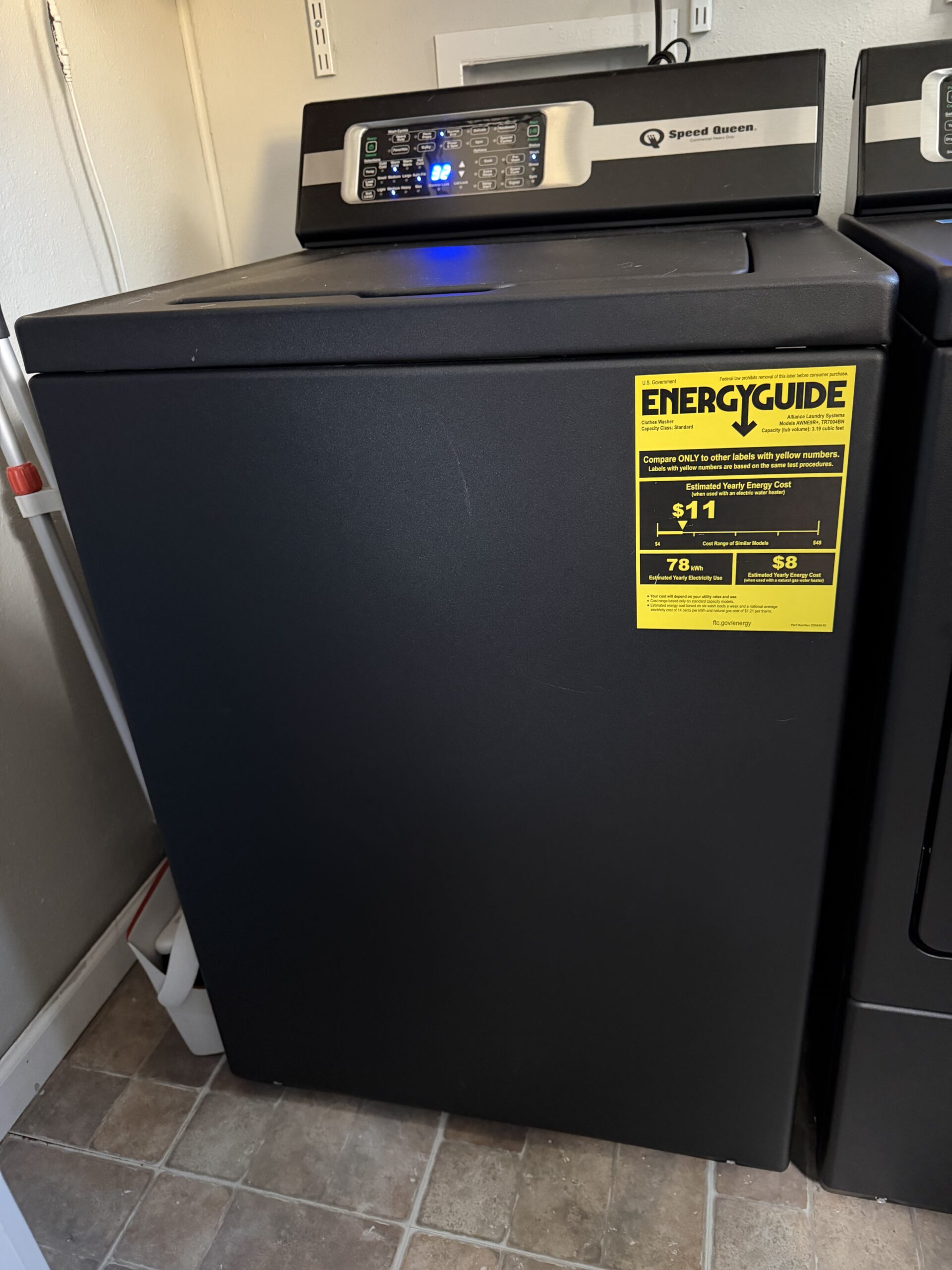
We recently bought a Speed Queen TR7, and after actually living with the thing, I’ve developed one major complaint:
I can’t fold clothes fast enough to keep up with it.
Seriously.
I’ll move one load into the dryer, start another load in the washer, and begin folding whatever came out of the dryer.
Before I’ve finished folding everything and putting it away, the damn washer is ready again.
Ding.
“Hey asshole. I finished your clothes.”
Jesus Christ.
Give me a minute.
Why the Hell Did We Buy a Speed Queen?
Speed Queen occupies a strange place in the washing-machine world.
It doesn’t really compete on giant touchscreens, Wi-Fi connectivity or the ability to send a push notification to your phone announcing that your underwear is clean.
Instead, the company’s pitch is basically:
“Here’s a washing machine. We built the shit out of it.”
And I can appreciate that.
The TR7 uses a stainless-steel wash tub, porcelain outer tub, automatic balancing system, traditional center agitator and a variable-speed 1-HP motor. Speed Queen also rates agitation noise at just 43 dB. Speed Queen TR7006WN [speedqueen.com]
There’s nothing particularly futuristic about the concept.
It’s a top-load washing machine.
You put dirty clothes in.
Clean clothes come out.
Call me nostalgic, but I’ve reached a stage in my life where I don’t particularly need my washing machine participating in the Internet of Things.
I need it participating in the Laundry of Things.
And preferably doing that without breaking.
The First Thing We Noticed: It’s Fast
This genuinely surprised me.
Our TR7 absolutely tears through laundry.
I don’t mean that it aggressively beats the shit out of the clothes.
Quite the opposite.
The clothes come out feeling noticeably soft.
That’s one of the things both of us picked up on pretty quickly.
The machine just seems to get through the job without making a huge production out of it.
Load.
Detergent.
Buttons.
Go.
Then approximately five minutes later…
Okay, I’m exaggerating.
But sometimes it sure as hell feels like it.
This has actually created one of the dumbest first-world problems I’ve ever encountered:
The washer is outrunning the human laundry department.
I’ll get one load moved, start folding, and before everything makes it back into drawers and closets, I’ve got another load demanding my attention.
Speed Queen even gives the TR7 a dedicated Speed Cycle feature in addition to its regular cycle selection. Speed Queen TR7006WN [speedqueen.com]
I have no idea why I’d need to encourage it.
Calm down, Speed Queen. We’re already losing.
But Doesn’t It Have a Tiny Tub?
Here we arrive at the elephant in the laundry room.
The TR7 has a 3.2-cu.-ft. capacity. Speed Queen TR7006WN [speedqueen.com]
If you’ve been comparison-shopping modern washers, that number can look pretty damn small.
And technically?
It is.
You can find plenty of washers marketed with substantially larger drums.
This was something I was concerned about before we bought it.
After using it?
I’m much less concerned.
The capacity number tells the truth, but it doesn’t necessarily tell the whole story about what owning the machine feels like.
For normal clothing loads, towels, sheets and everyday household laundry, we haven’t found ourselves constantly wishing for more room.
And we’ve discovered that it can handle more bulky bedding than I initially expected.
No, I’m Not Putting Our King Comforter in It
Let’s establish some limits here.
Would I cram a giant king-size comforter into this thing?
Hell no.
That’s asking a 3.2-cu.-ft. washer to perform an act of physical geometry that I don’t particularly want to witness.
That’s what the laundromat is for.
But thinner king-size blankets?
Those have been fine for us.
And that’s where I think the reputation for the TR7 having a tiny washer drum becomes slightly misleading.
The tub isn’t gigantic.
Nobody should pretend otherwise.
But I’ve found the usable capacity feels better than the specification suggests.
There’s an important distinction there.
I’m not saying 3.2 cubic feet has magically become 4.8 cubic feet because I really like my washing machine.
I’m saying that in normal household use, I’ve rarely felt constrained by it.
That’s what actually matters to me.
This Thing Is Surprisingly Gentle
Here’s the other thing we noticed:
Our fabrics feel better.
Softer.
And that’s interesting because Speed Queen doesn’t position the TR7 as the company’s aggressive dirt-beating monster.
The TR7 uses the company’s Perfect Wash system, which Speed Queen describes as a versatile, gentle wash system designed around fabric care. Speed Queen TR7006WN [speedqueen.com]
Our experience lines up with that pretty damn well.
The clothes are clean.
But they don’t feel like they just survived an interrogation.
That’s probably one of my favorite things about this machine.
There’s this tendency to assume a serious washing machine needs to attack your clothing like it’s personally offended by the existence of stains.
The TR7 doesn’t feel like that.
It just gets the job done.
It’s Also Really Damn Quiet
This isn’t something I usually spend much time thinking about with appliances.
A washing machine makes washing-machine noises.
Fine.
But the TR7 is remarkably civilized about it.
Speed Queen rates it at 43 dB during agitation. Speed Queen TR7006WN [speedqueen.com]
It’s another one of those features that fits the overall personality of the machine.
Nothing dramatic is happening.
No washing-machine reenactment of the Apollo 11 launch.
No appliance slowly migrating across the room because somebody washed three towels and a pair of jeans.
It just quietly goes about its business.
Way too quickly.
There Are Actually a Shitload of Settings
You’d be forgiven for looking at the TR7 and assuming it’s pretty basic.
Underneath the straightforward appearance, however, there’s quite a bit of flexibility.
Speed Queen lists 16 preset cycles, with four temperature selections, four load-size selections and four soil-level selections. There are also options including Pre-Wash, Extra Rinse, Warm Rinse, Soak, Favorite Cycles, Speed Cycle and Delay Start. Speed Queen TR7006WN [speedqueen.com]
So if you’re someone who wants to customize every load, you can.
If you’re like me and occasionally just want the machine to:
WASH THE DAMN SHIRTS
you can do that too.
That’s how appliance controls should work.
Give the people who care plenty of control.
Don’t require everyone else to attend Washer University.
The Delayed Lid Lock Is Something I Actually Appreciate
There’s also a small feature that sounds insignificant until you’ve owned washers that immediately imprison your missing sock.
The TR7 allows the lid to remain accessible early in the process so you can add something you’ve forgotten before it reaches the spin stage. Speed Queen TR7 [abt.com]
That’s surprisingly useful.
Because apparently the universe has established a fundamental law:
No matter how thoroughly you gather the laundry, one sock will reveal itself approximately twelve seconds after you start the washer.
Every.
Damn.
Time.
Being able to toss it in without having to negotiate with the appliance is nice.
Speed Queen Clearly Spent Its Money Differently
And I think this is the larger appeal.
The TR7 isn’t inexpensive.
Speed Queen currently lists the white TR7006WN at a $1,749 MSRP, and the company backs the TR7 with a seven-year warranty. Speed Queen TR7006WN [speedqueen.com]
That’s serious washing-machine money.
You can absolutely buy a washer with a bigger tub for less money.
Probably one with more tech too.
That means the argument for buying this thing can’t simply be:
“Look how much washer I got per dollar.”
That’s not really what Speed Queen is selling.
The appeal is that the machine feels like somebody prioritized the washing-machine parts of the washing machine.
And after dealing with modern appliances that occasionally seem designed primarily around making the showroom placard impressive, there’s something refreshing about that.
So Why the Hell Did We Spend This Much on a Washing Machine?
This deserves some explanation.
Because roughly $1,700 is a shitload of money for a washing machine.
We knew that going in.
We weren’t standing in the appliance store under the impression we’d discovered some incredible bargain.
We were gambling.
Just not in the way you might think.
The gamble wasn’t:
“Maybe this expensive washing machine will somehow make our underwear cleaner than every other washing machine.”
The gamble was:
“What if we buy a washing machine and don’t have to buy another goddamn washing machine for a very, very long time?”
That’s where the Speed Queen TR7 starts making more sense.
The current TR7 comes with a seven-year parts-and-labor warranty. That’s already a hell of a commitment for a household appliance. Speed Queen Warranty Guide [speedqueen…ential.com], [speedqueen…ential.com]
But the warranty was only part of what convinced us.
The bigger thing was longevity.
Speed Queen builds its reputation around machines engineered for extremely long service lives, and the company says the TR7 is built for 25 years of life in the average home. Speed Queen TR7006WN [speedqueen.com]
Twenty-five fucking years.
Now, let’s be clear.
That doesn’t mean Speed Queen promises your particular washing machine will wake up every morning for the next quarter-century, salute the flag, and cheerfully wash your socks without ever needing service.
Machines wear.
Parts fail.
Things need maintenance.
Nothing mechanical gets a magical exemption from physics because the brochure says Speed Queen on the front.
And that’s actually part of our gamble.
We’re going into this assuming that over the years, we’re going to take care of it.
If something needs service, we’ll service it.
If something wears out, we’ll deal with it.
We’ll maintain the machine rather than automatically treating the first repair bill as its death certificate.
Because that’s where I think the real value proposition lives.
The Cheap Washer Isn’t Cheap If You Keep Buying It
This was the math running through my head.
Imagine buying a cheaper washing machine.
Everything’s great.
Then years down the road something significant fails.
The repair quote comes back.
You look at the age of the washer.
You look at the repair bill.
Then you utter the most dangerous phrase in modern appliance ownership:
“Shit, we might as well buy a new one.”
And around the merry-go-round we go.
Another washer.
Another delivery.
Another installation.
Another old machine hauled away.
Another pile of money.
Then do the whole thing again whenever that machine decides it’s had enough.
We wanted to try something different.
Buy the expensive bastard. Maintain the expensive bastard. Repair the expensive bastard. Keep the expensive bastard.
If our TR7 lasts anywhere close to the sort of service life Speed Queen designs these machines around, suddenly the purchase price doesn’t look nearly as ridiculous. Speed Queen TR7006WN [speedqueen.com]
That’s the bet.
And I’ll happily come back to this review years from now and tell you whether we won.
That’s Where the Value Actually Is
I don’t think you can properly review a Speed Queen TR7 based solely on how much washer you get today for $1,700.
Do that and it honestly doesn’t look fantastic.
Other machines have bigger tubs.
Other machines cost less.
Other machines have more flashy technology.
You can stare at a comparison chart and make the Speed Queen look like a terrible deal.
But that’s not why we bought it.
We’re betting on time.
If we bought a $1,700 washer that lasts about as long as a $900 washer, then congratulations to us.
We’re idiots.
I’ll update the review accordingly.
Final Shit Rating: Financially Ruinous Appliance Hubris.
But if we’re still using this thing 20 or 25 years from now, having occasionally maintained and repaired it rather than throwing the entire machine away?
Then the equation changes completely.
That expensive washer might turn out to be one of the cheaper ones we’ve ever owned.
And honestly?
That’s the part of this experiment I’m most interested in finding out.
The Capacity Is Still the Big Compromise
I’m not going to drink the Kool-Aid here.
If you’ve got six kids and you’re washing bedding for a small military installation every weekend, the TR7’s 3.2-cu.-ft. capacity may legitimately piss you off.
You should think seriously about that before buying one.
This isn’t one of those reviews where I love something and therefore every disadvantage magically becomes a charming personality trait.
The tub is smaller.
Period.
The question is whether that actually matters for your laundry.
For ours?
So far, surprisingly little.
And because the washer gets through loads so quickly, I don’t particularly mind doing several reasonable loads instead of trying to recreate the Battle of Gettysburg inside one enormous drum.
The Other Downside
It’s expensive.
No clever explanation is going to make $1,700-ish MSRP pocket change. Speed Queen TR7006WN [speedqueen.com]
You’re paying premium-appliance money for something that, at first glance, looks fairly conventional.
That’s going to be difficult to justify for some buyers.
Especially when they’re standing at a store looking at another machine with a gigantic tub and a feature list long enough to require scrolling.
The argument for the TR7 becomes much more about how it does the basic job.
And ours does it exceptionally well.
What I Love
It’s fast.
Annoyingly fast, apparently.
Our clothes feel great coming out.
That’s something we noticed rather than something a specification sheet told us to notice.
It’s quiet.
Speed Queen’s 43-dB agitation rating isn’t just a meaningless brochure number in our experience. It really is a civilized machine. Speed Queen TR7006WN [speedqueen.com]
The capacity is more useful than I expected.
Again, not huge. Just less limiting than the number initially made me fear.
It’s straightforward.
There are plenty of options when we want them without the entire machine feeling like an iPad bolted to a water tank.
And finally:
It just seems really damn good at washing clothes.
Which shouldn’t seem revolutionary.
It’s a washing machine.
Yet somehow that feels worth mentioning.
What I Don’t Love
The tub could absolutely be bigger.
I’d love another little chunk of capacity without turning the washer into something the size of a commercial refrigerator.
And this isn’t the machine I’d buy specifically for enormous, thick king-size comforters.
Then there’s the price.
You’re paying a premium, and there’s no getting around that.
But my biggest complaint remains the most ridiculous one:
The son of a bitch won’t give me enough time to finish folding.
That might be the nicest negative thing I’ve ever written in a product review.
The Shitty Verdict
We love our Speed Queen TR7.
It’s one of those purchases where the specification that worried me the most before buying it, the 3.2-cu.-ft. capacity, has turned out to matter considerably less than I expected.
The thinner king blankets we’ve tried have been fine.
Normal laundry has been fine.
Towels have been fine.
Clothes come out clean and noticeably pleasant-feeling.
And the machine tears through the laundry pile quickly enough that I’m apparently the bottleneck now.
Fantastic.
I’ve finally achieved technological unemployment in my own laundry room.
The washer has retained me in a supporting role folding shirts.
Final Shit Rating: 💩 out of 4
Excellent crap.
The Speed Queen TR7 isn’t the cheapest washer.
It isn’t the biggest washer.
And if your weekly laundry involves king-size comforters, horse blankets and the sails from a 19th-century schooner, you should probably look elsewhere.
But for our actual household laundry?
This thing kicks ass.
It’s fast.
It’s quiet.
It’s gentle.
The clothes feel great.
And despite the supposedly tiny tub, we’re getting much more practical use from the capacity than I expected.
I wanted a washing machine that was really good at being a washing machine.
Apparently Speed Queen took that assignment a little too seriously.
Now if they’d just make the damn thing fold the clothes before starting the next load, we’d be set.

1 Comment
Pingback: Major Household Appliance Reviews: Expensive Crap That Better Last - ShouldIBuyThisCrap.com