


Some guitars are exciting because they’re temperamental.
They fight you a little.
Maybe they hum like a refrigerator from 1973. Maybe the tuning stability depends on atmospheric pressure, moon phase and whether you looked at the tremolo wrong.
Sometimes that’s part of the charm.
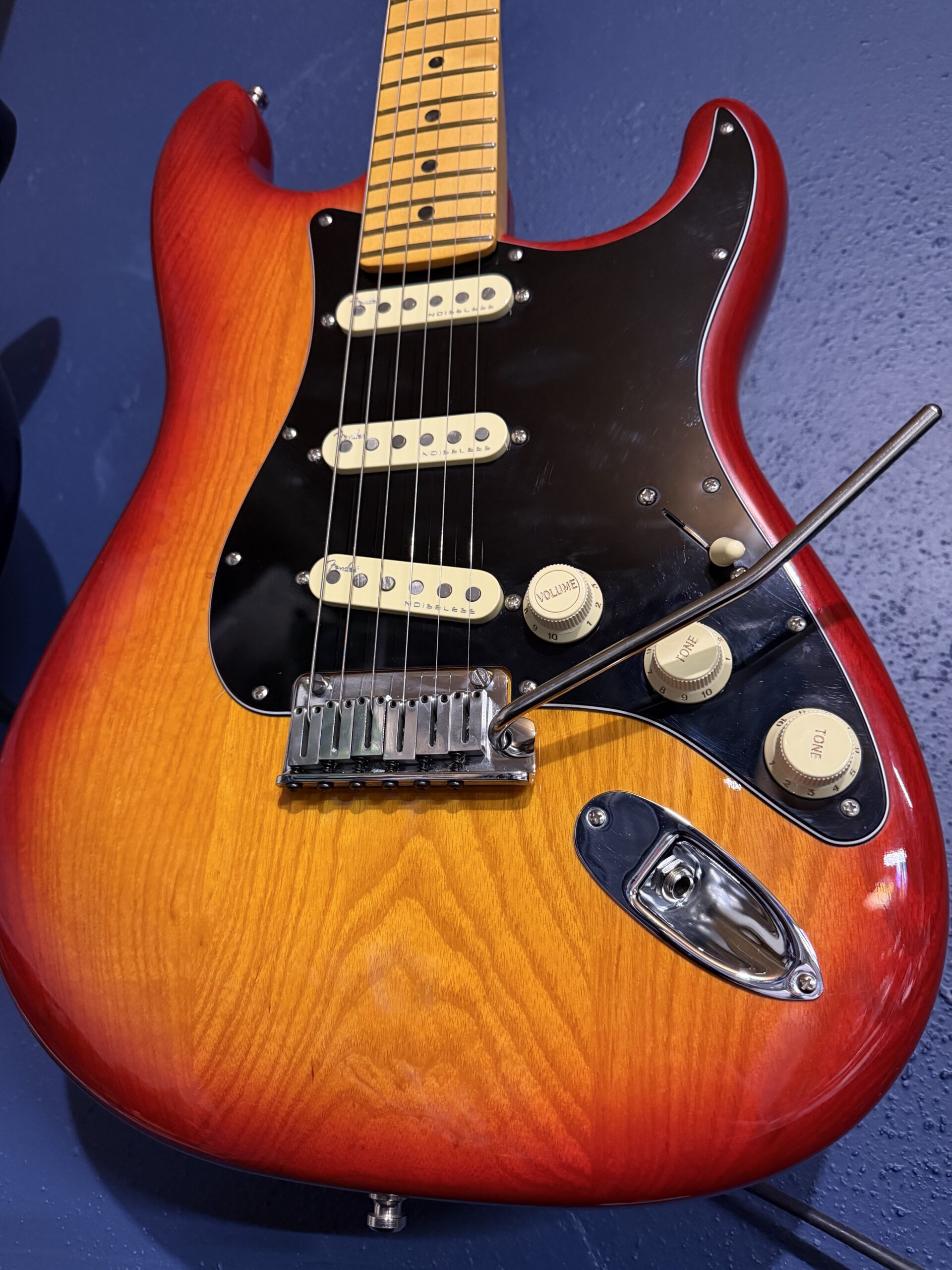
My Fender American Ultra Luxe Stratocaster isn’t that guitar.
This thing is my Sunday driver.
It’s comfortable.
It’s smooth.
It’s predictable.
It starts when I turn the key.
And if I want to take the scenic route through twelve guitar pedals and enough gain to communicate with nearby satellites, it doesn’t complain.
It just goes.
That’s probably the best way I can describe what makes the original American Ultra Luxe Stratocaster so good.
It takes the basic Strat formula, removes a bunch of the shit that can annoy you about a Strat, and replaces it with modern conveniences without completely turning the guitar into some pointy-headed shred machine.
And after living with one, I’ve discovered something slightly embarrassing:
Predictable can be pretty damn wonderful.
What the Hell Is an Ultra Luxe, Anyway?
Fender has approximately 47 billion different Stratocasters.
You’ve got Player Strats, American Professionals, Ultras, old American Standards, vintage reissues, Custom Shop guitars, signature models and enough variations to make researching one feel like you’re applying for a federal permit.
Mine is the original American Ultra Luxe Stratocaster SSS, the modern-performance version sold before the current Ultra Luxe Vintage generation.
That’s important because the name has subsequently evolved.
The current Fender Ultra family includes the American Ultra II and newer American Ultra Luxe Vintage instruments. Fender’s current Ultra Luxe Vintage models retain stainless-steel frets but pivot toward Pure Vintage pickups and vintage-inspired appointments rather than simply being the same guitar with different paint. American Ultra Stratocaster Guitars – Fender [fender.com]
So when you’re shopping used:
Pay attention to what the damn guitar actually is.
“Ultra,” “Ultra II,” “Ultra Luxe” and “Ultra Luxe Vintage” are not interchangeable names.
The Neck Is Where the Love Affair Starts
If I had to explain why I keep picking this guitar up, I’d probably start here.
The neck just feels good.
Mine has that wonderful combination of a compound-radius fingerboard and stainless-steel frets that makes everything feel slick without feeling sterile.
Chords are comfortable lower down.
Move up the neck and bends feel wonderfully natural.
And then there are those stainless frets.
Holy shit, I like stainless frets.
There’s something almost glassy about the feel.
Bends don’t feel like you’re dragging the string across something. They glide.
It’s one of those upgrades that’s remarkably easy to dismiss when you’re reading a specification sheet.
“Oh boy, different fret metal. Alert the media.”
Then you spend enough time actually playing stainless frets and go back to something rougher.
Oh.
Now I get it.
It’s also one of the distinguishing features separating the original Ultra Luxe concept from a regular Ultra.
And That Smoothness Sort of Defines the Whole Guitar
That’s what I mean by calling it my Sunday driver.
Nothing comes across as particularly unruly.
The contours are comfortable.
The neck feels familiar.
The upper frets are easy to get to.
The locking tuners make string changes pleasantly uneventful.
The two-point tremolo gives you the fun of a Strat trem without requiring you to develop the diplomatic skills necessary to negotiate with a Floyd Rose.
It’s just…
easy.
And sometimes easy gets mistaken for boring.
I don’t think it is.
I have other guitars for personality.
I have guitars that make me work.
I have guitars that make particular sounds exceptionally well.
The Ultra Luxe is the guitar I can grab without giving the decision much thought.
Some days that’s exactly what I want.
Let’s Talk About Those Noiseless Pickups
Here comes the controversial part.
They’re Noiseless pickups.
Everybody grab a chair.
Mention Noiseless Strat pickups around guitar people and eventually somebody will tell you they aren’t real Strat pickups because they don’t sound exactly like Leo Fender personally wound them during his lunch break in 1957.
Fine.
I get the argument.
Traditional single coils have a rawness and character that’s difficult to duplicate.
They also hum.
Sometimes they hum like bastards.
My Ultra Luxe doesn’t.
And for the way I use this guitar, that’s a huge advantage.
This Thing Loves Pedals
This may actually be my favorite thing about it.
The Ultra Noiseless pickups make the guitar an excellent pedal platform.
Start piling on compression, overdrive, fuzz, modulation or whatever other questionable financial decisions are currently occupying your pedalboard, and that low-noise foundation becomes incredibly useful.
Instead of amplifying a bunch of background garbage along with the guitar, I get a nice predictable signal going into the effects.
And the tone complements that personality.
It’s clean.
Glassy.
Smooth.
Controlled.
Does that make it the ultimate vintage Strat tone?
I don’t give a shit.
That’s not what I bought this guitar to do.
I like what it does.
There are plenty of other Strats for chasing vintage authenticity.
This one is my modern Strat.
That’s the entire point.
Then Fender Hid Another Trick in the Volume Knob
At first glance, you’ve got the familiar five-way Strat switch.
Neck.
Neck and middle.
Middle.
Middle and bridge.
Bridge.
We’ve all been here before.
But there’s an S-1 switch hiding in the volume control.
On the original Ultra design, engaging it can bring the neck pickup into combinations where a traditional five-way Strat wouldn’t normally give it to you. That expands the available palette without covering the guitar in mini switches like the control panel of a Soviet submarine.
Fender documentation for the Ultra SSS hardware confirms the five-way switch and S-1 control as part of the electronics package. American Ultra Stratocaster SSS Parts and Specifications [fmicassets.com]
And that’s how I like this kind of feature.
Useful without being annoying.
I don’t want to read a flowchart before playing guitar.
I want different sounds.
Push button.
Get different sounds.
Good job, Fender.
Is It the Most Exciting Stratocaster Ever Made?
Honestly?
Maybe not.
And I don’t mean that as criticism.
This guitar’s greatest strength might actually be that nothing about it pisses me off.
Think about how rare that is.
The pickups behave themselves.
The tuning behaves itself.
The frets feel great.
The tremolo behaves itself.
The neck is comfortable.
The controls make sense.
The guitar is comfortable against your body.
Everything works.
There’s no dramatic flaw that you eventually learn to describe as“part of its character.”
It just does its job.
That’s the Sunday-driver thing again.
I’m not getting into this guitar expecting some wild adventure.
I’m getting into it because I know I’m going to enjoy the ride.
Stainless Frets Are More Important Than They Sound
Beyond the feel, stainless steel brings another nice benefit:
They’re extremely wear resistant.
For a guitar you plan on actually playing rather than keeping in a humidity-controlled sarcophagus, that’s appealing.
I’m increasingly fond of guitar features that improve the instrument without demanding something from me in return.
Locking tuners?
Yep.
Compound radius?
Absolutely.
Stainless frets?
Give me that shit.
Noiseless pickups?
For a guitar going through a pedalboard, hell yes.
I don’t need every guitar to reproduce exactly what somebody played in 1962.
Sometimes I want 70 years of people looking at the electric guitar and asking:
“Couldn’t we make this part slightly less annoying?”
That’s basically the Ultra Luxe.
Used Is Where This Guitar Gets Really Interesting
This is also one of those situations where discontinuation can work in the buyer’s favor.
The original Ultra Luxe isn’t Fender’s current flagship configuration anymore. Fender’s current lineup has moved forward to other Ultra variants. American Ultra Stratocaster Guitars – Fender [fender.com]
That doesn’t suddenly make the old guitar worse.
Your frets don’t receive the Fender product announcement and immediately start deteriorating.
It just means you’re shopping for an older model now.
And I actually think that’s where the Ultra Luxe makes the most sense.
If you find a clean used example at an attractive price, you’re buying an extremely well-equipped American Stratocaster without necessarily paying the new-guitar premium.
I would care far more about the condition of the individual instrument than whether it’s the newest thing Fender currently advertises.
What I’d Check Before Buying One Used
I’d pay particularly close attention to the neck and fretwork.
Stainless frets are wonderful, but stainless doesn’t automatically mean perfect.
Play every position.
Bend notes up high.
Check for buzzing or choking.
Make sure the truss rod behaves normally.
Try every pickup position and the S-1 switch.
Turn every knob.
Use the tremolo and see how well the guitar returns to pitch.
Make sure those wonderful Noiseless pickups are actually still in there.
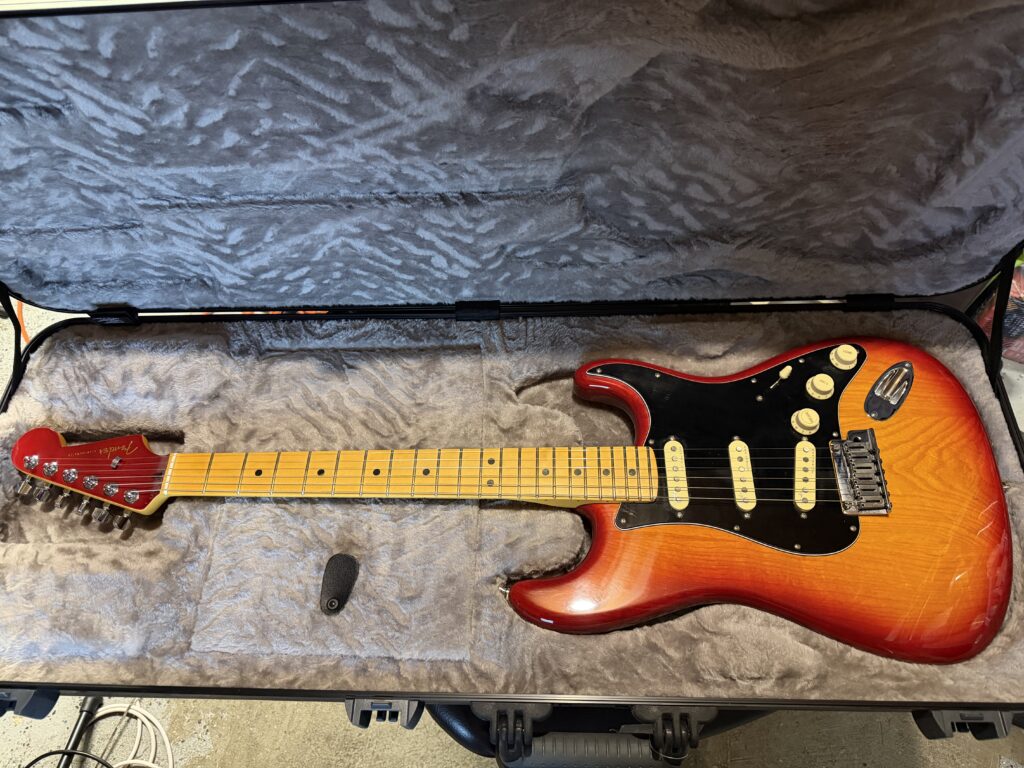
And I’d want the original molded case if possible.
None of this is particularly exotic.
It’s basically:
Check that the expensive used guitar you’re buying isn’t screwed up before you hand somebody a giant pile of money.
Groundbreaking consumer advice.
Who Should Buy This Thing?
I’d recommend it pretty enthusiastically to somebody who wants a Strat but isn’t necessarily obsessed with vintage correctness.
Especially if you:
- Play through a lot of pedals
- Hate single-coil hum
- Love stainless-steel frets
- Want modern neck ergonomics
- Use the tremolo
- Like locking tuners
- Want more pickup combinations
- Prefer a polished, predictable instrument
- Want a Strat you can just grab and play
And that last one matters more than it sounds.
Who Shouldn’t Buy It?
If what you’re chasing is the most authentic old-school Strat experience possible, this probably isn’t your guitar.
There are better choices for that.
If you want vintage frets, vintage radius, traditional single coils and all the little peculiarities that accompany the vintage Fender experience, the Ultra Luxe may actually feel too civilized.
And I understand that.
Sometimes you want the ’68 Camaro.
Sometimes you want something with air conditioning that starts every morning.
Different mission.
The Shitty Verdict
I think the Fender American Ultra Luxe Stratocaster is one of those guitars that’s easier to appreciate after you’ve owned it for a while.
There wasn’t one giant revelation for me.
Instead, I slowly realized how often I picked the damn thing up.
That’s probably a better compliment anyway.
It’s comfortable.
It’s quiet.
It’s smooth.
It’s versatile.
It handles pedals beautifully.
The stainless frets feel fantastic.
The additional switching gives me useful sounds without turning the guitar into an electrical-engineering project.
And everything about it feels predictable in the best possible way.
My other guitars don’t need to worry.
I haven’t fallen out of love with personality.
Sometimes I want strange.
Sometimes I want vintage.
Sometimes I want something that fights back a little.
But sometimes it’s Sunday afternoon.
I don’t want drama.
I don’t want surprises.
I just want the keys to the Strat.
Final Shit Rating: 💩 out of 4
Excellent crap.
One poop because there’s remarkably little here for me to complain about.
It isn’t the cheapest Strat.
It isn’t the most historically accurate Strat.
It isn’t necessarily the Strat I’d hand somebody trying to recreate 1965 down to the last capacitor.
But as an actual guitar to own, play, plug into a ridiculous collection of pedals and repeatedly reach for?
It’s fucking fantastic.
The Fender American Ultra Luxe Stratocaster is my Sunday driver.
Smooth, comfortable, predictable and always ready to go.
And sometimes the best guitar isn’t the one that creates the biggest spectacle.
It’s the one you keep grabbing the keys to.

