


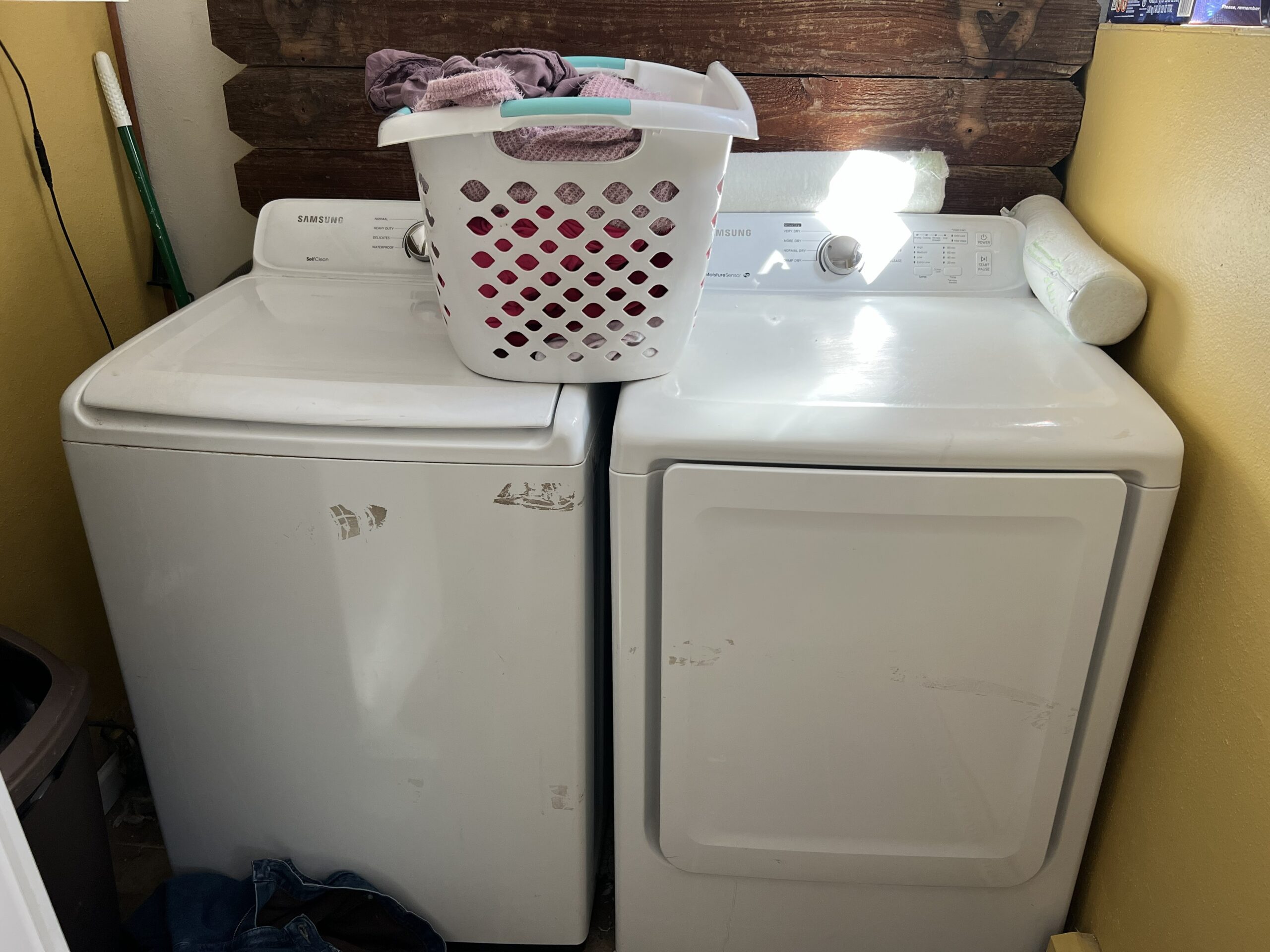
Our late-2010s Samsung top-loader survived 6½ years in a house that produces laundry like a small commercial operation. It wasn’t a bad washer. It just occasionally confused “large capacity” with “hostage situation.”
When we bought our late-2010s Samsung WA45-series washer, one feature stood out immediately:
The bastard was huge.
Our likely reference model, the Samsung WA45N3050AW, offered 4.5 cubic feet of capacity, eight wash cycles, five water-level settings, Self Clean, and Samsung’s VRT Plus vibration-reduction system. [ajmadison.com]
Coming from smaller washers, that cavernous tub looked wonderful.
Blankets?
Sure.
Dog bedding?
Throw it in.
A mountain of towels?
There’s room.
Giant comforter?
Hell, there’s still room for another pillow.
And that’s where we learned one of the more important lessons I’ve picked up reviewing appliances:
Being able to fit something inside a washer does not necessarily mean the washer is particularly enthusiastic about washing it.
For Ordinary Laundry, It Was Actually Pretty Good
Before I crap all over this machine, it deserves some credit.
We got 6½ years of use from it.
That’s important because this wasn’t a washer sitting in the laundry room of two adults who occasionally wash three shirts and a hand towel.
We have dogs.
Lots of dogs.
That means blankets, towels, bedding, clothes covered in fur, mysterious fabrics nobody remembers putting on the floor, and enough ordinary laundry to make our appliances earn their keep.
For most normal loads, the Samsung did exactly that.
Clothes went in dirty.
Clothes came out clean.
That’s not exciting, but washing machines occupy one of those rare professions where boring competence is actually a desirable personality trait.
Unfortunately, every once in a while we’d get ambitious.
That’s when the fun started.
The Great Comforter Negotiations
Samsung advertised the WA45N3050AW with VRT Plus technology, describing a tub and sensor system intended to help keep heavy loads balanced, even during high-speed spinning. [ajmadison.com]
Our comforter apparently never received that brochure.
Washing one could become an all-day diplomatic negotiation between the washer and a giant wet blanket.
It would wash.
It would drain.
It would attempt to spin.
Then apparently detect that something wasn’t quite right.
Rearrange.
Try again.
Nope.
Eventually we’d intervene, redistribute 700 pounds of soaking-wet bedding, and try again.
Sometimes this worked.
Sometimes the washer apparently looked at our suggestion and said:
“That’s adorable.”
Then we’d repeat the process.
A job that sounded wonderfully simple when standing in the appliance store could consume the better part of a day just getting through the spin cycle.
And afterward?
Congratulations.
Now you’ve got to dry the damn thing.
We’ll get to that machine separately.
It has crimes of its own.
Capacity Is One of the Most Misleading Appliance Numbers
This washer completely changed the way I look at capacity specifications.
The Samsung WA45N3050AW reference model had a 4.5-cu.-ft. tub. [ajmadison.com]
That’s useful information.
But usable capacity matters more.
A giant tub that accepts an enormous bulky item is only an advantage if the rest of the machine can successfully deal with what you’ve shoved into it.
That’s something appliance specifications don’t communicate particularly well.
We didn’t need to know:
Can the comforter physically enter the machine?
Clearly it could.
We needed to know:
Can this thing wash that comforter, drain it, balance it and spin enough water out of it without turning Saturday into a goddamn laundry-themed miniseries?
Those are two very different questions.
Six and a Half Years Later, The Pump Made the Decision for Us
Our Samsung didn’t gradually become useless.
It wasn’t constantly broken.
It wasn’t one of those appliances where you’re praying for death by year three.
It simply reached 6½ years old, and the pump failed.
At that point we investigated repairing it.
The economics were ridiculous.
The cost we were facing to repair the machine was more than buying another new Samsung washer made sense for us.
That’s a difficult moment with an appliance because six and a half years isn’t nothing.
The washer had performed thousands of cycles in a demanding household.
I could fix some things.
But eventually you have to ask the question every aging appliance owner encounters:
How much money do I put into this thing before I’m just buying my old washer again one replacement part at a time?
We chose retirement.
Was It a Bad Washer?
No.
And I want to be fair about that.
The Samsung was a solid appliance with caveats.
That’s substantially different from calling it junk.
It washed our clothes for 6½ years.
The large tub genuinely was useful with ordinary big loads.
Controls were straightforward.
We didn’t spend six years fighting constant breakdowns.
But buying another washing machine after only 6½ years wasn’t what we wanted either.
And the capacity had taught us an important lesson.
We stopped being impressed by big numbers.
For our next washer, we cared much more about whether the machine could consistently handle the laundry we actually produced.
Not whether the sales brochure could produce the biggest cubic-foot number.
That’s eventually part of what led us toward our much more expensive Speed Queen gamble.
Would We Buy It Again?
At the right price?
I wouldn’t call buying this Samsung a mistake.
It gave us 6½ years of legitimate service, and for the majority of that time it simply washed clothes without requiring us to think about it.
But knowing what we know now, I wouldn’t buy another washer primarily because it offered a giant tub.
That’s the part of this machine that fooled us.
Large capacity sounds like large capability.
It isn’t always.
Sometimes it means you can put an enormous comforter inside your washing machine and spend the next eight hours getting to know it personally.
And after 6½ years, when the pump finally decided it had washed its last dog blanket, so did we.
💩💩 The Crap Rating: 2/4 Poops
Flawed, but decidedly not full of crap.
Our Samsung washer was a decent machine.
Six and a half years of hard household use counts for something, and most days it did exactly what we paid it to do.
But troublesome bulky-load balancing, capacity that sometimes exceeded practical capability, and an eventual pump failure expensive enough to retire the machine keep it well away from one-poop territory.
2/4 Poops.
Good enough that I don’t regret owning it.
Flawed enough that when it died, we didn’t buy another one.
And somewhere, presumably, that goddamn comforter is still trying to reach the spin cycle.
