

Excellent Crap for Players Who Want Options
The Gibson Les Paul Traditional Pro V is what happens when somebody looks at a classic Les Paul and says:
“You know what this thing needs? More knobs that do secret crap.”
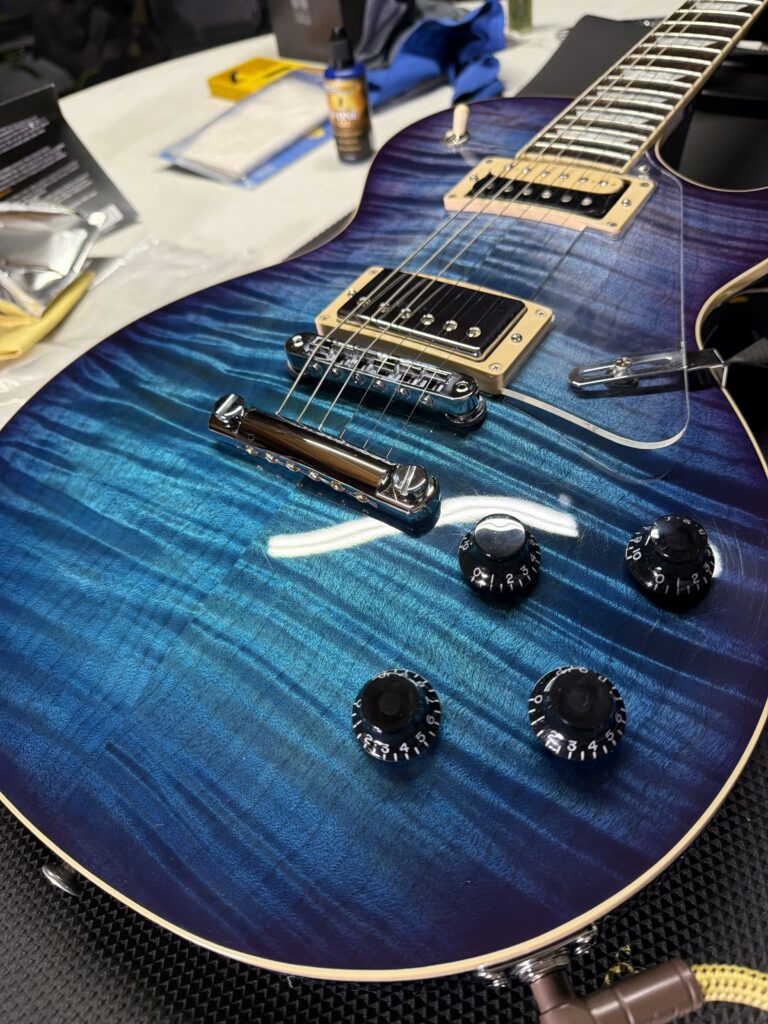
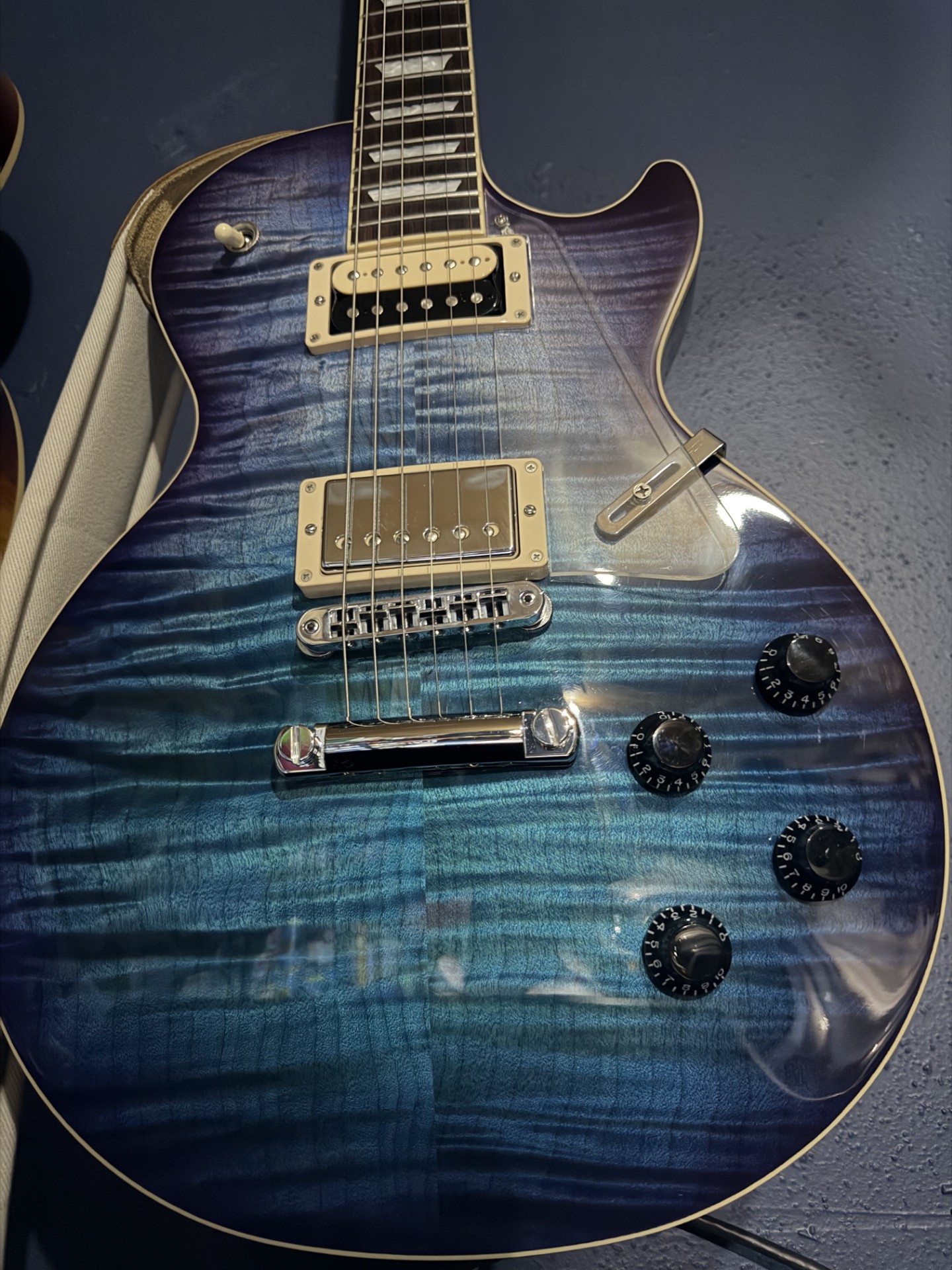
At first glance, it looks like a fairly traditional Les Paul. You get the mahogany body, carved AAA flame maple top, four familiar control knobs, and a gorgeous Blueberry Burst finish that can change dramatically depending on the light.
Then you start pulling those knobs.
Suddenly, you have coil splitting, coil tapping, phase reversal, inner and outer coil selection, high-pass filtering, and a bank of tiny DIP switches hiding beneath the control-cavity cover.
It is essentially a hot-rodded modern Les Paul disguised as a traditional one.
Thankfully, Gibson did not forget the most important part:
It still sounds and feels like a Les Paul.
The Crap at a Glance
The Traditional Pro V combines vintage-inspired Gibson construction with enough modern features to frighten a strict traditionalist.
The Blueberry Burst AAA Flame Top version includes:
- Mahogany body with nine-hole weight relief
- Carved AAA flame maple top
- Gloss nitrocellulose finish
- Set mahogany neck
- Bound rosewood fingerboard
- Asymmetrical neck profile
- Compound-radius fingerboard
- 22 frets
- Tradbucker pickups
- Four push-pull controls
- Five internal DIP switches
- Locking Grover tuners
- Nashville Tune-o-matic bridge
- Aluminum stopbar tailpiece
- Hardshell case
The result is a guitar that can cover classic rock, blues, hard rock, metal, funk, cleaner studio work, and some wonderfully weird experimental tones without requiring you to change instruments.
This is excellent crap, especially for players who have trouble leaving well enough alone.
A Little Les Paul History
The original Gibson Les Paul arrived in 1952 as a gold-finished solidbody built around what would become the familiar Les Paul recipe: a mahogany body, carved maple top, set neck, and separate volume and tone controls.
The design continued evolving throughout the 1950s. Humbucking pickups joined the Les Paul lineup in 1957, while the now-famous sunburst finish appeared in 1958. Those late-1950s instruments eventually became some of the most celebrated electric guitars ever built. [allgoodguitars.com], [en.wikipedia.org]
The Traditional Pro line came along much later as a collaboration between Gibson and Guitar Center. Its basic mission was to preserve the recognizable Les Paul foundation while adding practical features for working players.
By the fifth generation, Gibson had stretched the word Traditional nearly to its breaking point.
The Traditional Pro V AAA Flame Top retained the mahogany-and-maple construction, set neck, dual humbuckers, and classic four-knob layout. Underneath that familiar exterior, however, Gibson added an asymmetrical neck, compound-radius fingerboard, locking tuners, four push-pull controls, and configurable electronics.
The name may say Traditional, but this thing is really a modern player’s Les Paul wearing its grandfather’s good suit.
Construction and Build Quality
What This Crap Is Made Of
Mahogany Body and AAA Flame Maple Top
The basic recipe remains reassuringly Les Paul.
The mahogany body provides the familiar foundation, while the carved flame maple top gives the Blueberry Burst finish something worth showing off.
The AAA designation is primarily a visual grade, not a promise that every top will look identical. Some examples display broad, dramatic flames. Others have tighter figuring or appear more intense from certain angles.
That variation is part of the appeal of figured wood, but it means you should examine photographs of the actual guitar when buying one. Do not assume the catalog photo represents every example.
With this model, one person’s beautiful three-dimensional figuring may be another person’s disappointing blue pancake.
Traditional Nine-Hole Weight Relief
The AAA Flame Top model uses nine-hole weight relief rather than a heavily chambered body. Musician’s Friend lists the Blueberry Burst model with a mahogany body, flame maple top, and nine-hole relief. [musiciansfriend.com]
Do not let the words weight relief fool you into expecting an instrument that floats gently into your hands.
Many Les Pauls remain substantial guitars even after Gibson removes some mahogany. If weight matters to you, ask for the actual number before buying.
This is still a Les Paul, not a ukulele with anger problems.
Blueberry Burst Nitrocellulose Finish
The Blueberry Burst finish is one of the biggest reasons to want this particular version. The blue and purple edges frame the visible maple figuring without making the guitar look like another attempt at copying a 1959 sunburst.
It is distinctive without becoming obnoxious.
The gloss nitrocellulose finish also requires more care than many modern finishes. Nitro can develop scratches, polishing swirls, dull spots, checking, dents, discoloration, and general wear over time.
Some players call that patina.
Others call it the reason they inspect their guitar under seventeen different lights after every accidental bump.
Either way, nitro is not a museum display case. If you play the guitar, it will eventually show evidence that you played the guitar.
Asymmetrical Neck and Compound-Radius Fingerboard
The neck is one of the best features on the entire instrument.
Instead of copying a chunky 1950s profile or a uniformly thin 1960s neck, Gibson used an asymmetrical carve designed to provide support where your hand needs it while remaining relatively slim and comfortable.
The compound-radius rosewood fingerboard gradually becomes flatter toward the upper frets. That helps preserve comfortable chord work down low while making bends and lead playing easier higher up the neck.
Guitar Center and Musician’s Friend both list the asymmetrical mahogany neck and compound-radius rosewood fingerboard among the defining player-focused features of the model. [guitarcenter.com], [musiciansfriend.com]
For me, this is where the Traditional Pro V earns its keep. It still feels recognizably Gibson, but it plays more comfortably than many genuinely traditional Les Pauls.
It is a modern neck wearing vintage clothes.
Frets and Setup
The guitar has 22 modern or medium-jumbo-class frets, depending on how a retailer describes them.
Factory fret processing can provide an excellent starting point, but no production method guarantees that every guitar will arrive perfectly adjusted. Nut-slot depth, neck relief, fret finishing, bridge height, climate, shipping, and dealer preparation can all affect the final result.
Some examples play beautifully immediately.
Others need a setup before they stop fighting back.
That is not unusual for guitars, but it matters more at Gibson prices because nobody enjoys spending serious money and then discovering that the nut was apparently cut during somebody’s lunch break.
Electronics
The Secret Weapon of This Crap
Tradbucker Pickups
The Traditional Pro V uses proprietary Gibson Tradbuckers rather than the BurstBuckers frequently mentioned in questionable used listings.
The neck pickup is underwound for a warmer, clearer response. The bridge pickup is overwound to provide greater punch and output. Both use Alnico V magnets. [guitarcenter.com], [musiciansfriend.com]
In full-humbucker mode, they retain the weight and midrange you expect from a Les Paul. Start pulling knobs, however, and they become considerably more flexible.
The original visual presentation included uncovered zebra coils, giving the instrument a slightly more aggressive appearance than a Les Paul fitted with conventional nickel-covered pickups.
If you are evaluating a used example with covered pickups, verify whether the pickups or covers were changed.
Four Push-Pull Controls and Internal DIP Switches
At first glance, the Traditional Pro V has the same control layout Gibson has used for generations:
- Two volume controls
- Two tone controls
- Three-way pickup selector
That appearance is wonderfully deceptive.
All four knobs are push-pull controls, and internal DIP switches allow the player to determine how parts of the system behave.
Depending on the configuration, the guitar offers:
- Coil splitting
- Coil tapping
- Phase reversal
- Inner or outer coil selection
- High-frequency retention as volume is reduced
- Transient suppression
The two volume controls can be configured to split or tap their respective pickups. One tone control provides phase reversal, while the other helps select active coils in split mode. Guitar Center and Musician’s Friend document the split, tap, phase, and coil-selection functions. [guitarcenter.com], [musiciansfriend.com]
This is a ridiculous amount of tonal flexibility for a passive Les Paul.
It is either an inspiring playground or a magnificent way to spend forty minutes adjusting switches instead of practicing.
Coil Split Versus Coil Tap
These terms are routinely used as though they mean the same thing, but they do not.
A coil split disables one coil of a humbucker, producing a brighter and leaner single-coil-style sound.
A coil tap accesses a different point within a pickup’s winding, reducing its output and changing its response without simply shutting off one entire coil.
The Traditional Pro V can provide either behavior, depending on how its DIP switches are configured.
Many guitars offer a basic split and call it a day. This guitar apparently looked at that arrangement and decided there was not nearly enough crap to adjust.
Phase and Coil Selection
The phase function is most noticeable when both pickups are selected. It produces a thinner, more nasal and hollow sound by causing parts of the two pickup signals to cancel each other.
It is not a tone most players will use constantly, but it can be wonderfully distinctive in a mix.
When the pickups are split, the coil-selection function can change which coils remain active. Different inner and outer combinations alter the attack and frequency balance, giving you several variations on the guitar’s leaner tones.
Not every option will become part of your daily routine.
The useful part is that you can find the settings you like and forget about the rest until the next time you feel like crawling into the control cavity with a flashlight.
Printed Circuit Board and Quick-Connect Wiring
The Traditional Pro V uses a printed circuit board and quick-connect system rather than a completely traditional handwired harness.
That makes the complicated factory switching arrangement more organized, but it also makes the electronics less straightforward to diagnose, repair, or modify.
A conventional Les Paul harness can be rebuilt with standard pots, capacitors, wire, and some competent soldering. The Traditional Pro V has more specialized components and considerably more going on beneath the cover.
That does not automatically make it unreliable.
It simply means that if something does fail, troubleshooting may involve more than poking a soldering iron into the cavity and hoping for the best.
Hardware
The Practical Crap
Locking Grover Tuners
The locking Grovers make restringing faster and reduce the amount of string wrapped around each post.
They do not magically cure every tuning problem. On a Les Paul, nut friction, string installation, setup, saddle condition, and insufficient stretching can all cause tuning trouble.
Still, the locking tuners are a useful addition and suit the player-focused nature of the guitar.
Nashville Tune-o-Matic and Aluminum Stopbar
The Nashville Tune-o-matic bridge and aluminum stopbar are conventional, proven Gibson hardware.
The bridge provides individual saddle adjustment for intonation. The aluminum stopbar reduces some mass compared with heavier tailpieces without radically changing the familiar Les Paul arrangement.
No secret switches here.
Just hardware doing its job without demanding a meeting about it.
How Mine Has Held Up
I have owned my 2020 Blueberry Burst long enough for the honeymoon period to be over, and it remains one of those guitars that makes me happy whenever I open the case.
The finish still looks fantastic. The neck remains one of the most comfortable Gibson necks I have played, and the electronics continue to provide useful sounds rather than merely existing as brochure material.
I do not constantly change the internal DIP switches. Once you find the configurations that work for you, there is no requirement to keep fiddling with them like you are trying to launch a small aircraft.
The important thing is that the options are available when you want them.
Despite owning other guitars, this is one I continue returning to. The combination of traditional Les Paul tone, comfortable playability, and excessive electronic flexibility gives it a personality that is difficult to duplicate.
What’s Good
Polished-Turd Qualities
- Excellent neck design: The asymmetrical profile and compound-radius fingerboard make it exceptionally comfortable for a Les Paul.
- Huge tonal range: Full humbuckers, splits, taps, phase reversal, and coil selection cover considerably more ground than a conventional four-knob Gibson.
- Strong traditional foundation: Beneath the electronics, it remains a mahogany-and-maple, set-neck Les Paul.
- Distinctive appearance: Blueberry Burst over a figured maple top does not look like every other guitar hanging on the wall.
- Useful hardware: Locking Grovers, a Nashville bridge, and an aluminum stopbar create a practical factory package.
- Great recording flexibility: The switching options can help the guitar find space in a mix without changing instruments.
- No battery required: All this electronic nonsense remains passive.
- It encourages playing: This is the kind of crap that makes you pick up the guitar for five minutes and emerge two hours later wondering where your evening went.
What Sucks
The Steaming Bits
- It can still be heavy: Weight relief does not turn every example into a lightweight guitar.
- Individual examples vary: Setup, nut work, cosmetic execution, weight, and top figuring should be judged guitar by guitar.
- The electronics are complicated: Some players will love the options. Others will find one setting and never touch the switches again.
- Repairs may be less straightforward: The PCB, push-pull pots, connectors, and DIP switches create greater complexity than a traditional harness.
- Nitro requires sensible care: Certain stands, rapid temperature changes, and careless handling can leave permanent reminders.
- The angled headstock dislikes gravity: The traditional Gibson neck and headstock design requires more care around falls and impacts.
- Vintage purists may hate it: The asymmetrical neck, compound radius, locking tuners, PCB, and extensive switching are extremely modern features for something called Traditional.
None of these automatically ruin the guitar.
They are simply the steaming bits you should identify before handing over your money.
Important Nitro Stand Disclaimer
Full disclosure: Mine lives on a Hercules GS412B guitar stand despite every nitrocellulose warning on the internet trying to give me a heart attack. So far, I have not experienced any stand-related finish problems.
That is my personal experience, not a guarantee that every stand, every finish, every room, and every guitar will behave identically.
Check contact points periodically, keep the stand clean, and do not assume that a label saying “guitar stand” means every material touching your expensive nitro finish has been blessed by the Gibson gods.
If your guitar melts into your stand, please do not send me the repair bill.
Buying Advice
Inspect This Crap Carefully
The individual guitar matters with this model, especially when shopping used.
Check the headstock
Inspect the back of the headstock, the area around the nut, the truss-rod cavity, and the neck-to-headstock transition.
Look for cracks, finish lines, overspray, or signs of a previous repair.
A professionally repaired Gibson headstock can be structurally sound, but the repair should be disclosed and reflected in the price.
Check the nut and tuning
Listen for pinging noises while tuning. Test whether strings return to pitch after bends, and inspect the spacing and depth of the nut slots.
A great set of locking tuners cannot compensate for badly cut nut slots.
Check the frets and neck
Play every fret and listen for buzzing, choking, dead notes, or strange inconsistencies.
Confirm that the neck has reasonable relief and that the truss rod operates normally.
Test every electronic function
Pull every knob.
Test both pickups in every normal selector position, then verify the split or tap functions, phase reversal, and coil selection.
Remove the rear cover and confirm that the internal DIP-switch system is present and appears intact.
Verify the pickups
Original Tradbuckers used four-conductor wiring compatible with the factory switching system and were presented with uncovered zebra coils.
Do not automatically accept a seller’s claim that BurstBuckers, ProBuckers, or another Gibson pickup model is original equipment for a circa-2020 Blueberry Burst.
Inspect the finish
Look for:
- Stand-related discoloration
- Chemical reactions
- Finish checking
- Buckle rash
- Neck wear
- Overspray
- Dents and chips
- Evidence of structural repairs
Some finish wear is normal. Undisclosed damage is not.
Ask for the actual weight
Do not assume that nine-hole relief makes every example light.
Wood varies. Les Pauls vary. Backs complain.
Get the number.
Judge the actual top
AAA is not a magical spell ensuring that every guitar has identical flame.
Look at photographs from several angles and decide whether you like that specific top.
You are buying the guitar in the pictures, not the prettier one Gibson used in an advertisement.
Value of the Crap
The Traditional Pro V AAA Flame Top is one of the most feature-rich production Les Pauls Gibson has offered.
It is not a vintage reissue, and it is not trying to be a Custom Shop replica. Its purpose is different.
This is a Les Paul for somebody who wants the familiar construction, sound, and appearance without being limited to the usual two humbuckers and four conventional controls.
Players who only want a bridge humbucker, neck humbucker, and volume adjustment may find the electronics excessive.
Players who record, experiment, cover multiple styles, or simply enjoy discovering new sounds may find the guitar unusually valuable.
It can do almost everything short of making coffee.
Considering the number of controls, Gibson may simply have run out of room.
Final Thoughts
The Traditional Pro V is difficult to replace once you get used to it.
Many Les Pauls force you to choose between vintage authenticity and modern convenience.
This one mostly refuses to choose.
It looks right.
It feels right.
It sounds right.
Then it quietly offers a pile of extra tricks when you need them.
It is not perfect. It is still heavy. Nitro can scratch if you stare at it too aggressively. The electronics are more complicated than necessary, and if gravity gets hold of the headstock, you may be facing an expensive conversation.
But when I open the case and see that Blueberry Burst top staring back at me, those complaints become considerably less important.
This is excellent crap, and it is the kind of guitar you keep.
Poop Score: 💩
1 out of 4 Poops: Excellent Crap
The Gibson Les Paul Traditional Pro V AAA Flame Top in Blueberry Burst combines beautiful construction, modern playability, strong traditional Les Paul tones, and an almost absurd amount of passive electronic flexibility.
Its main drawbacks are the usual Gibson concerns: weight, nitro-finish sensitivity, setup variation, electronics complexity, and an angled headstock that should never be invited to meet the floor.
For players who want one Les Paul capable of covering an unreasonable amount of musical territory, this is outstanding crap.
Research and Further Reading
- Traditional Pro V AAA Flame Top specifications from Guitar Center [guitarcenter.com]
- Traditional Pro V specifications from Musician’s Friend [musiciansfriend.com]
- Overview of Gibson Les Paul history and model development [en.wikipedia.org]
- Guitar, gear and other related reviews can be found here