


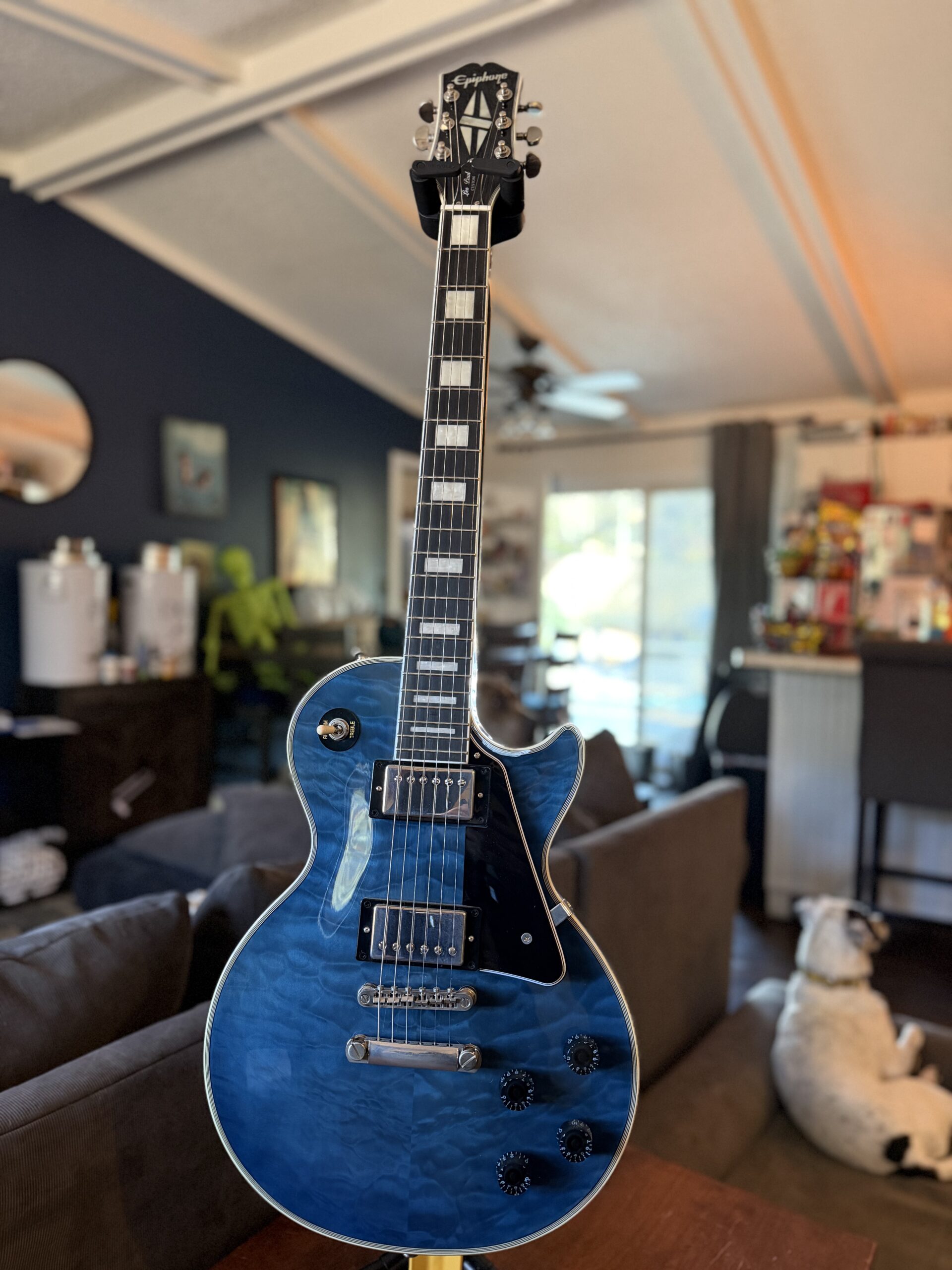
A Ridiculously Blue Les Paul Custom That May Have Already Slithered Away
There are guitars you buy because you need a particular sound.
There are guitars you buy because they fill some practical hole in the collection.
Then there are guitars you see and immediately start inventing reasons why owning another guitar is somehow a responsible adult decision.
My Epiphone Les Paul Custom Quilt Viper Blue falls pretty squarely into that third category.
This isn’t merely a blue Les Paul Custom. This particular version uses a quilted maple veneer beneath the Viper Blue finish, giving the top a shifting, almost three-dimensional appearance depending on the lighting. Archived listings identify examples as limited or exclusive models, including a 2024 Sweetwater-exclusive example carrying manufacturer part number EI-LPCFQVPBNH3. [reverb.com], [reverb.com]
Underneath all that fancy blue bullshit is a remarkably traditional guitar: mahogany body and neck, ebony fingerboard, SlimTaper neck profile, ProBucker humbuckers and classic Les Paul controls. [reverb.com], [reverb.com]
So is it merely a pretty Epiphone?
No.
After living with mine, I’d describe it as a legitimately good Les Paul that also happens to look like somebody trapped a tropical ocean underneath several coats of clear finish.
And I’m perfectly fine with that.
The Short Version
The Epiphone Les Paul Custom Quilt Viper Blue combines the traditional Les Paul Custom formula with one hell of a cosmetic makeover.
The documented specification includes a mahogany body, quilted maple veneer, set mahogany neck, SlimTaper profile, ebony fingerboard, 12-inch radius, 22 frets, 24.75-inch scale, Graph Tech nut, ProBucker 2 and 3 humbuckers, Grover Rotomatic 18:1 tuners and the traditional two-volume, two-tone Les Paul control layout. [reverb.com], [reverb.com]
It’s essentially a conventional Les Paul Custom wearing decidedly unconventional pants.
💩 Poop Rating: 1 Poop
Excellent crap.
Which Viper Blue Is This?
This distinction matters because searching for the guitar today can lead down a surprisingly confusing rabbit hole.
The guitar I’m reviewing is specifically the quilted-top Viper Blue model.
Archived listings describe the Epiphone Les Paul Custom Quilt Viper Blue as a limited or exclusive model. One 2024 example is identified as a Sweetwater exclusive, while another describes the model as having the distinctive quilted maple veneer over its mahogany construction. [reverb.com], [reverb.com], [reverb.com]
Meanwhile, documentation also exists for a Viper Blue Les Paul Custom under Sweetwater item ID ELPCVB, where the specification simply identifies a maple top rather than explicitly describing the quilted veneer of the guitar I’m reviewing. [sweetwater.com]
I haven’t found an authoritative Epiphone announcement formally declaring the Quilt Viper Blue discontinued, so I’m not going to claim that it is.
What I can say is that the quilted model now tends to show up in archived and used listings identified as a limited or exclusive variant. [reverb.com], [reverb.com], [reverb.com]
Welcome to guitar collecting, where apparently we need forensic investigators to determine exactly which blue Les Paul we’re looking at.
The Quilt: Completely Unnecessary and Absolutely Worth It
Let’s address the giant blue elephant in the room.
This thing is gorgeous.
The special ingredient is the quilted maple veneer. Documentation for the Quilt model specifically identifies that construction. [reverb.com]
And veneer is an important word here.
I’m not going to pretend that the spectacular figuring visible beneath the finish means there’s a huge slab of expensive figured maple underneath. The available documentation specifically calls it a quilted maple veneer. [reverb.com]
That’s not a criticism.
In fact, it makes perfect sense.
The veneer is primarily doing a visual job, and visually it accomplishes the absolute shit out of that job.
One thing I particularly like about mine is how much the appearance changes with lighting and viewing angle. The quilt can look fairly subtle one moment and far more dramatic the next.
That’s obviously a subjective observation from owning the guitar rather than something you’ll find on a specification sheet, but it’s a huge part of this particular model’s appeal.
The Les Paul Custom was already the overdressed member of the Les Paul family.
Binding.
Block inlays.
Fancy headstock treatment.
Glossy finish.
Lots of shiny crap.
It’s basically a Les Paul wearing a tuxedo.
Then somebody apparently looked at the tuxedo and said:
“Needs more blue tiger stripes.”
And somehow they were right.
Construction: Proper Les Paul Stuff Underneath the Fancy Crap
Fortunately, the appearance isn’t disguising bargain-basement construction.
The documented Quilt specification has a mahogany body and mahogany neck, along with an ebony fingerboard and the traditional Les Paul-style construction underneath that decorative quilt. [reverb.com], [reverb.com]
There’s a 24.75-inch scale, 12-inch fingerboard radius and 22 frets. [reverb.com]
None of this is revolutionary.
That’s precisely the point.
I’ve never wanted this guitar to reinvent the Les Paul. There was nothing fundamentally wrong with the recipe to begin with.
Give me the traditional construction, decent hardware, good pickups and an attractive finish.
Epiphone just happened to interpret “attractive finish” as:
BLUE. MAKE THE BASTARD REALLY BLUE.
Fair enough.
That Ebony Fingerboard
One specification I’ve particularly appreciated is the ebony fingerboard.
Documentation for the archived Sweetwater-exclusive example and other Quilt listings identifies an ebony board. [reverb.com], [reverb.com]
Paired with the block inlays, the dark ebony board works beautifully with the Custom aesthetic and the Viper Blue top.
The whole guitar has that deliberately overdressed Les Paul Custom vibe without looking like it’s desperately trying to impersonate something else.
It’s an Epiphone.
A very fancy Epiphone.
Nothing wrong with that.

Neck and Playability
The Epiphone Les Paul Custom Quilt Viper Blue uses a SlimTaper neck with the familiar 24.75-inch Les Paul scale and 12-inch radius. [reverb.com]
For me, that’s one of the reasons the guitar works so well.
It feels unmistakably like a Les Paul without saddling me with some enormous vintage baseball-bat neck.
Of course, it’s still a Les Paul.
No amount of blue quilt changes the basic ergonomic equation.
Anyone who fundamentally dislikes single-cut guitars, shorter scale lengths or traditional Les Paul body geometry isn’t going to be magically converted by Viper Blue.
It’ll just give you something gorgeous to complain about.
ProBucker 2 and 3: Don’t Replace Shit Just Because You Can
Epiphone equipped the guitar with a ProBucker 2 in the neck and a ProBucker 3 in the bridge, controlled by the traditional two-volume, two-tone arrangement and three-way selector. [reverb.com], [reverb.com]
And honestly, I’ve never understood the assumption that pickups need to be replaced merely because the headstock doesn’t say Gibson.
Guitar culture has conditioned us to believe that every factory pickup is just temporarily occupying space until UPS arrives with $400 worth of our latest bad financial decision.
My advice is simpler:
Play the damn thing first.
The ProBuckers belong here.
If someone dislikes their sound, pickups are replaceable. But there’s nothing about this guitar that makes an immediate pickup transplant some mandatory rite of passage.
Besides:
No batteries.
No app.
No Bluetooth.
No firmware update.
No account creation.
Move switch.
Electricity goes through wire.
Guitar makes noise.
Civilization survives another day.
Hardware: The Boring Stuff That Actually Matters
The archived specification includes Grover Rotomatic 18:1 tuners and a Graph Tech nut. [reverb.com]
Those aren’t glamorous features.
Good.
I don’t need my nut to be glamorous.
I need it to sit there doing its boring little nut job without pissing me off.
I’ve always been skeptical of automatically blaming tuners for tuning problems on Les Paul-style guitars. String installation, setup and the nut itself are worth investigating before throwing perfectly good Grovers into the parts drawer.
Sometimes the tuners aren’t the bastard.
Build Quality: Lots of Fancy Crap Means Lots to Inspect
The downside to an elaborate guitar is that there are more places for cosmetic imperfections to show themselves.
The body and neck binding, block inlays, headstock details, quilted top, hardware plating and gloss finish all give the guitar more visual complexity than something deliberately utilitarian.
On mine, that’s part of the appeal.
But it’s also exactly where I’d tell somebody considering a used one to pay attention.
I’d look particularly closely at:
- the binding
- fret ends
- nut
- finish around the edges
- quilt underneath the clear finish
- hardware
- electronics and controls.
That’s not because I’ve uncovered some epidemic of defective Viper Blue Les Pauls.
It’s simply because fancy guitars give manufacturers more opportunities to screw up fancy details.
Weight: Your Shoulder Has Entered the Conversation
A used 2024 Quilt example was documented at 3.93 kg, while another archived example was listed at 8 lb 10 oz. Those are weights for individual guitars, not an official weight specification for every Quilt Viper Blue. [reverb.com], [reverb.com]
That’s an important distinction because individual Les Pauls can vary.
I’d characterize mine based on how my guitar actually feels rather than pretending somebody else’s Reverb scale establishes the weight of every instrument Epiphone produced.
Still, nobody should approach a traditional Les Paul expecting something with the physical presence of a ukulele.
We’ve had decades to redesign the Les Paul into something more ergonomic.
Instead, guitarists collectively said:
“Nah. Looks cool.”
And bought another one.
Long-Term Ownership
One of my favorite things about this guitar is how fundamentally conventional it is.
Passive humbuckers.
Standard pots.
Traditional three-way selector.
Normal output jack.
Traditional Les Paul hardware.
I like guitars that don’t require a software-development team to remain functional.
The other reality of owning this particular finish is that it looks fantastic when clean.
Which leads naturally into the Viper Blue ownership cycle:
- Clean guitar.
- Admire guitar.
- Pick up guitar.
- Discover fingerprints.
- Swear.
- Clean guitar again.
- Repeat until death.
Apparently this is my life now.
Maintenance
Archived documentation lists.010-.046 strings for the Sweetwater example. [reverb.com]
Beyond normal setup, string changes, occasional fingerboard cleaning and keeping the hardware and finish reasonably clean, there’s nothing especially exotic about maintaining it.
And that’s another thing I like.
It’s fancy without being complicated.
My biggest practical recommendation with any Les Paul-style guitar is simple:
Use a proper stand and don’t lean the damn thing against things.
Gravity doesn’t care how pretty the quilt is.
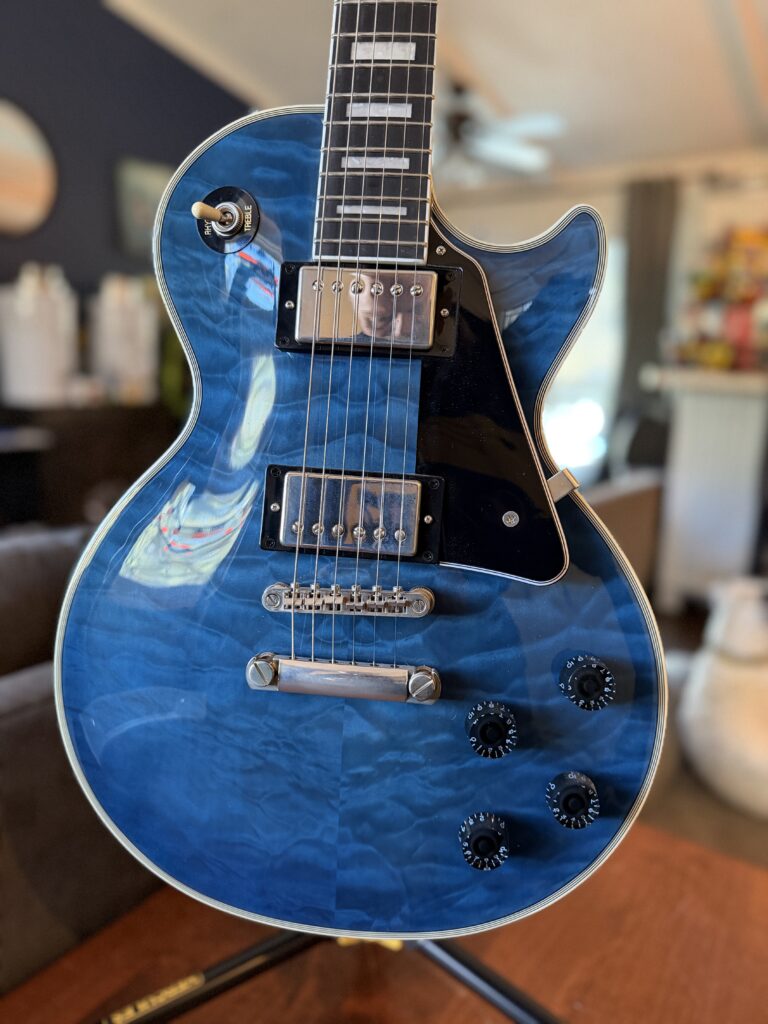
Is the Quilt Actually Better?
Sonically?
I’m not going to claim that.
I have no basis for saying the quilted veneer magically makes this guitar sound better than another properly constructed version with comparable electronics.
Visually?
Hell yes.
At least to me.
And that’s worth acknowledging because guitar reviews sometimes become ridiculous about this.
People buy guitars partly because they look cool.
We’ve always done that.
The quilt doesn’t need to contribute seventeen percent more sustain or improve harmonic resonance according to a laboratory full of scientists in white coats.
It makes the guitar distinctive.
It makes me want to pick it up.
That’s valuable enough.
Has the Quilt Viper Blue Disappeared?
Possibly from some regular retail channels, but I’m going to be careful with the wording.
Archived sources identify the quilted Viper Blue as a limited or exclusive model, including a 2024 Sweetwater-exclusive example and another 2024 Quilt described as an overseas-dealer exclusive. [reverb.com], [reverb.com]
Used and sold examples also continue to appear in secondary-market listings. [reverb.com]
What I haven’t found is a definitive statement from Epiphone saying:
“Yep, we discontinued the bastard.”
So I’m not going to make that up just because it creates a cleaner story.
For now, I think the fairest description is that the Quilt Viper Blue was sold as a limited/exclusive variant and doesn’t appear to be as straightforward to find new as a normal production model.
That also means anyone hunting for one should pay close attention to listings.
There are multiple Viper Blue configurations floating around.
Make sure you’re actually looking at the Quilt if that’s the one you’re after.
What Is One Worth Used?
This is another place where I’m reluctant to pull a number out of my ass.
Sweetwater’s used-price guide shows a suggested $519-$615 range for its Viper Blue Les Paul Custom category, but that listing is associated with the ELPCVB model and does not clearly establish that the range specifically represents the Quilt version. [sweetwater.com]
So I wouldn’t call $519-$615 the definitive market value of a Quilt Viper Blue.
Condition, exact version and availability matter.
I also wouldn’t automatically start screaming RARE COLLECTIBLE simply because the guitar isn’t sitting in every retailer’s inventory.
The used-guitar world has abused the word “rare” badly enough.
Eventually someone is going to list a three-pack of medium Fender picks as:
ULTRA RARE VINTAGE CELLULOID COLLECTION, INVESTMENT GRADE, NO LOWBALLS, I KNOW WHAT I HAVE.
Would I Modify Mine?
Only if something genuinely needed changing.
The stock guitar already gives me ProBucker 2 and 3 humbuckers, Grover Rotomatics, a Graph Tech nut and conventional Les Paul electronics. [reverb.com]
That’s not a parts list screaming for rescue.
Could I replace everything?
Of course.
Guitar players have an almost supernatural ability to purchase an $800 guitar, install $1,200 worth of upgrades and then explain that we saved money.
But I don’t see the point in replacing functioning parts simply for the privilege of saying I replaced them.
Mine works.
I’d rather play it.
Who Is This Guitar For?
For someone who wants a Les Paul Custom but doesn’t want another black, white or sunburst guitar, the Quilt Viper Blue certainly makes an argument for itself.
It has the traditional Custom attitude without being visually traditional at all.
It’s also for the person who sees that ridiculous blue quilt and immediately thinks:
Yep. That’s the bastard.
I understand.
That’s pretty much how guitars end up following me home too.
Who Should Skip It?
Anyone who already knows they dislike the fundamental Les Paul formula probably shouldn’t let the quilt hypnotize them.
It’s still a Les Paul-style instrument.
It still has the familiar single-cut body.
It still uses the shorter scale.
It still has four knobs.
It still represents an ergonomic philosophy originating from an era when apparently nobody possessed a rib cage.
There are lighter guitars.
There are more comfortable guitars.
There are cheaper guitars.
There are simpler guitars.
But there aren’t many that look quite like this.
Final Verdict
After owning the Epiphone Les Paul Custom Quilt Viper Blue, what I appreciate most is that the looks aren’t covering for an otherwise mediocre guitar.
The mahogany construction, ebony fingerboard, ProBucker 2 and 3 pickups, Grover tuners and Graph Tech nut give it plenty of substance underneath all that blue showing off. [reverb.com], [reverb.com]
I didn’t buy a spectacular top attached to a shitty guitar.
I got a legitimately good Epiphone Les Paul Custom that also happens to have a spectacular top.
And yes, let’s be honest:
That top is why we’re here.
The quilted maple veneer isn’t necessary.
Viper Blue isn’t necessary.
A Les Paul Custom isn’t necessary.
Owning multiple guitars capable of producing the same twelve notes sure as hell isn’t necessary.
And yet here we are.
That’s guitar ownership.
💩 Final Poop Rating: 1 Poop
Excellent Crap
My Epiphone Les Paul Custom Quilt Viper Blue takes a proven design, gives it respectable hardware and electronics, piles on the traditional Les Paul Custom appointments and then throws subtlety straight out the goddamn window with that quilted blue top.
It’s flashy.
It’s traditional.
It’s somewhat ridiculous.
It’s probably more guitar than I actually need.
In other words, I see absolutely nothing wrong here.
