


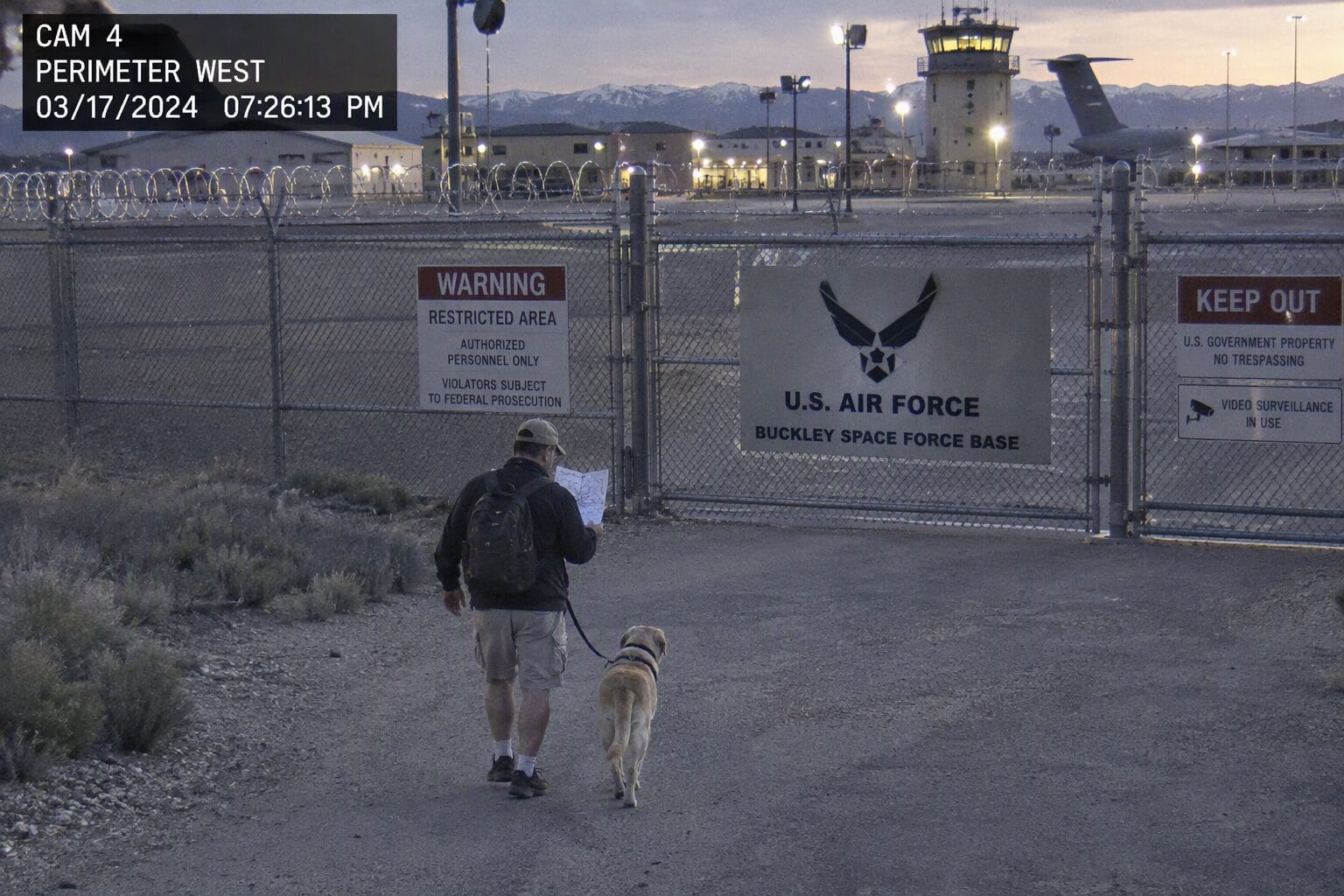
Friends later clarify he was supposed to make several assumptions not included on the map.
AURORA, CO — A Colorado man house-sitting for friends reportedly followed a hand-drawn map so literally that the excursion culminated in an interstate highway, a United States Air Force installation, military detention, and eventually a federal espionage conviction.
According to court records, the incident began innocently enough when the man agreed to watch a friend’s house and walk their dog.
Before departing, the homeowners provided a simple hand-drawn map.
The instructions were straightforward.
“Go down Alameda and turn on 1st Street.”
Authorities say this was the last point at which the situation could still be described as normal.
Investigators determined the man proceeded down Alameda exactly as instructed.
Then he began searching for 1st Street.
Sources close to the investigation confirmed he did not immediately encounter a road called 1st Street.
Undeterred, the man continued walking.
Witnesses say he remained committed to the mission for several hours.
Traffic cameras eventually recorded him crossing multiple intersections, several jurisdictional boundaries, and what experts later described as “numerous opportunities to ask for clarification.”
“He had a map,” explained one prosecutor. “Why would he ask questions?”
The man’s route ultimately led to Interstate 225.
Then beyond Interstate 225.
Then toward the secure perimeter of a United States Air Force installation.
Military personnel first became aware of the situation after observing a civilian and a confused Labrador repeatedly consulting what appeared to be a treasure map drawn on the back of a grocery receipt.
“The suspect kept talking about finding 1st Street,” stated one military police officer.
The officer paused.
“Unfortunately, 1st Street was nowhere near the base.”
Upon questioning, the man reportedly produced the map and explained that he was simply attempting to follow directions.
Federal investigators found the explanation suspicious.
“That’s exactly what a spy would say,” noted one official.
The map was entered into evidence.
Government analysts spent three weeks examining the drawing before concluding that it somehow raised more questions than it answered.
Among the concerns cited by investigators were a coffee stain covering half the route, a dog doodle of questionable scale, and a landmark labeled only as “that weird tree.”
Despite maintaining his innocence, the man was eventually convicted of espionage after prosecutors argued that no reasonable individual could accidentally wander that far while searching for a single street.
The dog was released without charges.
Public reaction shifted dramatically after the conviction when the homeowners finally clarified what they actually meant.
“Oh,” said one friend. “We didn’t mean an actual street called 1st Street.”
The revelation stunned onlookers.
“What did you mean?” asked reporters.
“The first street,” the friend explained.
“The first street after Alameda.”
Additional questioning revealed this critical information had never appeared on the map.
Nor had it ever been verbally communicated.
Nor had anyone considered it necessary.
Friends insist the intended route was obvious.
“You know,” explained another homeowner. “When we wrote ‘turn on 1st Street,’ we meant turn on the first street you come across. Everybody knows that.”
Legal scholars immediately described this defense as “less than ideal.”
At press time, the convicted man was reportedly still attempting to explain that roads called “1st Street” exist in many American cities and that following the written directions exactly seemed more reasonable than inventing entirely new directions on the fly.
Meanwhile, the friends had already begun drafting a new map for the appeal hearing that instructed him to, “Go past the big rock, take a left where the old Johnson place used to be, then keep going until it feels right.”

1 Comment
Pingback: All the News That’s Barely Fit to Print - ShouldIBuyThisCrap.com