


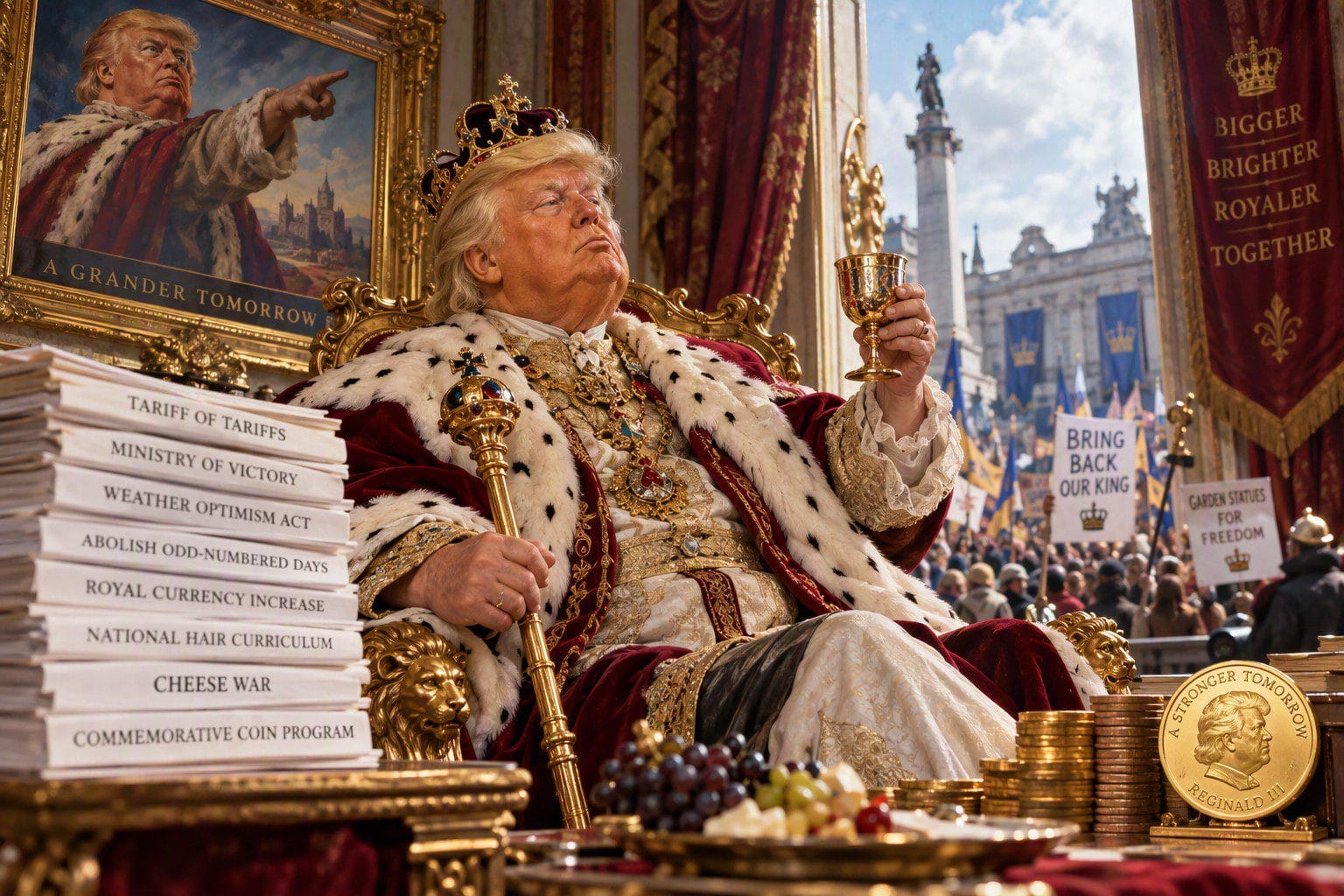
Experts say the kingdom’s succession plan failed to account for what happens when someone spends 70 years imagining how they’d run things.
KINGDOM OF WESTERMARSH — After waiting more than seven decades to inherit the throne, Prince Reginald III finally achieved his lifelong dream of becoming king at the age of 74, instantly becoming both the oldest first-time monarch in the kingdom’s history and the strongest argument against delayed gratification ever recorded.
“Most people wait that long for retirement,” said royal historian Edwin Thatch. “Reginald waited that long for absolute power.”
The new king entered office promising prosperity, stability, and common-sense governance.
Within six months, he had fired half the royal advisors, replaced the national bird with a more aggressive bird, and commissioned an eighty-foot portrait of himself pointing heroically toward something that palace officials later admitted had not been determined.
Officials described the portrait as “unsettlingly detailed.”
Supporters insisted the king was simply shaking up a stagnant system.
Critics pointed out that one of his first executive orders created the Ministry of Victory, whose sole purpose was declaring that any bad news was, in fact, good news.
The ministry’s first report described soaring food prices as “an exciting opportunity to explore fasting.”
The kingdom’s second report proudly announced that increasing unemployment proved citizens had finally achieved greater freedom from work.
After four chaotic years marked by economic instability, diplomatic incidents, and a three-month trade dispute over the proper definition of oatmeal, voters overwhelmingly removed Reginald from power.
Witnesses say the former monarch struggled with the outcome.
“He just kept insisting the kingdom had actually voted harder for him than anyone in history,” recalled one court official.
The dispute eventually culminated in thousands of loyal supporters marching on the Royal Assembly after Reginald urged them to “fight like the future of decorative garden statuary depended on it.”
Historians later described the uprising as “the least organized coup ever attempted.”
Several participants reportedly became lost while following enlarged royal maps that had been modified to make Westermarsh appear significantly larger than neighboring kingdoms.
The revolt failed.
Reginald lost the throne.
For a time.
Political observers assumed this would mark the end of the aging monarch’s career.
It did not.
Years later, frustration with the establishment, selective memory, and a surprising number of people saying “it couldn’t possibly be worse this time” propelled Reginald’s movement back into power.
Supporters celebrated.
Economists began stress drinking.
The king’s second reign quickly surpassed the first in both ambition and confusion.
Seeking to improve efficiency, Reginald abolished odd-numbered days.
The policy was reversed when engineers explained that calendars were not suggestions.
To combat inflation, he announced that the value of the kingdom’s currency had officially doubled.
Marketplaces declined to participate.
When weather forecasts predicted storms, he ordered royal meteorologists to adopt a more optimistic tone.
Hurricanes became “high-energy wind opportunities.”
Floods became “water-based growth initiatives.”
Droughts became “negative flooding events.”
The kingdom’s education system also underwent dramatic reform.
Students were required to memorize the complete history of Reginald’s hair.
Scholars described the curriculum as surprisingly short despite being taught over three semesters.
Meanwhile, foreign relations deteriorated.
The king launched disputes with neighboring kingdoms over trade routes, fishing rights, border markers, and, in one notable incident, a sarcastic editorial written by a newspaper located entirely outside his jurisdiction.
His most infamous conflict, the Cheese War, began after a neighboring duchy mocked royal economic policy.
Reginald retaliated by imposing sanctions on imported cheese.
The duchy responded by taxing crackers.
The resulting conflict lasted three years and left both nations poorer but substantially heavier.
As living costs rose, the king unveiled what advisors called his boldest economic proposal yet.
The Royal Tariff of Tariffs imposed taxes on imported goods, exported goods, domestically produced goods, and several categories of goods that did not yet exist.
Economists spent weeks attempting to identify the beneficiaries.
The answer was eventually determined to be “nobody.”
Despite worsening conditions, supporters remained fiercely loyal.
“You don’t understand,” explained one citizen while repairing a roof with scrap wood because lumber had become unaffordable. “Sure, my taxes tripled, my savings disappeared, and eggs are now considered a luxury item. But the king’s enemies are absolutely furious.”
Meanwhile, palace expenditures reached historic levels.
Records show increasing spending on private residences, ceremonial celebrations, gold-plated commemorative medallions, and a two-year government study examining whether official portraits of the king looked more regal with dramatic shadows.
The shadows won.
At press time, King Reginald had announced a new national recovery program requiring every household to purchase a commemorative gold coin honoring fiscal responsibility.
The coins cost three months’ wages, could not be exchanged for goods or services, and had already lost half their value before the ceremony concluded.
