


There are purchases you make because they’re exciting.
A new guitar.
A vacation.
A ridiculous television.
Maybe a new car.
Then there are purchases where you somehow find yourself standing in an appliance store contemplating spending several thousand dollars on machines whose primary purpose is cleaning your underwear.
Welcome to adulthood.
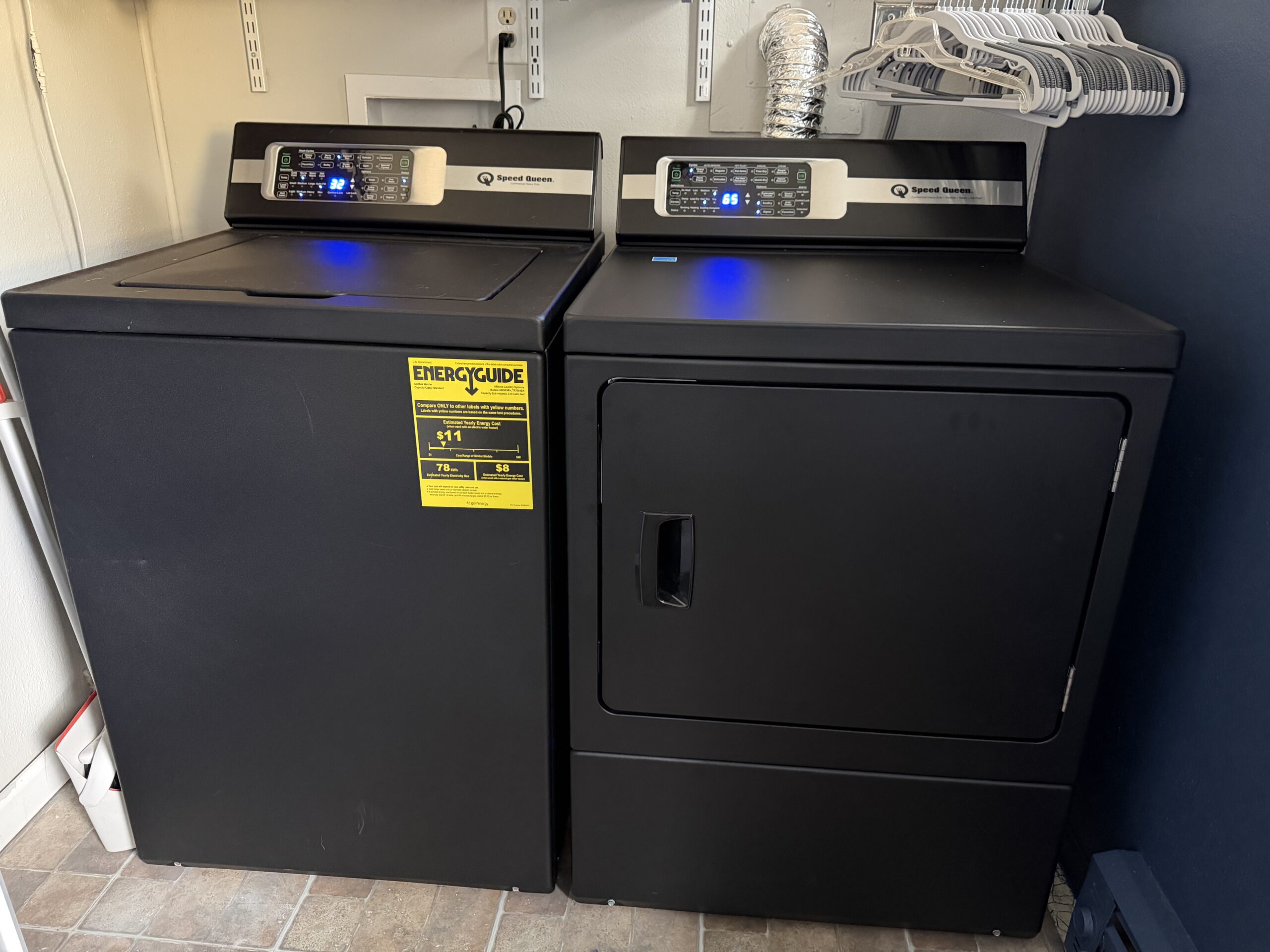
We recently bought the Speed Queen TR7 top-load washer and matching Speed Queen DR7 electric dryer.
These are not cheap appliances.
At current MSRP, Speed Queen lists both the white TR7006WN washer and DR7004WE electric dryer at $1,749 each, putting the pair at almost $3,500 before considering whatever deal you actually find. [speedqueen.com], [speedqueen.com]
That’s a lot of fucking money to move water into one metal box and remove it in another.
So why did we do it?
Because we weren’t really shopping for a washer and dryer for the next five years.
We were shopping for the washer and dryer we hope to still own decades from now.
And so far?
We fucking love them.
The Strange Thing Is How Well They Work Together
I’ve reviewed the TR7 and DR7 separately because each machine has its own strengths.
But owning them together has changed my opinion of the purchase.
The washer isn’t just good.
The dryer isn’t just good.
The whole laundry process is better.
That’s the part that didn’t really occur to me when we were shopping.
The TR7 washes clothes remarkably quickly.
Our fabrics come out feeling noticeably soft.
Then everything goes into the DR7, where it gets dried equally quickly, a bunch of the remaining dog hair gets captured, wrinkles barely seem to survive, and our permanent-press stuff sometimes looks like it just came back from the cleaners.
What comes out at the end isn’t simply:
Clean laundry.
It feels like our clothes are better cared for.
That was unexpected.
Unfortunately, the Machines Have Identified Us as the Bottleneck
This is probably my biggest complaint about owning the pair.
And it’s absolutely ridiculous.
They’re too fucking fast.
The TR7 finishes a load.
I move everything into the dryer.
Another load goes into the washer.
Then I start folding and putting away whatever was previously in the dryer.
Before I know it:
DING.
Here’s another goddamn load.
I’m still putting the first one away.
At some point we’ve stopped doing laundry and begun operating a small textile-processing facility.
The washer is ready.
The dryer is ready.
I’m standing there holding three folded T-shirts and wondering when I lost control of the operation.
We spent all this money upgrading the laundry equipment.
Apparently I’m the part that needs replacing.
The TR7’s Tiny Tub Isn’t Nearly as Tiny as I Feared
This was probably my biggest concern before buying the set.
On paper, the TR7 has a 3.2-cu.-ft. tub. That’s undeniably smaller than many modern top-load washers. It uses a stainless-steel wash tub, traditional agitator, 1-HP variable-speed motor and has a maximum spin speed of 820 rpm. [speedqueen.com]
When I first saw 3.2 cubic feet, I thought:
That’s it?
After actually using it?
It bothers me considerably less.
Would I stuff a giant king-size comforter in there?
Hell no.
I’m trying to wash bedding, not recreate a YouTube hydraulic-press video.
But we’ve successfully washed thinner king-size blankets in it.
Our everyday clothing, towels, sheets and normal household loads haven’t made us wish we’d bought some enormous washing machine instead.
The tub is smaller.
I’m not going to bullshit you about that.
But its practical capacity has been considerably less limiting for us than the specification suggested.
And because the washer finishes loads so quickly anyway, doing another load isn’t exactly a major hardship.
Quite the opposite.
Please stop giving me more laundry, Speed Queen.
Then the DR7 Gets Hold of Everything
This is where the pairing really starts making sense.
The washer may have a relatively compact tub, but the DR7 dryer has a 7.0-cu.-ft. cylinder. [speedqueen.com]
Everything coming out of the washer has plenty of room to tumble around.
And this dryer is damn good.
Our clothes dry quickly.
The moisture sensing has worked well for us.
Permanent-press items come out looking fantastic.
And there’s dramatically less of the twisted, wrinkled fabric origami that can make folding laundry such a pain in the ass.
That’s something I wasn’t really expecting from an expensive dryer.
I figured a dryer dried clothes.
Instead, I find myself looking at shirts coming out of this thing and thinking:
Did somebody press this?
I’ll take it.
The Dog-Hair Situation Has Improved
This was another big surprise.
We have dogs.
Therefore, according to the laws of nature, everything we own eventually becomes part dog.
Blankets.
Clothes.
Furniture.
Probably the furnace.
I assume there’s dog hair inside the walls.
The DR7’s Pet Plus features sounded nice when we bought it, but pet-specific modes are also exactly the kind of appliance feature that can turn out to be mostly marketing bullshit.
In our experience?
They’re useful.
Speed Queen specifically equips the DR7004WE with Pet Plus functionality and pet-hair-removal cycles. [speedqueen.com]
And we’ve noticed less dog fur making it all the way through the laundry process.
The lint filter has basically become a trophy case.
Every wad of fur I pull out of there represents dog hair that isn’t currently attached to my pants.
Victory.
Folding Laundry Is Actually Easier
This sounds like an incredibly boring thing to get excited about.
I don’t care.
It’s great.
Our permanent-press items are coming out of the DR7 with far fewer wrinkles than what we were accustomed to.
That means less shaking things out.
Less smoothing fabric.
Less trying to fold something that looks like it spent the previous 40 minutes wrestling an alligator.
Grab it.
Fold it.
Stack it.
Done.
Speed Queen also builds wrinkle-management features into the DR7, including Steam Refresh, Steam Boost and Extended Tumble. [speedqueen.com]
But the important part for this review isn’t that those features exist.
It’s that our clothes actually look better.
That’s the distinction between reviewing a specification sheet and owning the damn thing.
These Aren’t Particularly Flashy Appliances
And honestly?
I like that.
Neither machine feels like someone designed an app and then reluctantly attached a washing machine to it.
The TR7 still gives you a good amount of control. Speed Queen lists 16 preset cycles, four temperature selections, four load sizes and four soil levels, along with options including Pre-Wash, Extra Rinse, Soak, Favorites and Speed Cycle. [speedqueen.com]
The DR7 gives you the expected drying controls plus moisture sensing, steam functionality, Pet Plus and wrinkle-management features. [speedqueen.com]
There’s plenty to play with if you care.
But fundamentally, the workflow is still:
Put clothes in.
Select what you want.
Push button.
Go do something else.
Exactly how I want my relationship with a washing machine to work.
So Why Did We Spend This Much Money?
Here’s the real question.
Because if you’re comparing these machines exclusively on purchase price and capacity, they’re difficult to justify.
There are cheaper washers.
There are bigger washers.
There are cheaper dryers.
There are probably machines with considerably longer lists of flashy features.
We knew that before buying them.
We were making a different bet.
We’re betting on longevity.
Seven Years Wasn’t Actually the Number That Sold Us
Both the TR7006WN and DR7004WE are sold with seven-year warranties. [speedqueen.com], [speedqueen.com]
That’s impressive.
But seven years isn’t really the timeline we’re interested in.
Speed Queen explicitly says its TR7 is built for 25 years of life in the average home, while an authorized dealer describes the TR7006WN as tested to 25 years of household laundry. [speedqueen.com], [speedqueen…ential.com]
That’s the philosophy we bought into.
Not:
“Hopefully nothing breaks for seven years.”
More like:
“Let’s see if we can keep these damn things running for a quarter century or longer.”
That’s a completely different way of looking at appliance ownership.
We’re Not Expecting 25 Maintenance-Free Years
This part is important.
We aren’t expecting to install these machines and eventually pass them down to our descendants without ever calling a service technician.
That would be idiotic.
Machines wear.
Parts wear.
Things need adjustment.
Stuff needs cleaning.
Eventually something will probably break.
Our attitude going in is:
So fix it.
That’s actually part of our plan.
We intend to maintain these machines.
Service them when necessary.
Keep the dryer exhaust clean.
Take care of the washer.
Replace wear items when appropriate.
And when something eventually fails, our first instinct isn’t going to be:
“Welp, time for a new washer.”
Instead:
Buy the expensive bastards.
Maintain the expensive bastards.
Repair the expensive bastards.
Keep the expensive bastards.
That’s the experiment.
Because Cheap Appliances Aren’t Cheap If You Keep Replacing Them
This is where our purchasing logic really came from.
Imagine buying a cheaper washer and dryer.
Years go by.
Something significant breaks.
You call somebody.
They give you a repair quote.
You look at the age of the appliance.
You look at the repair cost.
And somebody eventually says:
“You know, at this point you’re probably better off replacing it.”
There goes another pile of money.
Another delivery.
Another installation.
Another old appliance hauled away.
Then you restart the clock.
We’re trying to opt out of that cycle.
Maybe we’ll succeed.
Maybe we won’t.
That’s the gamble.
If They Last 25 Years, the Math Gets Very Interesting
Here’s what I think people sometimes miss about expensive durable products.
Purchase price is only one measure of cost.
If we pay significantly more upfront but keep the machines for decades, while somebody else purchases multiple cheaper sets over the same general span, then suddenly our ridiculously expensive laundry equipment doesn’t look quite so ridiculous.
But there’s a giant IF attached to that.
They actually have to last.
We’re not giving Speed Queen credit in advance for 25 years of service we haven’t received yet.
That’s why I think these reviews are going to become more interesting over time.
Right now this is our initial ownership experience.
In a few years?
We can update it.
After seven years?
Did that big warranty ever matter?
Ten years?
What has actually broken?
Twenty years?
Are these damn things still downstairs terrorizing us with clean laundry faster than we can fold it?
That’s when we’ll know whether the gamble paid off.
What We Love About the Pair
They’re ridiculously fast.
Laundry no longer seems to spend half the day trapped somewhere between dirty and finished.
The clothes feel better.
We’ve noticed softer fabrics coming from the TR7.
Permanent-press items look fantastic.
Less wrinkling means easier folding and clothing that comes out looking remarkably polished.
The dog-hair situation has improved.
The DR7’s Pet Plus functionality has made a noticeable difference in our house.
They’re quiet and civilized.
The TR7 is officially rated at just 43 dB during agitation. [speedqueen.com]
They work well together.
The washer’s smaller tub hasn’t caused a problem feeding the larger 7.0-cu.-ft. dryer. [speedqueen.com], [speedqueen.com]
And most importantly:
Laundry is simply less of a pain in the ass.
That’s worth quite a bit.
What We Don’t Love
Let’s start with the obvious.
Holy shit, they’re expensive.
Current white-model MSRP puts the pair at nearly $3,500. [speedqueen.com], [speedqueen.com]
The TR7 washer also has that 3.2-cu.-ft. capacity. [speedqueen.com]
For us?
Fine.
For a huge family constantly washing bulky bedding?
That could legitimately be a deal breaker.
And despite all the talk about longevity, we don’t actually know yet how long ours will last.
Ask anybody selling you an expensive product and apparently every damn thing is designed to last forever.
Time gets the final vote.
Would I Recommend Buying Them Together?
Right now?
Yes, with one enormous qualification.
You need to value the same things we do.
If your priority is obtaining the largest washer and dryer possible for the least amount of money, this probably isn’t your set.
If your priority is having the latest appliance technology every four or five years, spending premium money on machines you hope to own for decades doesn’t make much sense either.
But if your thinking is closer to ours:
“Can I buy something really good, maintain it, repair it and keep the damn thing?”
Then the Speed Queen TR7 and DR7 become considerably more interesting.
The Shitty Verdict
So far, buying the pair has actually made more sense to me after owning them than it did when we paid for them.
Beforehand, this was mostly an expensive bet on durability.
Now we know something else:
They’re also really fucking good laundry machines.
The washer is fast.
The dryer is fast.
Our fabrics feel softer.
Permanent-press stuff looks fantastic.
Folding is easier.
There’s less dog hair surviving the process.
And the machines are so efficient at moving laundry through the house that the human beings have become the bottleneck.
That’s pretty compelling.
The durability question?
Come back in a couple decades.
We haven’t earned the right to answer that one yet.
Final Shit Rating: 💩 out of 4
Excellent crap.
One poop because together these two have done something I wasn’t expecting:
They’ve made laundry noticeably better.
Not exciting.
Let’s not get carried away.
I’m still folding underwear.
But faster washing, faster drying, softer fabrics, fewer wrinkles and less dog hair are improvements we actually notice every time we use them.
Now comes the real test.
We bought these machines with the intention of maintaining them and keeping them for 25 years or longer.
If we pull that off?
The price that looked ridiculous when we bought them may eventually look pretty damn smart.
If both machines shit themselves in eight years?
I’ll be right back here changing this rating.
That’s the deal.
Ask me again in 2051.
Hopefully I’ll be complaining that the same two Speed Queens still won’t give me enough time to finish folding.

1 Comment
Pingback: Major Household Appliance Reviews: Expensive Crap That Better Last - ShouldIBuyThisCrap.com