


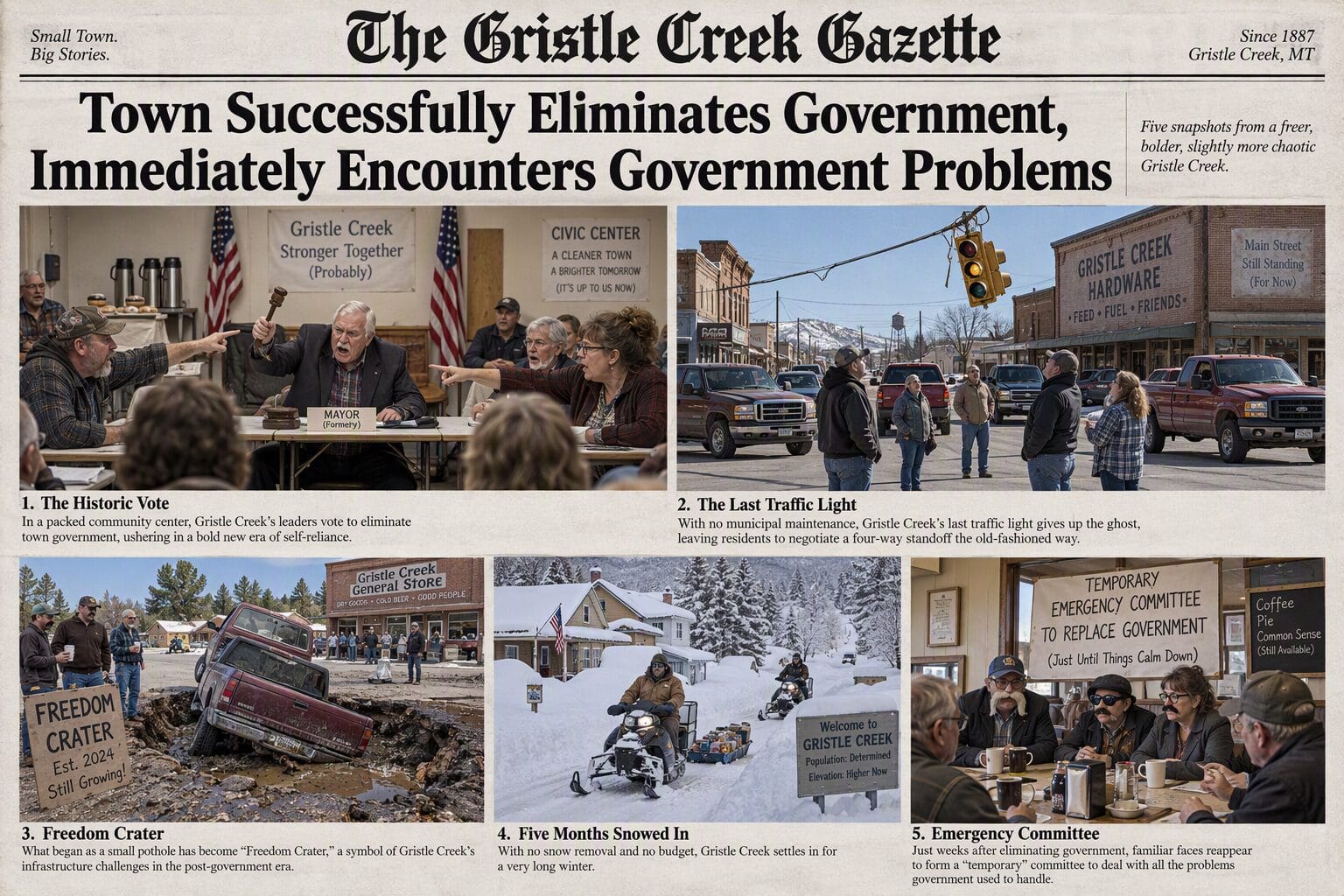
GRISTLE CREEK, MT — In what residents are calling “the most efficient local government action in living memory,” the Town of Gristle Creek voted Tuesday evening to abolish its own municipal charter following a seven-hour council meeting typically reserved for arguing about drainage ditches, unauthorized rooster ownership, and whether the town Christmas tree should continue leaning 12 degrees to the left.
The motion passed unanimously after council members discovered that eliminating the government entirely was the first proposal in decades that nobody immediately hated.
Witnesses described the vote as emotional.
“There was laughter, there were tears, there were threats,” recalled longtime resident Harold “Buck” Farnsworth, age 74. “One councilman called another one a useless sack of shit. The other guy thanked him for his years of service. It was honestly kind of beautiful.”
Attendees confirmed that as the meeting adjourned, roughly as many “fuck yous” were exchanged as “goodbyes.”
Political analysts say the ratio represented an unusually high level of civic unity.
Town records indicate Gristle Creek spent the previous five years deadlocked over virtually every issue imaginable, including speed limits, potholes, fireworks regulations, town signage, dog leash requirements, and whether the annual catfish festival should continue allowing a competitive grilling division.
The final straw came when a three-hour debate over replacing a broken stop sign ended exactly where it began.
“We spent eight months trying to determine which side of Main Street a trash can should be on,” former mayor Clayton Bender told reporters while loading municipal office furniture into the back of his pickup. “Eventually somebody asked what exactly we were accomplishing here and there was just this long silence.”
Sources say the chamber remained quiet for nearly thirty seconds before someone responded, “Mostly resentments.”
The room erupted in applause.
Life Has Improved Dramatically, Residents Say
Several months after government dissolved, most residents report being largely satisfied with the arrangement.
“My taxes are way lower,” said local mechanic Darla Jenkins. “Sure, the traffic lights stopped working and nobody knows who fixes them now. But honestly they weren’t working all that well before.”
Others expressed similar optimism.
“The roads are terrible,” admitted resident Rick Pomeroy while carefully navigating what experts initially mistook for an artillery impact zone. “But they were terrible under government too, so I’d call that statistically unchanged.”
Transportation officials estimate deterioration accelerated shortly after the town ceased maintaining streets.
Within weeks, several roads reportedly began resembling lunar geography.
Children have since begun naming larger potholes.
The biggest, known locally as “Freedom Crater,” is believed to contain at least one pickup truck, a riding mower, and part of the former public works department.
Winter Presented Minor Challenges
While most citizens praise the lower tax burden, the first winter following dissolution revealed several administrative gaps.
Specifically, nobody remembered to arrange snow removal.
“We got about four feet of snow in November and that was kind of the end of transportation,” said resident Janice Holloway.
Asked how long residents remained stranded, Holloway paused.
“Until April, more or less.”
Records indicate the town became inaccessible for nearly five months after residents collectively assumed someone else would eventually plow the roads.
Nobody did.
Residents adapted by sharing supplies, checking on neighbors, and converting three detached garages into unofficial trading posts.
One entrepreneur reportedly accepted venison, batteries, and two snowblowers in exchange for a gallon of milk.
“It sounds bad,” said Holloway, “but for Gristle Creek that’s actually one of our better winters.”
Emergency Services Continue Operating Through Vague Mutual Understanding
Despite concerns from outside observers, emergency response remains surprisingly effective.
“If somebody’s house catches fire, everyone just sort of shows up,” explained former volunteer firefighter Eddie Krantz.
“And if nobody shows up?”
“Then it’s probably not that important of a fire.”
The arrangement has proven popular among residents, who appreciate the reduced bureaucracy.
In one recent incident, a fallen tree blocked Oak Street for three weeks before three retirees removed it using a tractor, a logging chain, and what authorities described as “unearned confidence.”
Experts Unsure Whether Town Has Failed Or Achieved Perfection
Political scientists studying Gristle Creek remain divided on whether the community represents a governmental collapse or an unexpectedly successful experiment in self-governance.
Researchers note that citizens maintain roads poorly, enforce laws inconsistently, possess no official budget, and no longer have any functioning municipal departments whatsoever.
On the other hand, residents appear happy.
Crime remains low.
Taxes are nearly nonexistent.
Council meetings have been reduced from weekly occurrences to zero.
“Honestly, we’re seeing higher public satisfaction than before,” admitted one university researcher. “The biggest complaint people have now is the roads, and they were already complaining about the roads.”
At press time, former town officials were reportedly discussing whether they should recreate municipal government to address worsening infrastructure before the conversation devolved into shouting and ended with unanimous agreement that doing absolutely nothing remained the safest option.
