


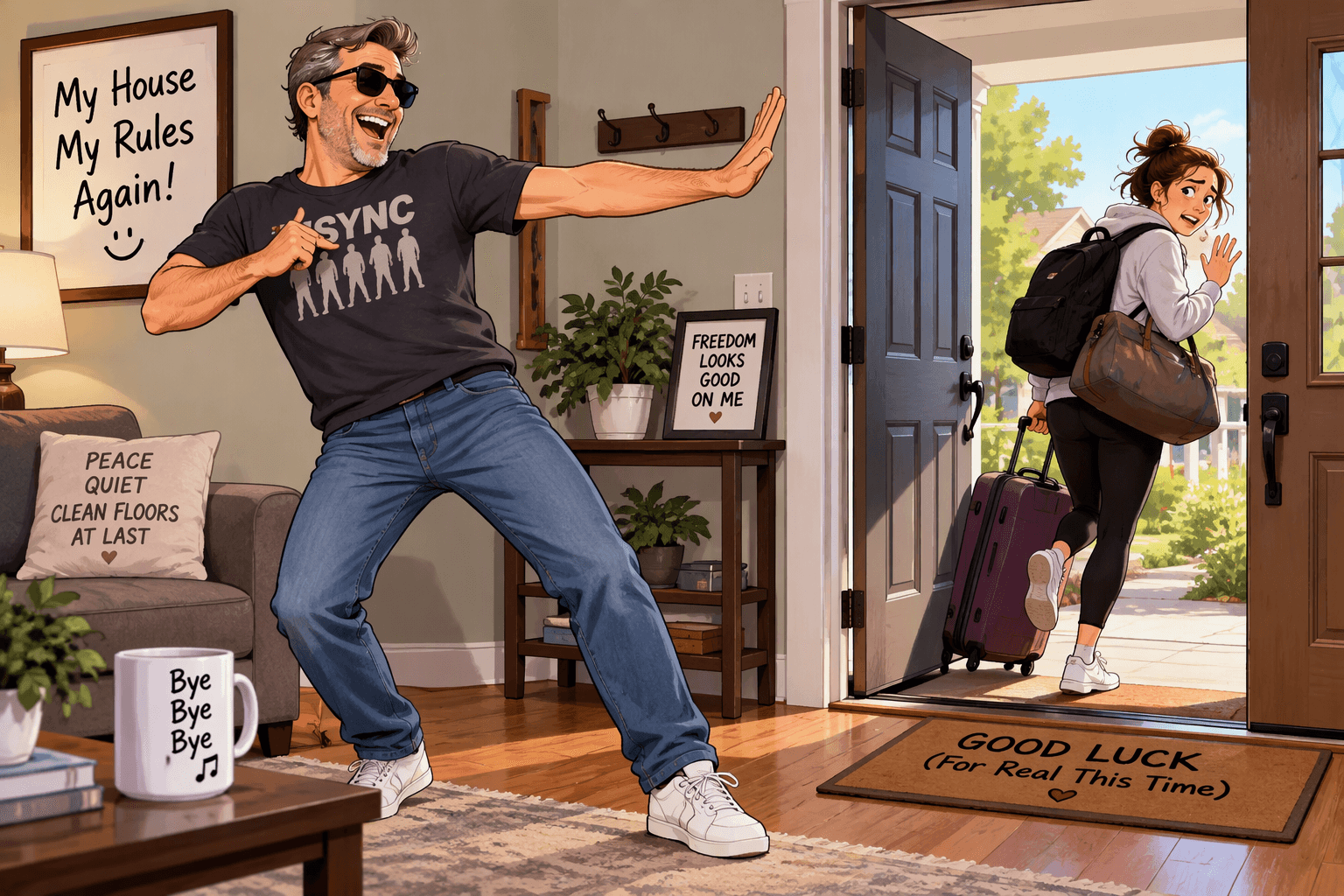
“I spent 25 years thinking this song had no purpose,” local man reports.
WOODLAND PARK, CO — After decades of dismissing late-’90s boy-band music as a regrettable cultural accident that should have been buried alongside dial-up internet and frosted tips, local man Joseph has reportedly developed a profound new appreciation for the genre after discovering that playing “Bye Bye Bye” causes his niece to rapidly vacate whatever room she is occupying.
“I was completely wrong about this song,” Joseph said, watching his niece disappear down a hallway approximately eight seconds after the music began. “For years, I judged it strictly on its artistic merits. I never stopped to consider its usefulness.”
According to Joseph, the breakthrough occurred accidentally when he noticed that his niece reacted to the *NSYNC song with an intensity normally reserved for smoke alarms, dental drills, and adults asking teenagers how school was.
“At first I thought she was just going to complain about it,” he said. “Then she actually left. That’s when I realized we weren’t dealing with entertainment anymore. We were dealing with a tool.”
Joseph said the discovery has completely changed the way he evaluates music.
“Most songs don’t actually do anything,” he explained. “You listen to them. Maybe you enjoy yourself for four minutes. Then the song ends and you’re left with the exact same number of people in the room as when it started. Frankly, that’s pathetic.”
“Bye Bye Bye,” by comparison, produces measurable results.
Joseph claims the track requires no installation, batteries, chemicals, complicated setup, or expensive monthly subscription. Users simply locate the song, press play, and allow late-1990s pop production to take its natural course.
“It’s remarkably simple,” he said. “I don’t have to argue. I don’t have to get aggravated. I don’t even have to ask anyone to leave. Justin Timberlake handles it.”
The discovery has led Joseph to reconsider other songs he may have unfairly dismissed over the years, acknowledging that music critics have traditionally focused far too heavily on meaningless characteristics such as melody, lyrics, originality, musicianship, and cultural significance while virtually ignoring practical household applications.
“We need to stop asking whether a song is ‘good,’” Joseph said. “That’s primitive thinking. The question is: What can this thing do?”
Researchers have proposed an entirely new classification system in which songs would be rated according to Room-Clearing Efficiency, Repeatability, Operator Enjoyment, Range, and Effectiveness Against Specific Family Members.
Under the proposed system, a technically excellent song that merely sounds pleasant would receive a mediocre score, while an irritating novelty song capable of ending an unwanted visit could potentially achieve coveted Utility Grade status.
Joseph said “Bye Bye Bye” performs particularly well because repeated use has created an unexpected secondary benefit: he now genuinely loves the song.
“That’s the beautiful part,” he said. “Originally, I figured we’d both be suffering. I just knew I could suffer longer.”
“But somewhere along the way, I started liking it.”
His niece, meanwhile, reportedly remains convinced that refusing to tolerate the song constitutes a form of protest, apparently unaware that this is precisely how the device works.
At press time, Joseph was said to be researching whether Hanson’s “MMMBop” could safely clear an entire floor.
