


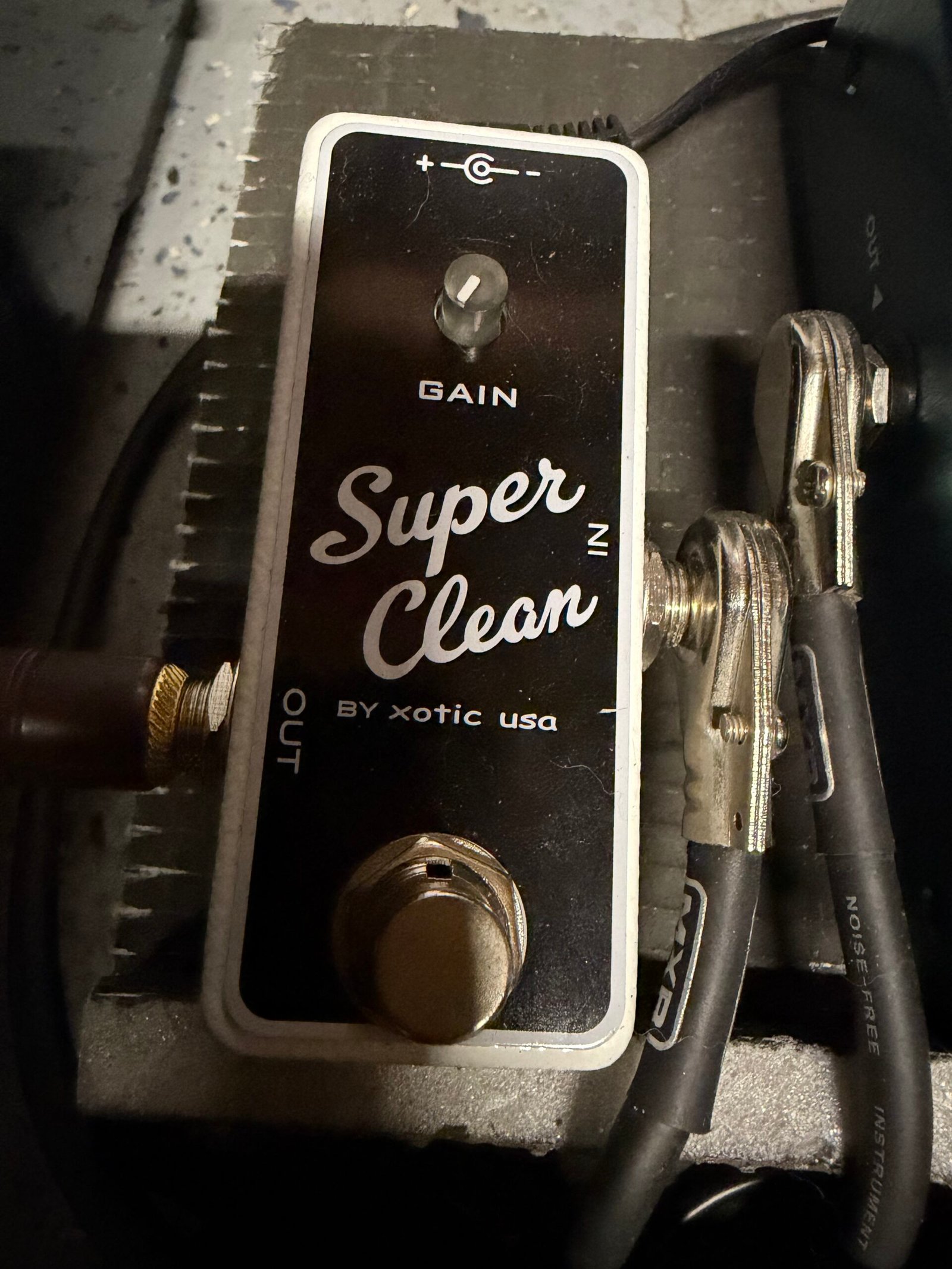
Some guitar pedals are designed to completely change what your guitar sounds like.
The Xotic Super Clean Buffer does something I might like even more.
It makes my guitar sound more like my guitar.
That’s a weird thing to spend money on until you actually hear it.
The first time I really started appreciating what this little pedal was doing, it wasn’t because I’d suddenly discovered some wild new effect. There was no wall of distortion, no swirling modulation and no delay bouncing around the room.
The guitar just sounded alive.
Notes seemed to jump out more clearly. Little changes in picking had more definition. Chords had that articulation where you could actually hear the individual strings doing their jobs.
Turn things up the right way and this little box can make a guitar damn near sing like a harp.
And once you’ve experienced that, turning it off can feel strangely disappointing.
What the Hell Does a Buffer Actually Do?
Buffers might be one of the least exciting things anybody has ever tried to sell a guitarist.
“Check this out. It makes my signal more signal-y.”
Fantastic.
Where do I swipe the credit card?
But there’s a legitimate reason these things exist.
A guitar signal traveling through cables and a collection of pedals can lose some of the character you heard when you plugged straight into the amp. The bigger and more complicated the signal chain becomes, the more relevant that problem can become.
The Xotic Super Clean is designed to combat exactly that sort of loss.
And you don’t need an enormous pedalboard that looks like the control room of a nuclear submarine to appreciate it.
Sometimes what I want is simply a strong, articulate guitar signal reaching the amp.
That’s where this thing shines.
Put It at the End and Let It Do Its Thing
One of the simplest ways I like using the Super Clean is toward the end of the chain.
After everything else has had its opportunity to stomp on, distort, delay, compress, wobble and otherwise abuse my guitar signal, the Xotic gets the final word.
And its final word is basically:
Clean this crap up.
That’s the beautiful thing about this pedal. It doesn’t need to announce itself.
You can use it as the quietly competent little box at the end of the board helping maintain a strong signal, and that’s reason enough to own one.
But stopping there would miss half the fun.
Or Turn It Up and Make the Guitar Sparkle
This is where I really fell for the Super Clean.
It’s not just a utility box.
The pedal gives you a gain control with up to +12 dB of clean boost, which means you can go beyond simply preserving your signal and start using the pedal to bring more life and presence out of the guitar.
The difference can be surprisingly dramatic without sounding like you’ve thrown another “effect” over everything.
That’s what I love about it.
Instead of thinking, I like what this pedal sounds like, I find myself thinking, Damn, my guitar sounds good.
There’s a difference.
Pick softly and you can hear that delicacy.
Dig into the strings and they answer.
Play something where individual notes need to ring through and suddenly all those little differences in articulation become much more obvious.
That’s what I mean when I say it can make a guitar sing like a harp.
It isn’t literally turning your Les Paul into something an angel carries around.
It just has a wonderful way of letting the articulation and sparkle already present in your playing come forward.
Four Little Switches Give You More Control Than You’d Expect
For something this simple, Xotic actually gives you a surprising amount of control.
On the side are four DIP switches for shaping the frequency response. You’ve got options involving the highs, high mids, low mids and bass.
That means you’re not locked into one definition of “clean.”
You can adjust the character of the pedal to better suit the guitar, amp and rest of the board.
That’s especially useful if you’re somebody like me who wants the buffer to complement the guitar rather than announce, HELLO, I AM NOW PROCESSING YOUR GUITAR SIGNAL.
The entire appeal of this pedal is subtlety.
It’s Tiny, Which Is Exactly How a Buffer Should Be
Another thing I appreciate is the size.
Pedalboard real estate is valuable.
I’m not giving up half the board for something whose primary job is making everything else behave better.
The Super Clean is narrow, simple and easy to squeeze into a crowded setup.
That’s exactly what I want from a utility pedal.
It should earn its spot without demanding its own zip code.
Buffered Bypass Makes It Even More Useful
There’s another clever feature hiding inside the pedal.
The Super Clean can be configured for either true bypass or buffered bypass.
Buffered bypass means the buffer can remain active even when the effect itself is switched off.
That’s a wonderfully practical option because sometimes I don’t necessarily want the boost or tonal adjustment I’m using when the pedal is engaged.
I just want the buffer doing its boring little job in the background.
And boring little jobs are important.
Ask the power supply.
This May Be the Pedal You Didn’t Know You Needed
Nobody starts playing guitar dreaming about buffers.
We start dreaming about wah pedals and distortion and delays and gigantic amplifiers that could sterilize a squirrel at 200 yards.
Then eventually you build a pedalboard.
And add some cables.
And some more pedals.
And some more cables.
Then one day you plug straight into your amp and wonder why everything suddenly sounds so immediate again.
That’s where something like the Xotic Super Clean starts making sense.
It isn’t adding another crazy effect to your board.
It’s helping everything you’ve already spent money on do its job.
What I Like
The list is pretty straightforward:
- It can help maintain a strong signal through a pedalboard.
- It gives me up to +12 dB of clean boost when I want more.
- It can add wonderful clarity and articulation without taking over my sound.
- The external EQ switches provide useful tone shaping.
- It can operate with buffered or true bypass.
- It’s tiny.
- It’s simple.
- It makes guitars sound fantastic.
That last one is why it stays on my board.
What I Don’t Like
Honestly?
Not much.
If you’re expecting this thing to transform your entire rig into something completely different, you’re shopping for the wrong pedal.
Go buy a fuzz pedal. Those things will happily turn your expensive guitar into an angry chainsaw.
The Super Clean is about refinement.
And because the difference can be subtle depending on your guitar, cables, amplifier and pedalboard, I can understand somebody with a very simple setup plugging one in and wondering what all the fuss is about.
That’s fair.
But once you’ve got a longer signal chain, or you start using the boost and EQ options to bring out a little more life and articulation, its usefulness becomes much easier to appreciate.
So, Should You Buy This Crap?
I think the Xotic Super Clean Buffer is one of those pedals almost every serious pedalboard could find a use for.
That’s not because it does a hundred things.
It’s because it does a few extremely useful things without getting in the way.
Leave it quietly buffering your signal.
Use the clean boost to wake things up.
Adjust the EQ switches until your favorite guitar gets that extra little bit of sparkle.
Or do what I sometimes do and use the thing to bring out so much articulation that individual notes seem to leap from the strings.
There are pedals on my board because I want distortion.
There are pedals because I want delay.
There are pedals because apparently grown adults can never own enough different ways to make an electric guitar sound ridiculous.
The Xotic Super Clean is there for a different reason.
It makes me want to hear the guitar.
And for a tiny pedal that doesn’t have a single ridiculous effect hiding inside it, that’s one hell of an accomplishment.
