


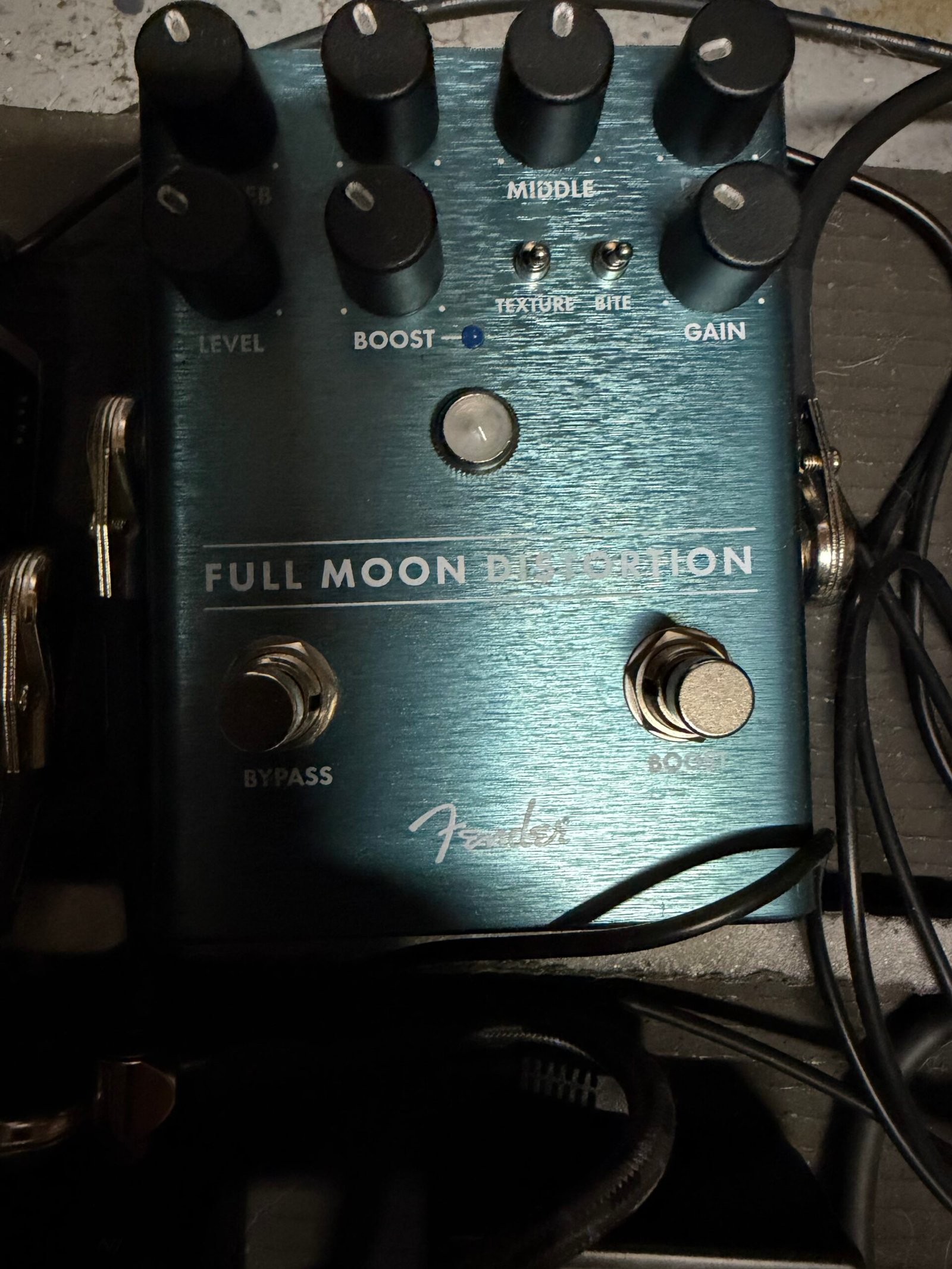
Some distortion pedals have three knobs.
The Fender Full Moon looked at those pedals and apparently thought they weren’t trying hard enough.
This thing looks less like somebody designed a distortion pedal and more like Fender was attempting to launch a small spacecraft.
There are knobs.
There are more knobs above those knobs.
There are switches between the knobs.
There are two footswitches.
There are enough options here that I’m reasonably certain NASA could have landed Apollo 11 with fewer controls.
And I absolutely love the ridiculous thing.
Because the Full Moon isn’t just a pedal that makes your guitar dirty.
It can make your amplifier feel like an entirely different amplifier at the push of a switch.
This Thing Is Practically an Extra Amp Channel
That’s what makes the Full Moon interesting to me.
If you’re starting with a relatively simple amplifier, suddenly you’ve got an enormous amount of additional control over your distorted sound.
Instead of simply choosing how much distortion you want, you can start sculpting the character of the entire thing.
Bass.
Middle.
Treble.
Even more control over the high treble.
Gain.
Level.
Texture.
Bite.
And then there’s a boost.
Jesus, Fender.
Leave some knobs for everybody else.
But there’s a reason all that stuff is here.
A basic distortion pedal gives you a distorted version of your amp.
The Full Moon can create something that feels considerably more like an alternate channel you’ve bolted onto the front of it.
That’s a much more interesting proposition.
Simple Amp? Congratulations, You Have More Knobs Now
I think players with relatively straightforward amps may appreciate this pedal the most.
There’s something wonderful about a simple amp.
Volume.
Tone.
Maybe gain.
Done.
But simplicity can become a limitation when you decide you want to drastically reshape the sound without touching the amplifier.
Step on the Full Moon and suddenly you’ve added a miniature tone laboratory to the floor.
The onboard three-band EQ lets you adjust bass, mids and treble, while the additional Hi-Treble control gives you even more authority over the top end.
You can scoop things.
Push things.
Brighten things.
Darken things.
Make the sound thicker.
Make it cut harder.
Make the neighbors start wondering why their glassware is walking across the kitchen counter.
And you can do all of that without touching the amp.
Already Have a Big-Boy Amp? Even Better
Things get even more interesting if your amp already gives you a bunch of control.
Now you’re not using the Full Moon to compensate for what the amplifier doesn’t have.
You’re using it to fine-tune what it already does.
Maybe there’s a distorted tone you like from the amp but you want to alter where the mids sit.
Maybe you want more bite.
Maybe you want a dramatically different distortion sound available without rearranging the amplifier every time.
That’s where I love pedals like this.
You’ve effectively created another personality for an amplifier you already know.
Set the amp for one sound.
Set the Full Moon for another.
One stomp later, you’ve gone somewhere else entirely.
No crawling over to the amplifier.
No taking a picture of the knobs because you’re never going to remember where they were.
No attempting to recreate your favorite settings while everybody waits for you.
Just stomp.
Different animal.
Texture and Bite: Because Apparently the Knobs Weren’t Enough
Then Fender gives you the Texture and Bite switches.
Texture changes the clipping character, giving you another way to change how the distortion responds and feels.
Bite affects the upper-midrange and harmonic character, helping bring forward pick attack.
Those aren’t tiny details when you’re messing around with high-gain sounds.
The difference between enormous distortion and enormous distortion that disappears into everything else can be surprisingly small.
Being able to shape that character on the pedal means the Full Moon isn’t simply throwing more gain at the problem.
You can actually sculpt the mess you’ve created.
That’s civilized.
Sort of.
Yes, There’s a Lot of Gain
None of this would matter much if the actual distortion sounded like angry bees trapped inside a coffee can.
Fortunately, the Full Moon has plenty of high-gain attitude.
This is not the pedal I’d buy because I wanted one tiny touch of polite breakup during Sunday brunch.
The Full Moon wants to rock.
It wants big riffs.
It wants palm-muted nonsense.
It wants you standing in front of your amplifier pretending for several glorious minutes that you’re considerably better at guitar than you really are.
And then Fender went and put another footswitch next to the bypass switch.
Because apparently what the Full Moon really needed was more.
And Then There’s the Boost
This might be my favorite part.
You’ve already dialed in your distortion.
You’ve already sculpted the EQ.
You’ve adjusted the gain, the texture and everything else until you’re feeling pretty good about yourself.
Then you step on the second switch.
Boost.
The Full Moon has a separate post-gain boost, adjustable up to 12 dB.
This is your moment.
Your solo has arrived.
The imaginary arena crowd is screaming.
You plant one foot on an equally imaginary monitor and become a shredding god.
Or at least you become loud enough to make your neighbor’s beer vibrate.
That’s basically the same thing.
If that beer eventually becomes so agitated that the carbonation causes some sort of domestic beverage incident, let’s be very clear about something:
You cannot be held liable for carbonated beverages exploding in your neighbor’s house.
That’s not real.
Probably.
I’m reviewing guitar pedals, not practicing law.
The Boost Makes the Full Moon Feel Like Two Pedals
Joking aside, having the boost on its own footswitch is tremendously useful.
You can establish the basic Full Moon distortion as your rhythm sound and then kick in extra level when you need to stand out.
That’s considerably more practical to me than having to stack another pedal simply because I want a louder version of the sound I’ve already created.
And because the boost comes after the gain stage, this isn’t merely about dumping more gain into an already distorted signal.
The idea is to give what you’ve already created another shove.
That’s useful.
This Pedal Rewards Screwing Around
There’s one important thing you should know about the Full Moon:
If you’re the sort of person who wants to plug in a pedal, set every knob to noon and never touch anything again, this might be overkill.
There are easier distortion pedals.
Much easier distortion pedals.
The Full Moon rewards the person who enjoys sitting on the floor turning knobs.
Change the mids.
Now change the Texture.
Try more Bite.
Move the treble.
Back off the gain.
Hit the boost.
Accidentally discover something awesome.
Immediately forget how you got there.
Spend the next 15 minutes trying to recreate it.
This is half the fun.
What I Like About the Fender Full Moon
A lot:
- A ridiculous amount of tone control
- Three-band EQ plus additional high-treble adjustment
- Texture and Bite controls that further change the distortion character
- A ton of high-gain capability
- Independent footswitchable boost
- Enough flexibility to dramatically reshape a simple amplifier
- Enough flexibility to further fine-tune an already sophisticated amplifier
- The ability to create a completely different sound without touching your amp
It’s almost less useful to think of the Full Moon as “a distortion.”
I think of it as another place to build an entire guitar sound.
What I Don’t Like
You can probably guess.
There are a lot of damn controls.
That’s the feature.
It’s also the drawback.
If you want straightforward distortion, the Full Moon is bringing a spreadsheet to a fistfight.
There are pedals where three knobs get you 90 percent of the way there in about 30 seconds.
The Full Moon invites experimentation.
Personally, that’s one of the reasons I like it.
But if looking at a pedal covered in knobs makes you feel like you’re about to take an exam, there are simpler ways to make a guitar angry.
So, Should You Buy This Crap?
If what you want is a distortion pedal with a tremendous amount of control over what kind of distortion you’re creating, the Fender Full Moon is an absolute playground.
Put it in front of a simple amplifier and suddenly you’ve gained a remarkable amount of tone-shaping control.
Put it in front of an already sophisticated amp and now you can fine-tune things even further or create an entirely different distorted personality you can summon with your foot.
Then you’ve still got the boost waiting.
One stomp for your distortion.
Another stomp for MOVE, THE SOLO IS HAPPENING.
That’s what makes the Full Moon so much fun.
It’s excessive.
It’s complicated.
It’s more pedal than a lot of guitarists probably need.
And that’s precisely why I like it.
Sometimes I don’t want a distortion pedal with three knobs that makes one great sound.
Sometimes I want the control room.
Sometimes I want to turn knobs until my amplifier sounds like something completely different.
And sometimes I want to hit the boost and play loudly enough that somewhere down the street a perfectly innocent bottle of beer begins trembling on a table.
Whatever happens to that beer afterward is between my neighbor and God.
