


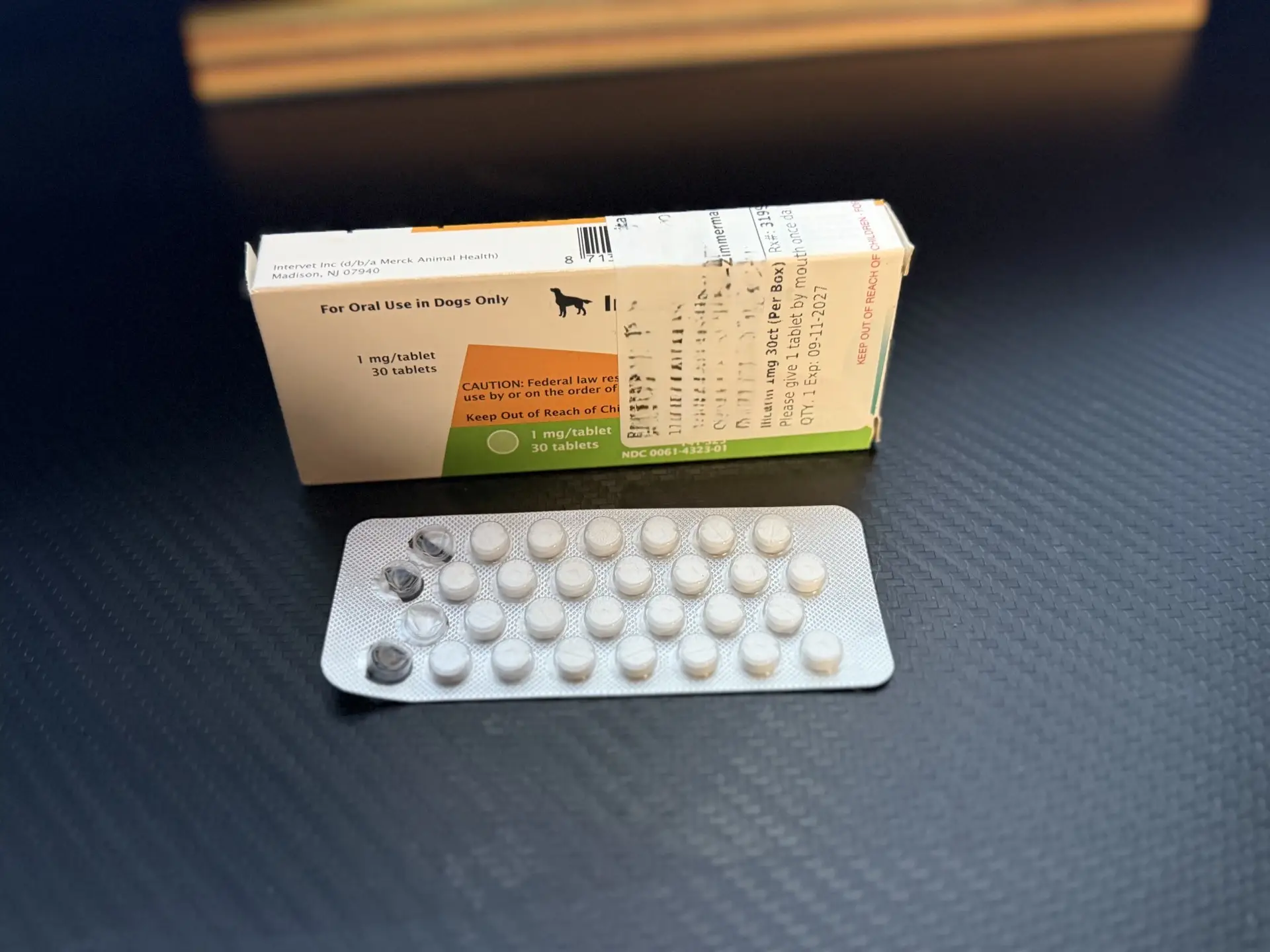
There are certain accomplishments we expect from modern medicine. Prevent disease. Relieve pain. Extend lives.
And then there is the equally noble task of keeping a deeply relaxed dog from pissing on the couch.
In our house, that job belongs to Incurin.
Our girl Scarlett is a former foster momma who apparently reached the point in life where falling peacefully asleep and maintaining bladder integrity became two activities she could no longer reliably perform at the same time. She wasn’t deliberately peeing in the house. She could go outside and urinate normally. The problem showed up when she got comfortable, relaxed, and apparently decided all remaining bodily functions were somebody else’s responsibility.
The couch disagreed with this arrangement.
Fortunately, Incurin has worked extremely well for her.
And when a tiny prescription tablet stands between us and repeatedly washing dog bedding, blankets, furniture covers, and whatever else Scarlett has decided to sleep on, we’re prepared to give credit where credit is due.
Our rating: 1/4 Poops. Solidly good crap.
What Is Incurin?
Incurin is the brand name for estriol, an estrogen medication prescribed for a particular type of urinary incontinence in spayed female dogs.
That’s an important distinction. This isn’t a general-purpose “dog keeps peeing in the house” pill.
Urinary accidents can have all sorts of causes, including urinary tract infections, bladder problems, excessive urine production, neurological conditions, and other medical issues. Incurin is specifically intended for estrogen-responsive urinary incontinence in spayed female dogs, which is why this is something to discuss with a veterinarian rather than diagnosing from an unfortunate wet spot on the comforter.
In Scarlett’s case, the pattern was pretty obvious from an owner’s perspective: she could pee normally, but when she became deeply relaxed, we’d occasionally discover that her bladder had quietly resigned from active duty.
Why Does This Happen to Spayed Female Dogs?
Urinary incontinence in spayed female dogs is often associated with urethral sphincter mechanism incompetence, usually shortened to USMI.
That’s the expensive medical terminology for a fairly simple household problem: the system responsible for keeping urine inside the dog isn’t maintaining enough closure pressure all the time.
Hormonal changes following spaying can be one part of the problem. Estrogen affects tissues involved in urinary continence, and replacing some estrogenic activity with estriol can improve urethral resistance in dogs whose incontinence responds to hormones.
That doesn’t mean spaying automatically causes incontinence, nor does it mean every incontinent female dog needs estrogen. The condition is more complicated than that.
Scarlett’s history makes the subject especially interesting to us because she had puppies before becoming part of our family. Whether that history contributed to her particular problem isn’t something I’m going to diagnose from the couch. What we can say with considerable confidence is that before treatment the couch occasionally got wet.
With Incurin, it doesn’t.
That’s the portion of the clinical trial we conducted in our living room.
Does Incurin Actually Work?
Here’s where our experience and the legitimate clinical research line up nicely.
The FDA approval study involved more than 200 spayed female dogs with urinary incontinence. During the placebo-controlled portion of the study, 66% of dogs receiving estriol met the study’s treatment-success criteria after 14 days, compared with 37% receiving placebo.
That’s a meaningful difference.
Things became even more encouraging when researchers subsequently adjusted treatment for individual dogs. By Day 42, roughly 93% of the dogs with available response data were either continent or had improved.
There’s an important asterisk there.
That later portion wasn’t a continued placebo-controlled comparison, so the 93% number shouldn’t be interpreted as “Incurin cures 93% of incontinent dogs.” It’s evidence that many dogs responded well when treatment was individualized, not a promise printed on the side of the box by the Canine Ministry of Dry Furniture.
Our personal sample consists of exactly one Scarlett.
Scarlett votes yes.
Enthusiastically, if she understood what we were talking about.
What We’ve Actually Seen at Home
This is ultimately why Incurin ends up in our Crap Worth Buying category instead of merely receiving a bunch of impressive medical statistics.
It solved the problem we were trying to solve.
Before Incurin, Scarlett could leak urine when she became extremely relaxed. That meant wet bedding and, occasionally, wet furniture.
Since she’s been successfully treated with Incurin, our bedding and furniture have stayed dry.
That’s about as straightforward a product review as we’re ever going to get.
There are products where you spend months trying to determine whether they actually made a difference.
This isn’t one of them.
Wet couch. Medication. Dry couch.
Even I can follow that dataset.
It’s Still a Prescription Hormone Medication
This is where we put the jokes down for a minute.
Incurin is a prescription estrogen medication, and while it has worked wonderfully for Scarlett, that doesn’t mean it is appropriate for every dog with urinary leakage.
Reported adverse effects include things such as appetite changes, vomiting, vulvar swelling and other estrogen-related effects. The prescribing information also discusses less common but more serious concerns associated with estrogen treatment.
That’s why figuring out why a dog is leaking urine matters.
A urinary infection isn’t going to become impressed because you bought estrogen.
Neither is a bladder stone.
If a previously house-trained dog suddenly starts leaking urine, particularly if there are other changes such as increased thirst, frequent urination, straining, blood in the urine, appetite changes, or unusual behavior, that’s veterinarian territory.
And because the medication is hormonal, decisions about starting it, monitoring it, changing the amount, combining it with other drugs, or stopping it belong between the owner and the dog’s veterinarian.
Incurin vs. Other Treatments
Incurin isn’t the only medication veterinarians use for canine urinary incontinence.
Another common approach is phenylpropanolamine, usually referred to as PPA, which tackles continence through a different mechanism involving urethral muscle tone. Older estrogen medications have also been used historically.
The interesting part is that there isn’t good evidence establishing one medicine as universally superior for every dog.
Which is actually reassuring.
The goal isn’t to find the medication with the biggest number on an advertisement. It’s to figure out what’s causing this dog’s problem and find something that controls it without creating worse problems somewhere else.
For Scarlett, Incurin appears to be that something.
The Real Benefit Isn’t Just a Dry Couch
It would be easy to describe this entirely from the human perspective.
Nobody likes washing dog bedding constantly. Nobody enjoys discovering a wet spot on a couch cushion. And nobody wants their washing machine drafted into the Canine Urinary Emergency Response Team.
But there’s another side to it.
Scarlett isn’t doing anything wrong when she leaks while sleeping.
She’s asleep.
Punishing a dog for something physically outside her control would accomplish nothing except making everyone involved miserable.
Treating the underlying problem means she gets to curl up, pass out, and sleep like a dog without anyone worrying about what we’ll find underneath her afterward.
That’s better for the furniture.
It’s also better for Scarlett.
So, Should You Buy This Crap?
If your veterinarian determines that your spayed female dog’s urinary leakage is the kind that may respond to estriol, Incurin deserves serious consideration.
The clinical evidence says it works for many appropriately diagnosed dogs.
Our considerably less scientific household evidence says it has worked extremely well for Scarlett.
No miracle claims. No pretending one medication works for every incontinent dog. No suggestion that you should diagnose your dog from an article written by a guy whose principal clinical observation is “Hey, the couch isn’t wet anymore.”
But that’s exactly why we recommend it.
We had a specific problem.
Our veterinarian treated it.
The problem stopped.
Sometimes a product doesn’t need fireworks, revolutionary technology, or thirty-seven features controlled by an app.
Sometimes it just needs to keep the dog pee out of the furniture.
💩 Our Rating: 1/4 Poops
Solidly good crap.
Incurin has done exactly what we needed it to do for Scarlett, and that’s earned it one of the better ratings we give around here.
Scarlett gets to sleep comfortably.
The bedding stays dry.
The couch has been honorably discharged from active duty.
We’d call that money well spent.
This review describes our personal experience and is not veterinary advice. Incurin is a prescription medication. Urinary incontinence can have multiple causes, so diagnosis, treatment, dosing, monitoring, and medication changes should be handled by your veterinarian.
