


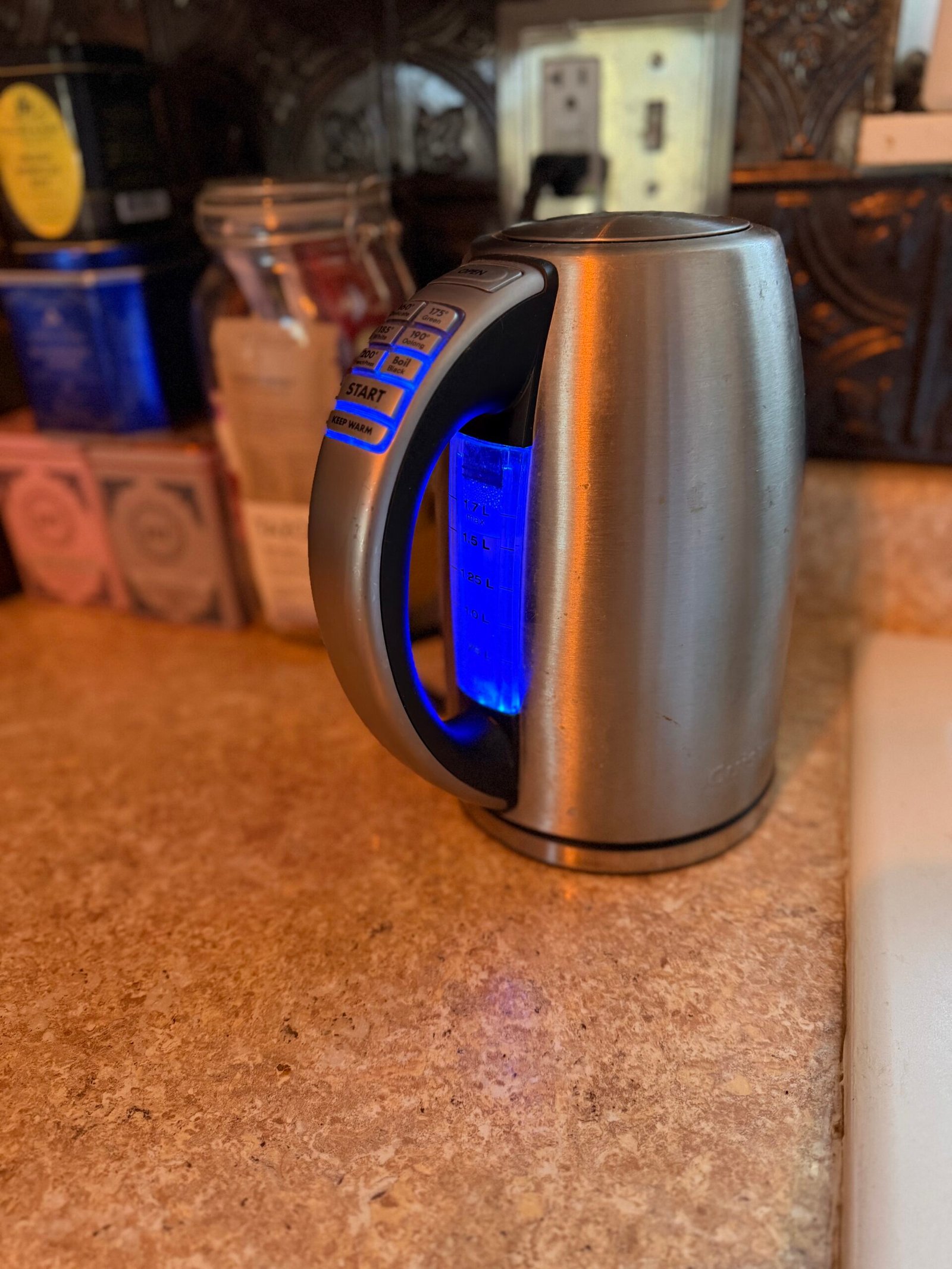
Long-term owner review: 2+ years of tea, boiling water, and occasionally ignoring clearly marked fill lines
There are certain appliances you spend most of your life assuming you don’t need.
An electric kettle was one of those for me.
I already owned a kettle. It went on the stove. I put water in it, turned on the burner, and eventually it screamed at me. Humanity had been successfully producing hot water this way for generations, so I saw absolutely no reason to introduce electricity, buttons and LEDs into the situation.
Then I got the Cuisinart CPK-17P1.
I’ve owned mine for more than two years now, and if you’re a serious tea drinker who’s still heating water on the stove, I’m here to tell you something:
You don’t know what you’re missing.
This is one of those kitchen appliances that initially feels unnecessary and then quietly becomes something you use constantly.
It’s a Kettle With Buttons. Wonderful, Beautiful Buttons.
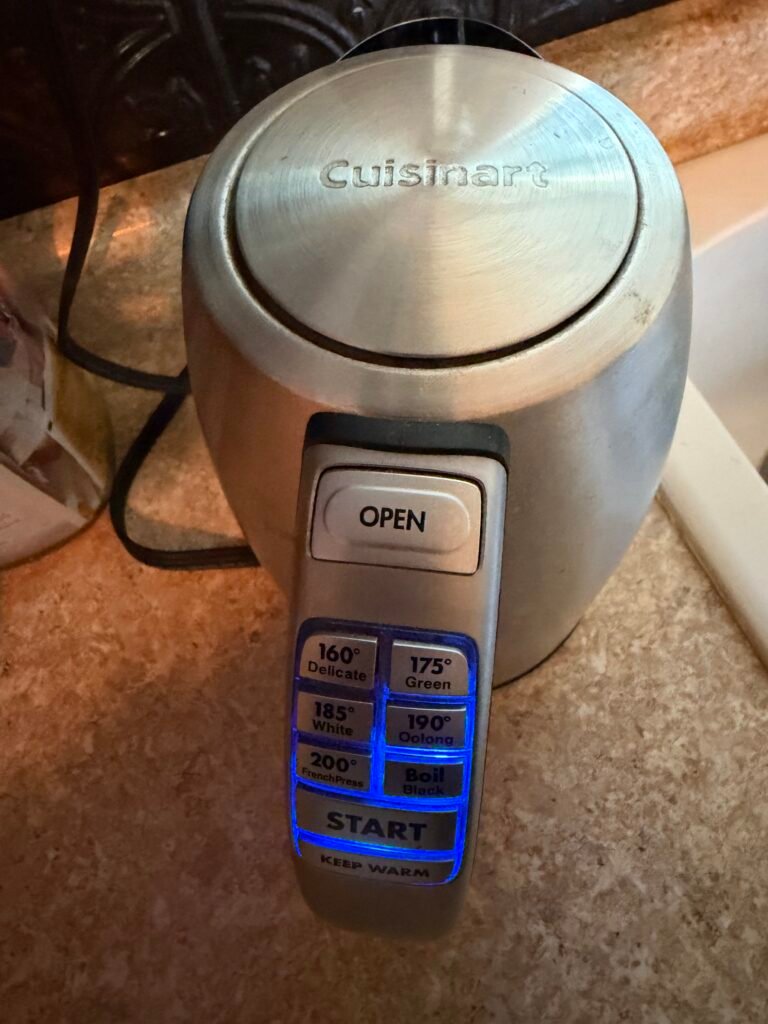
The Cuisinart CPK-17P1 is a 1.7-liter, 1500-watt electric kettle with six preset temperature settings rather than the traditional kettle’s two settings:
- Water
- Angry water
The presets are designed for Delicate, Green, White, Oolong, Black and Herbal teas, plus French press coffee.
And if you’re into tea, that actually matters.
Different teas do better at different water temperatures. With my old-school kettle, temperature control consisted primarily of staring at the thing and thinking, “Eh, that’s probably hot enough.”
The Cuisinart eliminates the guesswork.
Pick the appropriate temperature, hit Start, and let the kettle handle the rest.
After using it this way for a couple of years, going back to boiling every cup of tea to within an inch of its life feels surprisingly primitive.
Holy Crap, That Was Fast
Speed is probably the thing you’ll appreciate first.
Fill it. Hit the button. Go find the tea.
The CPK-17P1 uses 1500 watts for fast heating, and compared with my old routine of breaking out a kettle or pot and firing up the stove, the whole process feels ridiculously convenient.
And that’s really the secret to why I continue using it.
Hot water is no longer a minor cooking project.
Tea? Kettle.
French press? Kettle.
Need boiling water for something you’re cooking? Kettle.
Need hot water for some random household purpose?
You get the idea.
Instead of getting out a pot, turning on a burner and heating half the kitchen to accomplish the technological miracle of making water hot, I’m pushing a button.
It’s Not Just for Tea
I bought into the idea because I’m a tea drinker, but after living with it, that’s not the only reason I’d replace it if it died tomorrow.
Having fast hot water sitting on the counter is just useful.
Anything that requires hot or boiling water suddenly becomes easier because you don’t have to break out cookware and occupy a burner just to heat some water.
And because the kettle lifts completely off its powered base, you can carry it over to wherever you actually need the water rather than standing over the stove scooping or pouring from a pot.
That’s the kind of convenience that sounds incredibly minor until you’ve gotten accustomed to it.
Then somebody makes you boil water in a saucepan again and suddenly you feel like you’re camping.
The Temperature Controls Are the Real Reason Tea Drinkers Should Buy It
If you mostly need something capable of producing boiling water, cheaper electric kettles can do that.
What makes the Cuisinart interesting to me is the temperature selection.
There are six presets covering Delicate, Green, White, Oolong, Black and Herbal teas, plus French press coffee.
Instead of trying to monitor a thermometer or guessing when the water has cooled sufficiently after boiling, you tell the kettle what you’re making.
That’s it.
There’s also a Keep Warm function that maintains the selected temperature for up to 30 minutes, which is particularly handy when you’ve heated the water and then immediately gotten distracted by literally anything else in your house.
There’s even a memory function that lets you remove the kettle from the base for up to two minutes without it forgetting what it was doing.
It’s the sort of stuff you absolutely don’t need in order to make tea.
It’s also the sort of stuff you immediately miss once you’re accustomed to having it.
And the Damn Thing Looks Good
I’ll admit this matters to me.
If an appliance is going to permanently occupy countertop territory, I don’t want it looking like something stolen from a motel breakfast buffet.
The Cuisinart looks good.
Brushed stainless steel, blue-lit controls and a blue backlit water-level window give it a nice slightly industrial appearance without making it look like you’re preparing tea aboard the Starship Enterprise.
After more than two years, mine still doesn’t look out of place sitting on the counter.
And since I use it constantly, that’s where it stays.
Two Years Later, Would I Buy It Again?
Absolutely.
That’s probably more important than anything I could tell you about wattage or temperature presets.
I’ve actually lived with this thing for more than two years.
It hasn’t become one of those appliances that seemed like a great idea, got used enthusiastically for twelve days and then migrated into Cabinet Purgatory next to the sandwich press.
I still use it.
Frequently.
If mine died, I’d want another electric kettle.
And I’d have absolutely no problem buying this one again.
That’s about the strongest endorsement I can give a kitchen gadget.
A Word of Warning for People Who Consider MAX FILL Lines to Be Suggestions
Now we need to discuss the MAX fill line.
Apparently, when engineers print MAX on the side of an appliance, they aren’t expressing an opinion.
Who knew?
If you’re staring at the kettle thinking:
“There’s still plenty of room in there. What could possibly happen?”
I can answer this because I have conducted the experiment on your behalf.
It boils over.
Hot water will come out of the kettle and onto whatever surface you’ve cleverly decided to place your electric appliance on.
So here’s some hard-won consumer advice:
Don’t overfill the damn thing.
The engineers already did the math.
You don’t need to challenge them.
The Verdict
The Cuisinart CPK-17P1 is one of those appliances I didn’t think I needed until I owned one.
Now I wouldn’t want to go back.
It’s fast. It’s convenient. It looks good sitting on the counter, and the adjustable temperature settings are genuinely useful if you drink different types of tea.
More importantly, after more than two years of ownership, I’m still using mine regularly.
For tea drinkers in particular, this is less about replacing your old kettle with an electric version of the same thing. It’s about realizing that your old kettle was actually kind of stupid.
It knew one trick:
Make water as hot as physically possible and start screaming.
The Cuisinart gives you much more control while taking less effort.
Pros
- Heats water quickly
- Six useful temperature presets
- Excellent for different varieties of tea
- 30-minute Keep Warm function
- 1.7-liter capacity
- Cordless kettle lifts off the powered base
- Useful for much more than tea
- Attractive stainless-steel design
- Has held up well through more than two years of regular use in my experience
- Makes heating water ridiculously convenient
Cons
- Costs considerably more than a basic electric kettle
- Takes up permanent countertop space because you’ll probably start using it constantly
- Maximum fill line apparently means maximum fill line
- Will respond to your attempt at amateur hydrological engineering by depositing boiling water on the counter
THE VERDICT: GOOD CRAP
I’ve owned the Cuisinart CPK-17P1 for more than two years, I still use it regularly, and if mine died tomorrow, I’d buy another electric kettle without hesitation.
That’s ultimately the review that matters.
It heats water quickly, gives tea drinkers useful temperature control, looks good sitting on the counter and makes something as boring as boiling water considerably less of a pain in the ass.
Just remember one thing:
The MAX fill line isn’t a suggestion.
Trust me on this one.
