


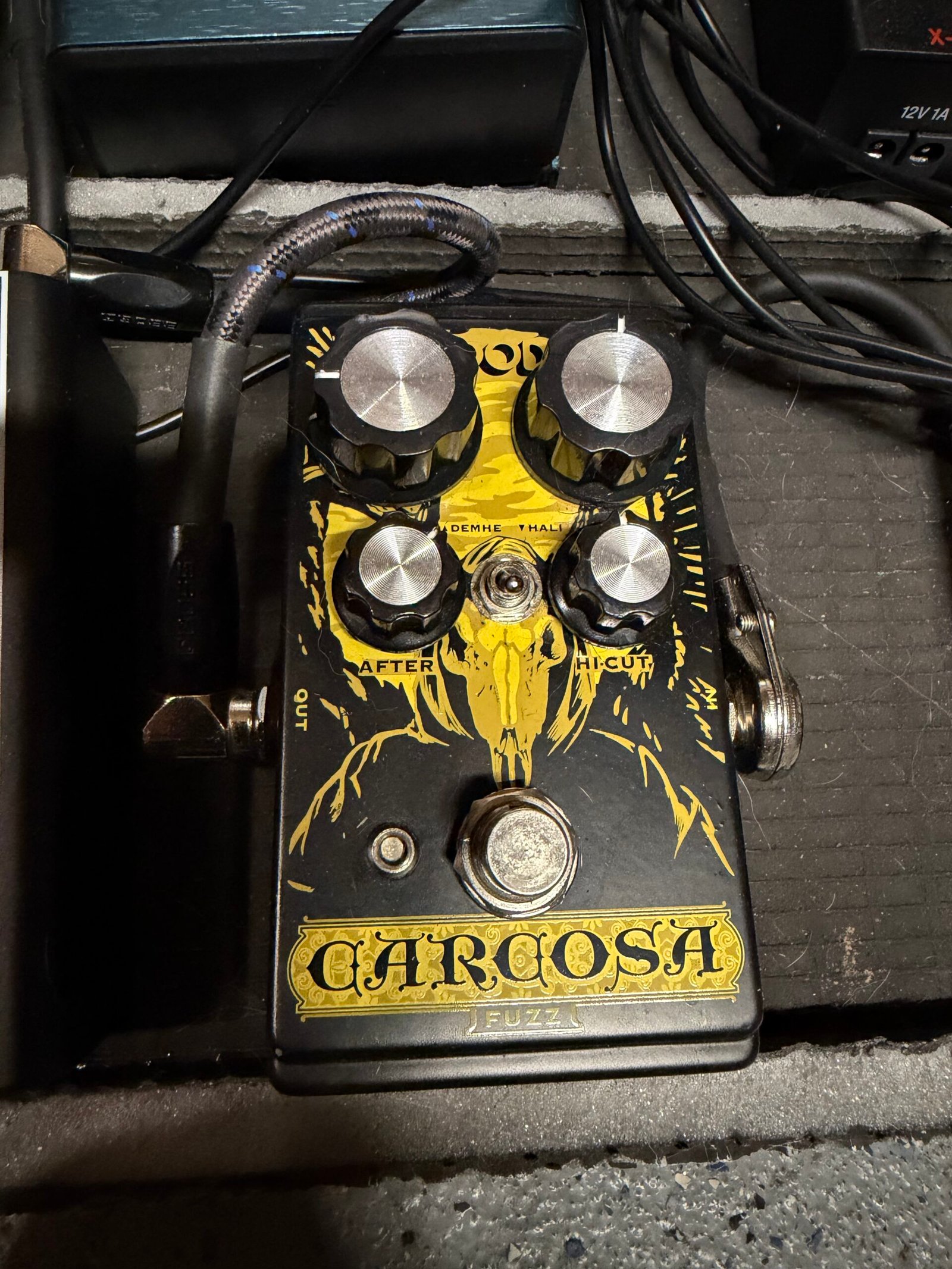
The DOD Carcosa was my introduction to fuzz pedals.
Holy hell, what an introduction.
I went into this thinking fuzz was basically one sound. You stepped on a pedal, your nice clean guitar signal got dragged behind a truck for a couple of miles, and congratulations, you had fuzz.
Then I started turning knobs on the Carcosa.
Vintage fuzz? Yep.
Thick, creamy leads? Absolutely.
Big walls of filthy guitar? No problem.
Weird sputtering broken-speaker noises that sound like your amplifier is attempting to communicate its final wishes before dying?
Oh yeah.
The Carcosa does that too.
And that’s why, even after playing with fuzz pedals that specialize in one particular corner of fuzz insanity, I still think the DOD Carcosa is one of the best all-around fuzz pedals for somebody who doesn’t want three different fuzz boxes taking up space on the board.
It isn’t completely vintage.
It isn’t completely modern.
It’s the wonderfully screwed-up territory somewhere in between.
My Introduction to Fuzz Was Apparently the Deep End
Looking back, I probably could have picked a simpler first fuzz pedal.
But I’m glad I didn’t.
The Carcosa taught me almost immediately that “fuzz” isn’t really one sound.
It’s an entire family of ways to completely mistreat a guitar signal.
Some fuzz pedals specialize in recreating those thick vintage sounds we associate with old records. Others, like some of the more modern fuzzes I’ve played, push much farther into gated, destructive, almost synthetic territory.
The Carcosa can visit both neighborhoods.
That’s what makes it special.
You can dial this thing into something warm and familiar, then start moving the controls around and eventually arrive somewhere that sounds like somebody stabbed the speaker cone with a screwdriver.
And somehow there are useful sounds almost everywhere along the trip.
BEFORE and AFTER: Where the Madness Happens
The controls have appropriately weird names.
There’s BEFORE, which handles how much fuzz you’re feeding into this little monster.
Then there’s AFTER.
AFTER is the bias control, and this is where the personality of the Carcosa really starts coming out.
Move through its range and you can take the pedal from more traditional, woody fuzz textures into increasingly aggressive, splattered and broken sounds.
This isn’t one of those pedals where the manufacturer gives you four knobs but two of them don’t seem to do a damn thing.
The controls fundamentally change the personality of the fuzz.
That’s exactly what I want from a pedal like this.
From Creamy Vintage Fuzz to a Dying Speaker
My favorite thing about the Carcosa is the amount of territory between its extremes.
If I want something that feels closer to a vintage fuzz, I can get there.
There’s warmth, thickness and that gloriously fuzzy character that makes a guitar sound enormous without necessarily making it sound like something has gone terribly wrong.
But sometimes I do want something to sound like it’s gone terribly wrong.
That’s when you start wandering farther into the Carcosa.
Push the bias into more extreme territory and things can get splattery, gated, broken and wonderfully unpleasant.
Notes start behaving differently.
The fuzz becomes less polite.
Eventually you’re no longer trying to make the guitar sound creamy.
You’re trying to make it sound like the speaker has suffered a workplace accident.
And that’s fun too.
The HI-CUT Knob Is More Important Than It Looks
The Carcosa can get bright and aggressive.
Fortunately, DOD gave you a HI-CUT control to rein that in.
I like having that control because the ideal fuzz tone depends tremendously on everything surrounding the pedal.
Different guitars, pickups, amplifiers and the rest of your signal chain can turn “bright and articulate” into “please make it stop” surprisingly quickly.
The HI-CUT lets you tame that top end without abandoning the fuzz texture you’ve dialed in elsewhere.
Once you start playing with the extremes of the AFTER control, the relationship between those controls becomes even more useful.
This is one of those pedals where twisting one knob can make you want to revisit another.
There’s a lot of interaction going on inside this little yellow-and-black lunatic.
DEMHE and HALI Give You Even More Room to Play
Then there’s that little DEMHE/HALI switch, because apparently “normal” and “insane” weren’t sufficiently mysterious labels.
The two modes change the low-frequency character of the pedal.
That gives you another way to adapt the Carcosa depending on the amplifier and sound you’re chasing.
And that’s really the theme of this entire pedal.
Options.
A lot of fuzz pedals have a sound.
Maybe it’s a damn good sound.
But it’s their sound.
The Carcosa feels more like a fuzz toolbox.
The Carcosa Sits Right Between Vintage and Modern Fuzz
This is where I’d put the Carcosa if I were drawing a completely unnecessary map of fuzz pedals.
On one end you’d have the vintage specialists.
These are the boxes you buy because you’re chasing a particular classic fuzz character. They aren’t necessarily supposed to sound like the future. They’re supposed to make you wonder why you didn’t grow your hair out and start a psychedelic rock band 50 years ago.
On the other side you’ve got the modern lunatics.
I’ve already reviewed more modern fuzz designs that push into stranger territory, and that’s a natural next stop if you find yourself loving the broken, gated side of the Carcosa and thinking:
Yes, but could we make this even more ridiculous?
I’ll link my Eventide fuzz review here, because that’s a perfect comparison for somebody deciding which direction they want to go.
The Carcosa lives between those worlds.
And honestly, I think that’s its greatest strength.
Because How Many Fuzz Pedals Do You Really Need?
Don’t answer that.
We’re guitar players.
We both know the answer is “one more.”
But let’s briefly pretend we’re financially responsible adults with limited pedalboard space.
If you love vintage fuzz, there are pedals that specialize more heavily in vintage fuzz.
If you love insane modern gated fuzz, there are pedals built specifically to make your guitar sound like malfunctioning industrial equipment.
But owning one of each means you’re consuming more pedalboard space, more power outputs and more money.
The Carcosa makes a compelling argument for just carrying one.
No, it isn’t going to perfectly duplicate every specialized fuzz circuit ever made.
That’s not the point.
The point is that I can get a ridiculous number of genuinely different fuzz personalities out of one little box.
For most of us, that’s considerably more useful.
It’s Also Surprisingly Good at Remaining Musical
This is something I’ve come to appreciate more as I’ve tried other fuzzes.
Weird is easy.
Useful weird is harder.
You can absolutely make the Carcosa sound broken.
You can send it into sputtering, splattering territory where it seems increasingly questionable whether you’re playing an instrument or testing damaged electronics.
But there’s still a guitar under there.
That’s important to me.
I don’t just want a pedal that makes interesting noises when I’m screwing around by myself.
I want something that can actually become part of a song.
The Carcosa gives me plenty of ridiculous sounds without completely abandoning that goal.
What I Like About the DOD Carcosa
Quite a bit:
- It covers an enormous range of fuzz sounds.
- It can move from vintage-inspired fuzz into distinctly modern territory.
- The AFTER bias control dramatically changes the fuzz character.
- The HI-CUT makes its brighter sounds far easier to manage.
- DEMHE/HALI gives you another way to adapt it to your setup.
- It can get properly weird without being a one-trick novelty pedal.
- One Carcosa can potentially take the place of several more specialized fuzz pedals.
That last point is the big one for me.
This thing earns its pedalboard space.
What I Don’t Like
The versatility that makes the Carcosa great can also make it a little less immediately obvious than a traditional one-flavor fuzz.
If you’re looking for one extremely specific vintage fuzz sound, buying a pedal dedicated to that sound might make more sense.
Likewise, if your entire reason for owning fuzz is creating the most extreme modern gated destruction possible, there are pedals that go farther in that particular direction.
The Carcosa’s specialty is not really having a specialty.
And I mean that as a compliment.
This is the Swiss Army knife approach to fuzz.
So, Should You Buy This Crap?
If you’re buying your first fuzz pedal, I’d absolutely put the DOD Carcosa on the list.
Hell, it was mine.
And one of the reasons I still appreciate it is that I didn’t immediately outgrow it once I learned what fuzz could do.
Instead, the pedal grew with my understanding of fuzz.
At first it was:
Hey, cool. Fuzz.
Then I started discovering the vintage sounds.
Then the nastier sounds.
Then the gated sounds.
Then the broken-speaker insanity.
Eventually I realized I’d bought one little pedal that could let me explore a huge portion of the fuzz world.
If you already know exactly which fuzz sound you’re chasing, buy the specialist that gives you that sound.
But if you’re like me and sometimes want thick vintage cream and other times want the sonic equivalent of throwing an amplifier down a staircase, buying separate pedals for every flavor gets ridiculous pretty quickly.
The DOD Carcosa Fuzz lives beautifully between those extremes.
It’s vintage when you want it to be.
It’s modern when you want it to be.
And when nobody else is home, it will gladly make noises that cause you to reconsider whether the amplifier is still functioning correctly.
If you don’t want three fuzz pedals on your board, this might be the one you’re looking for.
