


My guitar pedals already make plenty of questionable noises. They don’t need assistance from the electrical system in my 50-year-old house.
Unfortunately, assistance is exactly what they were getting.
For years I’d occasionally plug in my pedalboard and hear some mysterious buzz or hum that sent me down the usual troubleshooting rabbit hole. Pedal? Cable? Amp? Outlet? Ancient wiring? Some electrician 50 years ago who decided grounding was for cowards?
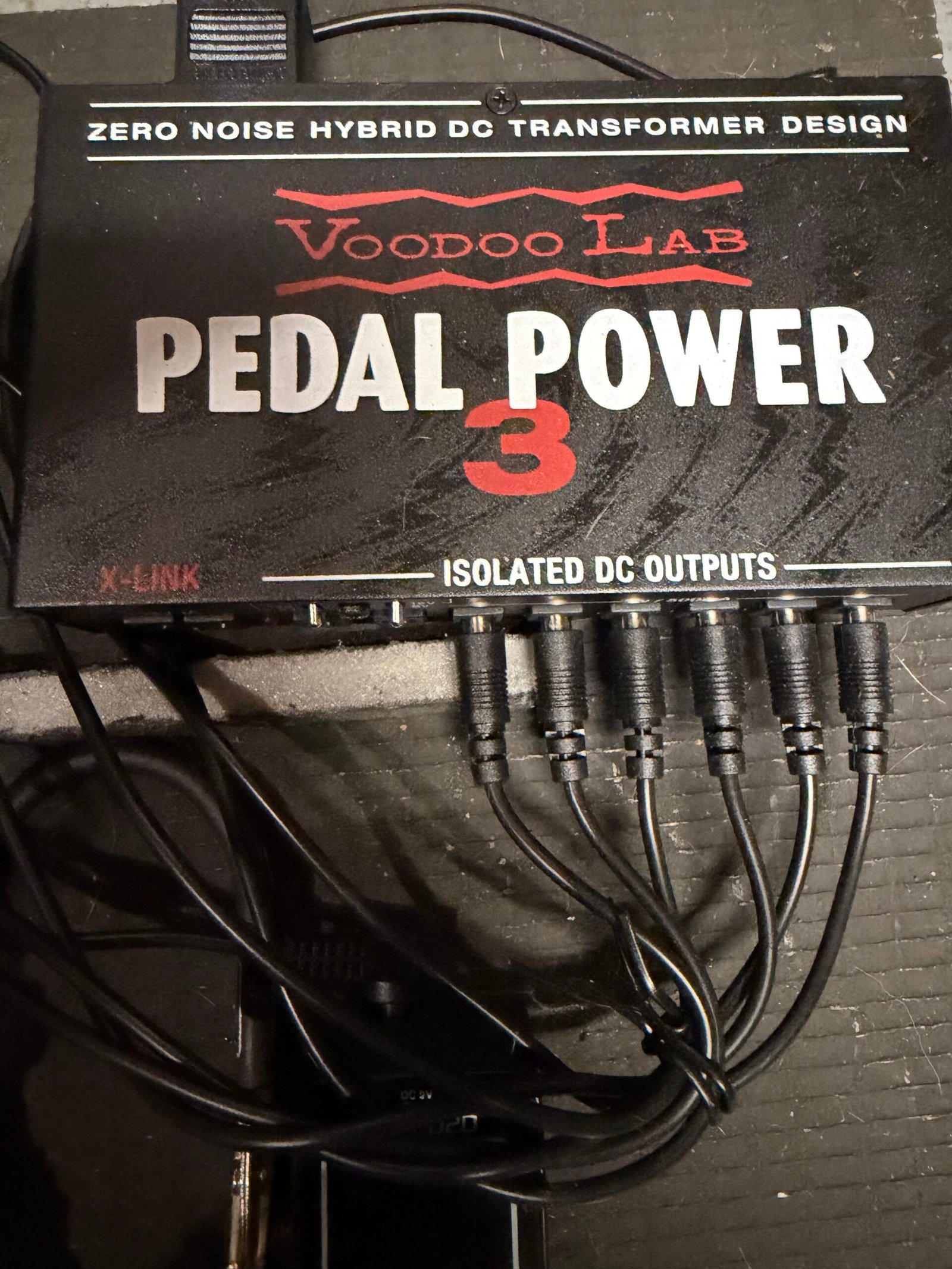
Eventually I got tired of playing detective and bought a Voodoo Lab Pedal Power 3.
Problem solved.
Apparently Good Power Matters
I know. Shocking.
No guitarist dreams about buying a power supply. We dream about guitars, amps and pedals. A power supply ranks somewhere between patch cables and remembering to buy strings.
But after living with the Pedal Power 3, I’m convinced a good isolated power supply is one of the least exciting and most useful pieces of equipment on my entire board.
Before this thing, sometimes my pedals made their intended noises plus a complimentary selection of noises provided by my house.
Now they just make their intended noises.
That’s progress.
The whole point of an isolated power supply is that your pedals aren’t all sharing the same electrical path like a bunch of drunken relatives fighting over one extension cord. The Pedal Power 3 gives you eight isolated outputs, and in my setup the difference was obvious.
Instead of continually wondering which pedal, cable, outlet or electrical ghost was responsible for a noise, I could get back to worrying about more important things.
Like whether I really need another overdrive pedal.
Obviously I do.
Eight Outputs Without Eight New Problems
The Pedal Power 3 gives me enough outputs to run a respectable collection of pedals without turning the underside of my board into an electrical crime scene.
That’s really what I wanted.
I don’t want to think about power. I don’t want to diagnose power. I don’t want to rearrange everything because one pedal isn’t happy.
I want to plug the stupid thing in and play guitar.
The Voodoo Lab lets me do that.
Each of its eight main outputs can provide up to 500mA, which also makes the Pedal Power 3 considerably more useful with modern, power-hungry digital pedals than some older power supplies.
There’s support for more than the usual 9-volt pedals, too. Depending on how you configure things, the Pedal Power 3 can accommodate 9V, 12V, 18V and 24V pedals.
So this isn’t something I bought specifically for the pedals I own today. It’s the foundation of the pedalboard for whatever stupid thing I decide I need tomorrow.
And When Pedal Acquisition Syndrome Strikes Again…
The ability to expand the system is another feature I appreciate because I’m realistic about my own behavior.
Am I finished buying pedals?
Of course I am.
Just like I was finished buying pedals the last six times.
The Pedal Power 3 has Voodoo Lab’s X-LINK expansion system, meaning I don’t necessarily have to throw my existing power supply aside and start over when the inevitable happens and another pedal mysteriously follows me home.
That’s exactly how expensive gear should work.
If I’m spending real money on a power supply, I don’t want to find myself shopping for its replacement simply because my pedalboard grew.
I’d rather buy the right foundation once and expand it later.
It’s Also Built Like a Tank
Then there’s the construction.
This thing feels absurdly solid.
It’s the kind of piece of equipment you install and immediately stop worrying about.
If civilization collapses tomorrow, I don’t know whether we’ll have electricity, food, functioning government or reasonably priced housing.
But I’m pretty confident somebody will eventually dig my Pedal Power 3 out of the rubble, plug a Tube Screamer into it and discover that the damn thing still works.
I’m not volunteering mine for the test.
The Best Feature Is That I Don’t Think About It Anymore
This is probably the biggest compliment I can give the Pedal Power 3.
I basically forget it exists.
That’s exactly what I want from a power supply.
Before I bought it, power was sometimes part of my guitar troubleshooting routine.
Where’s that hum coming from?
Did a cable go bad?
Is one of the pedals causing it?
Is it the outlet?
Is something else in the house on the same circuit?
Does the ghost living inside the breaker panel simply hate classic rock?
Now I plug in the board and play.
This thing doesn’t make my guitar sound better in the traditional sense. It doesn’t give me better distortion, a bigger delay or some lush new modulation effect.
It simply gives my pedals clean, isolated power and gets the hell out of the way.
That’s surprisingly valuable.
What I Like About the Pedal Power 3
After living with it, the things I appreciate aren’t particularly glamorous:
- Eight isolated outputs
- Plenty of current for modern pedals
- Support for pedals with different voltage requirements
- Expandable through Voodoo Lab’s X-LINK system
- Solid construction
- Compact enough to disappear into the pedalboard
- It dramatically reduced the power-related noise problems I was dealing with
That last one is what matters most to me.
There are plenty of features on guitar equipment that look fantastic on a specification sheet but don’t fundamentally change the ownership experience.
This did.
I stopped chasing buzzes.
What I Don’t Like
There’s one obvious drawback.
This isn’t a cheap way to power some guitar pedals.
If you’ve got a tuner, an overdrive and nothing else, spending this kind of money on a power supply is going to be difficult to justify.
There are cheaper ways to get electricity from the wall to a couple of pedals.
The value of the Pedal Power 3 starts making considerably more sense as your board gets bigger, your pedals get more demanding or, like me, you discover that the electrical system supplying your precious guitar equipment was installed during an era when people apparently had more faith in electricity than I do.
It’s a premium solution to a pretty boring problem.
But boring problems can drive you absolutely insane.
So, Should You Buy This Crap?
If you’ve only got a pedal or two, probably not.
Keep your money and buy something that makes obnoxious noises instead.
But if you’re building a proper pedalboard, running several pedals, dealing with old-house wiring or regularly plugging into electrical systems you didn’t personally inspect, an isolated power supply is one of those upgrades that suddenly makes a lot more sense once you’ve experienced one.
For me, the Voodoo Lab Pedal Power 3 was absolutely worth it.
It solved a real problem.
My pedals are quieter. My board is easier to manage. I’ve got plenty of power for the pedals I’m using now, and I have room to expand the system when my inevitable next case of pedal acquisition syndrome strikes.
Most importantly, I don’t have to wonder whether the sound coming out of my amp is being produced by my pedals or by whatever my electrician thinks constitutes music.
The Pedal Power 3 isn’t exciting.
It doesn’t make my guitar sound like a Marshall stack. It doesn’t give me another flavor of distortion. It doesn’t make me play better.
It just sits there quietly and makes everything else work the way it’s supposed to.
And after years of chasing buzzes around a 50-year-old house, quietly doing its damn job might be the best feature of all.
