

Formerly Mount Evans, and still called that by plenty of us who knew it by the old name.
Colorado is full of 14ers, and traditionally you’re supposed to climb them.
This involves hiking boots, backpacks, waking up at some ungodly hour and voluntarily walking uphill for several hours while increasingly questioning whether seeing the top of a mountain was really that important.
Mount Blue Sky offers another option:
Bring the car.
Formerly known as Mount Evans, Mount Blue Sky is probably about as easy as getting above 14,000 feet is ever going to get. The scenic road does almost all of the hard work for you, depositing you high enough on the mountain that the remaining trip to the summit is a short walk rather than an expedition.
Provided, of course, that the weather cooperates.
And the sheep haven’t taken over the road.
More on the sheep shortly.
Because there are sheep.
You Get an Entire Geography Lesson Through the Windshield
The drive is half the reason to go.
You start among trees and familiar Colorado mountain scenery, then just keep climbing.
And climbing.
And climbing.
The landscape changes ridiculously quickly.
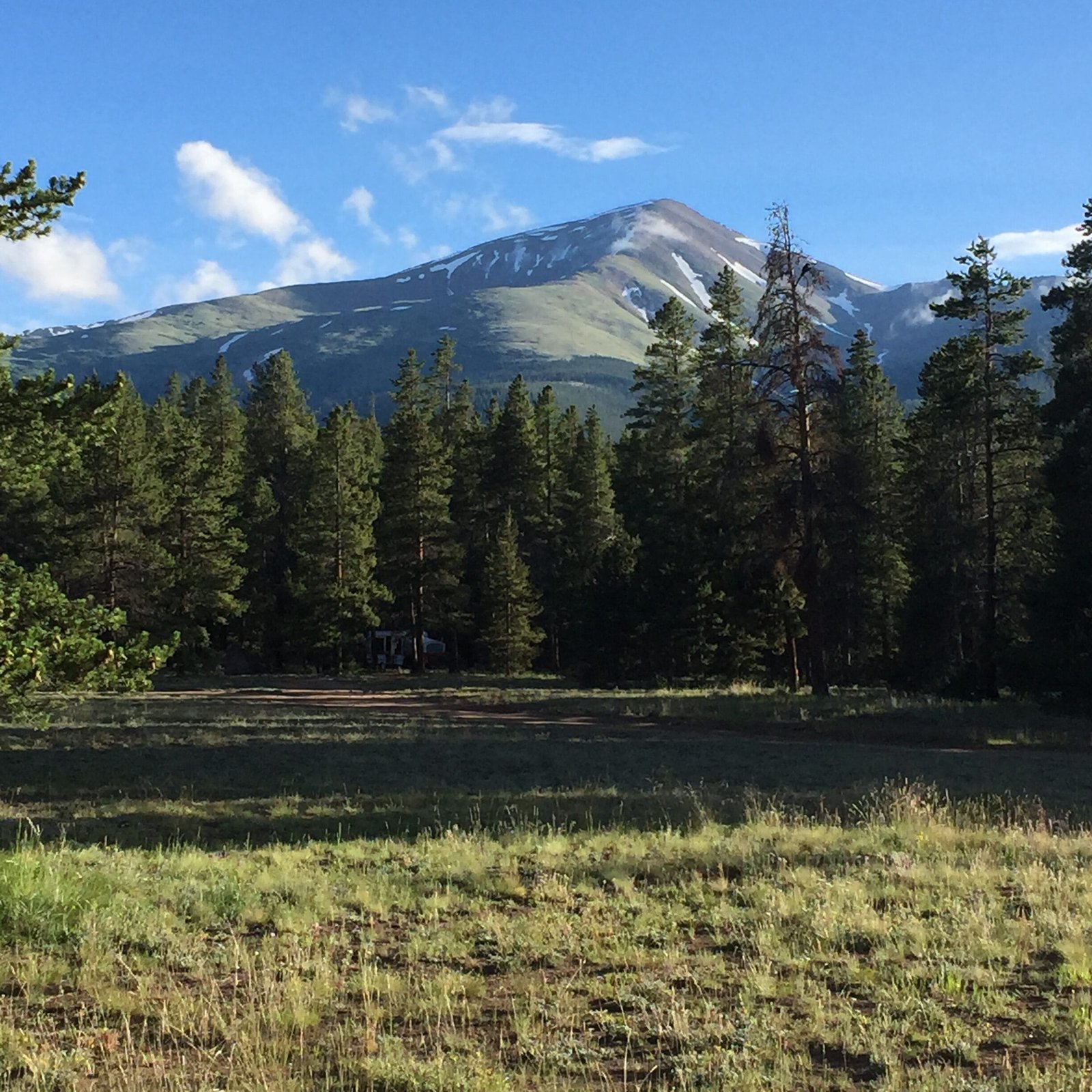
The Mount Blue Sky Scenic Byway climbs more than 7,000 feet, taking you from lower forests through high mountain environments and ultimately above timberline into alpine tundra.
It’s like somebody put several different pieces of Colorado on top of each other and built a road through all of them.
At lower elevations you’re driving past forests.
Higher up, the trees start getting smaller, weirder and increasingly determined to prove they can survive somewhere trees clearly weren’t intended to live.
Then eventually:
No trees.
Just rock, tundra, enormous skies and the growing realization that you’re driving a passenger vehicle through an environment that feels considerably more serious than wherever you stopped for breakfast.
You don’t have to understand climate zones to appreciate what’s happening.
Just look out the window.
Stop and Look at the Damn Trees
Before you get completely distracted by what’s happening above timberline, pay attention to the trees along the way.
The Mount Goliath area is home to Rocky Mountain bristlecone pines, some of those spectacular twisted high-elevation trees that look less like they grew and more like they’ve spent centuries personally arguing with the wind.
They’re gnarly.
They’re twisted.
They’re beautiful.
And after seeing what they’re growing in, you may develop considerably more respect for the little tree in your backyard that starts looking depressed every time you forget to water it.
The Forest Service describes the bristlecone pines here as among the oldest living organisms on Earth.
So slow down.
Get out where you’re allowed.
Look at them.
The summit will still be up there.
Then There Are the Sheep
I cannot stress this enough:
THERE ARE SHEEP.
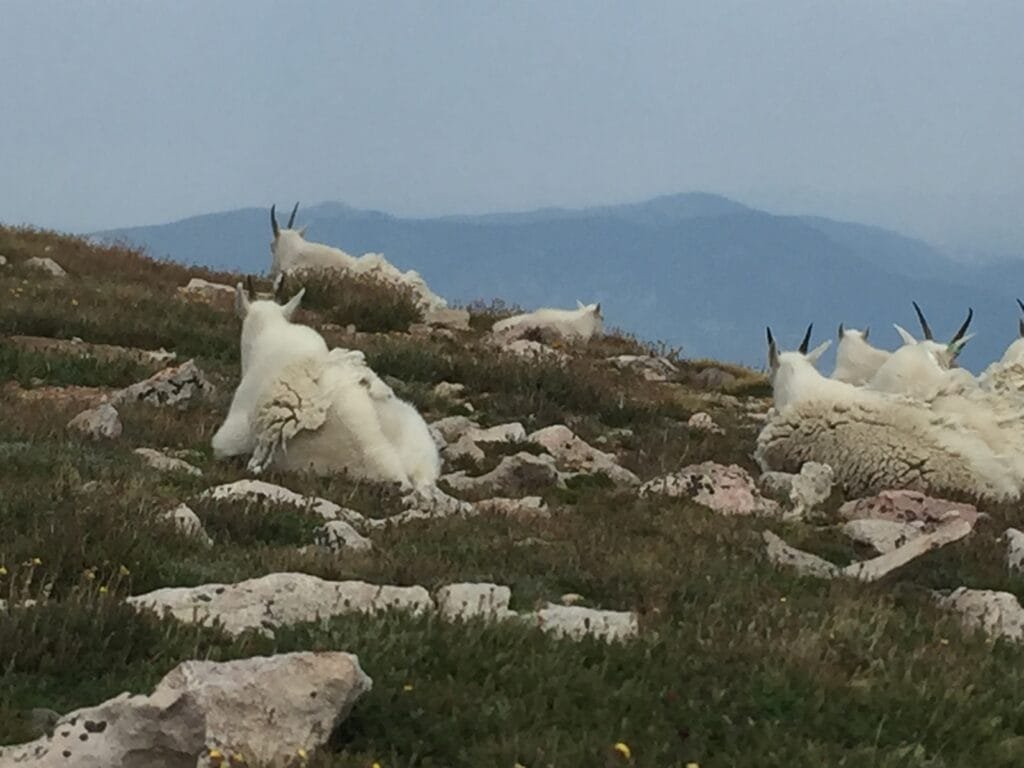
Bighorn sheep.
Actual Colorado bighorn sheep wandering around an environment so spectacular that they somehow manage to make the mountains seem like background scenery.
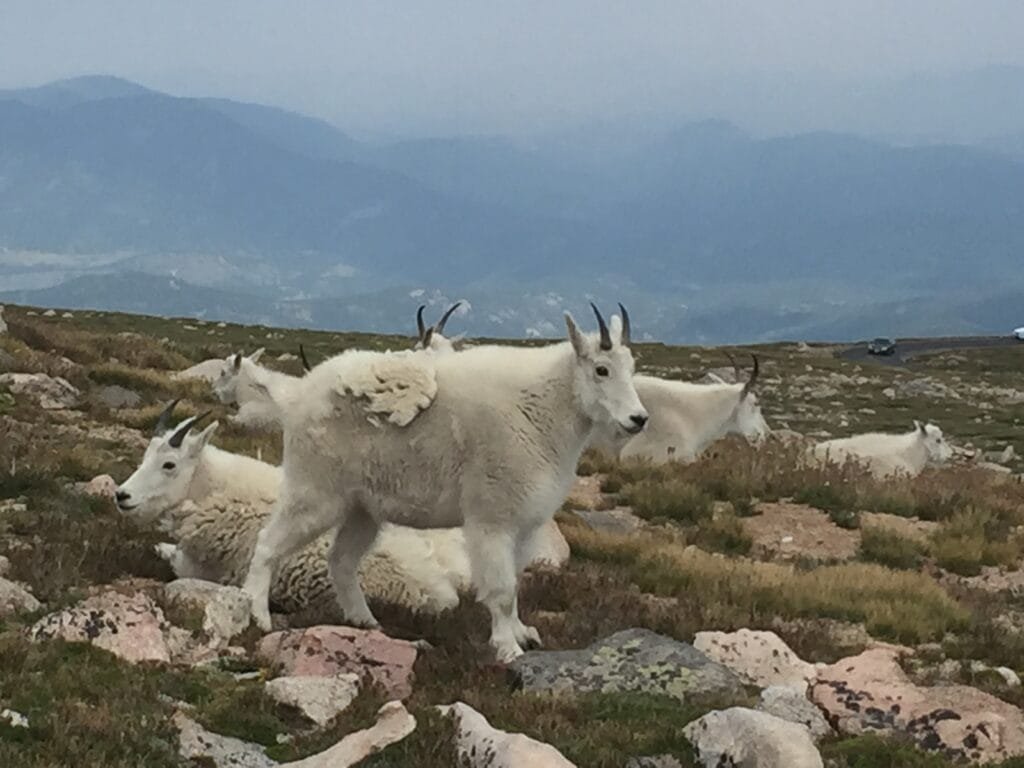
You can also encounter mountain goats, marmots and other alpine wildlife, but the sheep are worth the trip by themselves.
Sometimes they’re off in the distance.
Sometimes they’re considerably closer.
And sometimes they apparently have somewhere important to be and the roadway happens to be part of the route.
If wildlife blocks the road, congratulations:
Your schedule has been changed by a sheep.
Wait.
Enjoy it.
Take pictures.
This is vastly more interesting than whatever you were planning to do five minutes from now.
DO NOT PET THE SHEEP
This apparently needs to be said.
They’re wild animals.
They are not part of a petting zoo.
They don’t need snacks.
They don’t need to meet your children.
And that giant ram with curled horns did not see you approaching and think:
“Finally. Someone to scratch behind my ears.”
Leave the animals alone.
I have occasionally watched people get far too comfortable around wildlife because an animal happens to be standing near a road.
Distance does not become optional just because you drove there.
I’ve even seen people make incredibly stupid decisions around rams and discover that the ram gets a vote in how that interaction ends.
Enjoy them from a respectful distance.
Take the picture.
Zoom in.
Then let the sheep continue doing sheep stuff without becoming part of the day’s entertainment yourself.
The View Just Keeps Getting More Ridiculous
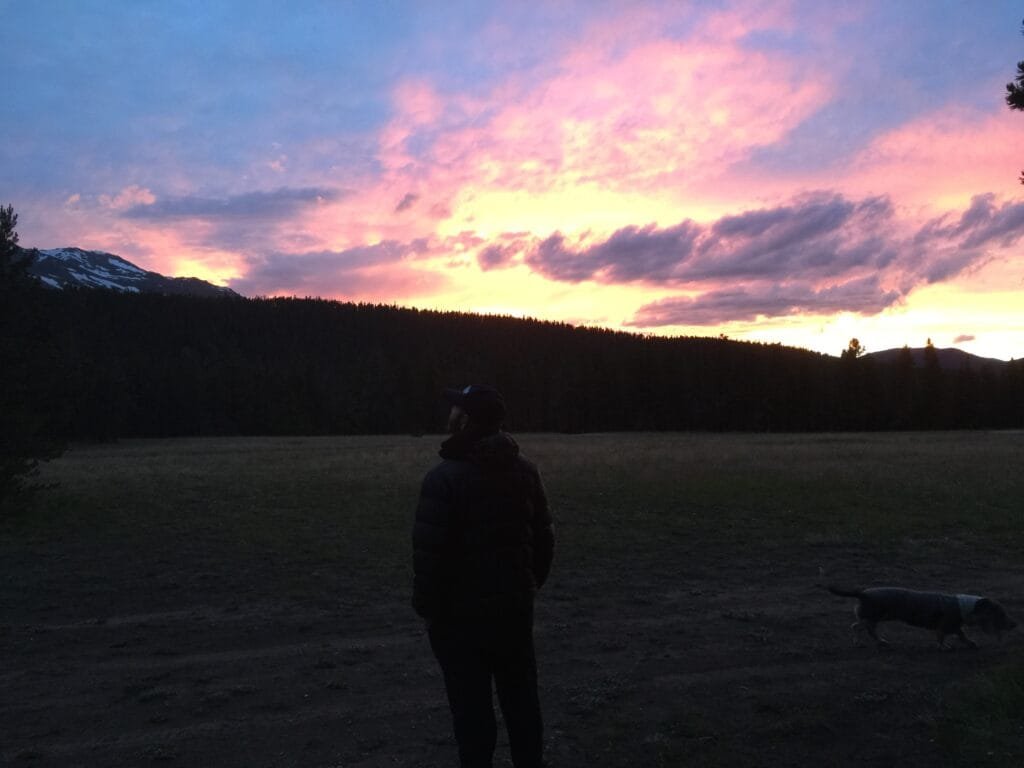
Once you get high enough, almost every direction starts looking like somebody’s desktop wallpaper.
Mountain ranges disappear into the distance.
Alpine lakes sit below you.
Valleys suddenly make sense because you’re looking down into them instead of driving through them.
And toward the plains you get a bird’s-eye perspective in the direction of Denver and the Front Range that makes everything down there seem impossibly far away.
That’s the thing I love about Mount Blue Sky.
There isn’t one view.
There are views everywhere.
Turn around.
There’s another one.
Walk 30 feet.
There’s another one.
Look back toward where you came from.
Somehow that’s gorgeous too.
Eventually you stop trying to decide which direction has the best scenery.
It all wins.
And Yes, You Can Say You Went Up a 14er
Driving most of the way might not earn you enormous bragging rights with the people who wake up at 4 a.m. and climb these things for fun.
That’s okay.
Let them have that.
They earned it.
Meanwhile, the rest of us can experience an environment above 14,000 feet without first developing opinions about ultralight backpacking equipment.
The road reaches 14,130 feet, with a short walk taking visitors the rest of the way to the summit area.
And when you step out of the car, the altitude reminds you remarkably quickly that the automobile did most of the work.
Take your time.
The air is thin.
The weather can change quickly.
You are still on top of a very large mountain even if getting there involved cup holders.
The Weather Is Not Screwing Around
This part deserves to be taken seriously.
The weather at Mount Blue Sky can change quickly, and CDOT warns visitors to be prepared for wind, rain, lightning, snow and hail even when everything seemed perfectly reasonable farther down the mountain.
Bring layers.
Pay attention to conditions.
And don’t assume the weather where you started has anything whatsoever to do with the weather you’re going to encounter thousands of feet higher.
Mountains don’t care what your weather app said when you left Denver.
Don’t Just Race to the Top
This may be my biggest recommendation.
The summit is spectacular, but if you treat everything before it as an obstacle between you and the top, you’re missing half the experience.
Stop where you’re supposed to stop.
Look at the bristlecone pines.
Watch for wildlife.
Check out the alpine lakes.
Look back down the mountain.
Watch the landscape change.
And, obviously:
LOOK AT THE SHEEP.
The road itself is the attraction.
The summit is just the absurdly beautiful ending.
Is Mount Blue Sky Worth Visiting?
Absolutely.
It’s one of the easiest ways to experience the dramatic high-alpine environment of a Colorado 14er without actually having to climb one from the bottom.
But calling it easy shouldn’t make it sound boring.
Quite the opposite.
In a relatively short drive, you move through a spectacular change in geography, see some of the toughest trees on Earth, climb above timberline, look down across the Front Range and stand in an environment most people simply don’t encounter on an ordinary drive.
And then a bighorn sheep might walk across the road.
It’s difficult to improve upon that.
THE VERDICT: GOOD CRAP
Mount Blue Sky is Colorado showing off.
The road is outrageous.
The views are outrageous.
The trees look like they’ve survived several wars with the atmosphere.
And the wildlife apparently has right of way.
Go for the summit.
Take your time getting there.
And if the sheep block the road, don’t honk.
The sheep were here first.