
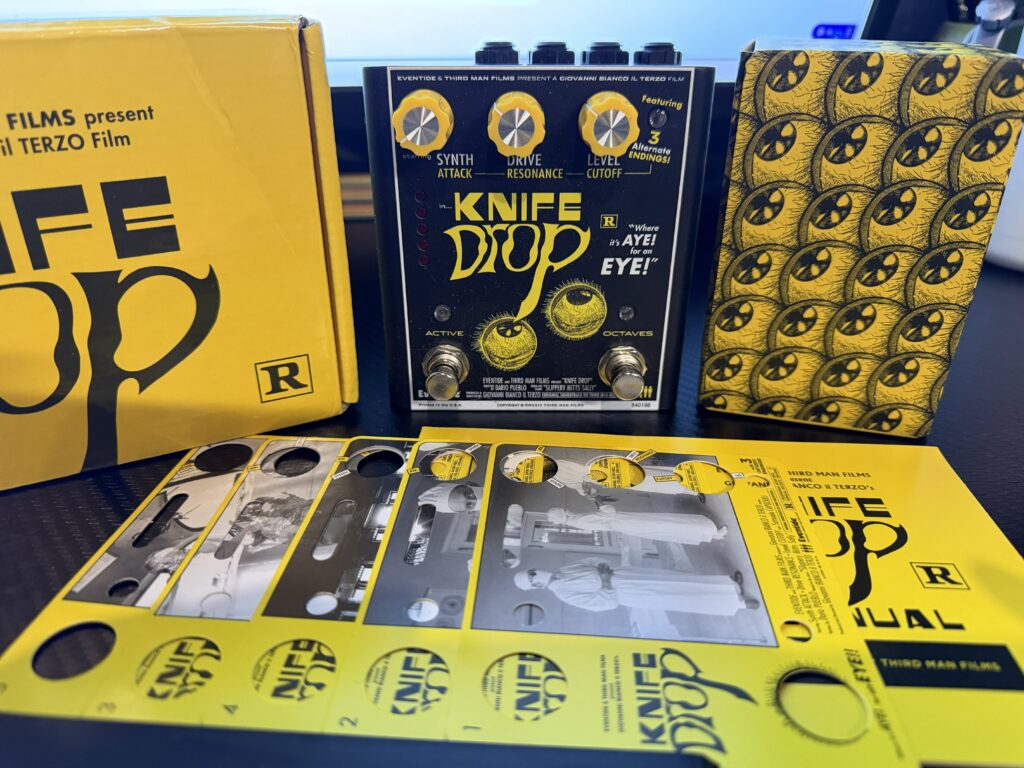
Some pedals give you a better version of your existing tone.
The Eventide Knife Drop does not care about your existing tone.
The Knife Drop looks at your carefully crafted guitar sound, laughs, and asks:
“Would you like to sound like a broken Nintendo, an angry synthesizer, a spaceship landing in a junkyard, or perhaps all three simultaneously?”
This thing is ridiculous.
And I mean that as a compliment.
It can do fuzz.
It can do octaves.
It can do synth sounds.
It can do weird glitchy noises.
It can do sounds that make other guitar players wander over and ask:
“Okay, seriously… what the hell is that thing?”
The Knife Drop is less of a guitar pedal and more of a creativity machine.
I’ve owned pedals that improved my tone.
I’ve owned pedals that improved my versatility.
The Knife Drop improves my ability to waste an entire afternoon making noises instead of practicing.
And honestly?
That’s worth something.
💩 1 Poop
Really Good crap.
Not because it isn’t amazing.
It’s amazing.
But this is specialty-grade weirdness.
Some people want a screwdriver.
The Knife Drop is a Swiss Army knife that occasionally catches fire and begins speaking in robot noises.
Why This Review Matters
If you’re researching:
- Eventide Knife Drop Review
- Knife Drop pedal
- Eventide fuzz pedal
- Jack White pedal
- Best synth pedal
- Fuzz octave pedal
- Weird guitar pedals
This review combines research with actual owner impressions from someone who thinks musical chaos is a feature and not a bug.
More Fun Than A Jack-In-The-Box
I don’t say this lightly.
This pedal is more fun than a jack-in-the-box was when I was three years old.
Every knob adjustment feels like opening a surprise.
Sometimes the surprise is:
“Wow, that’s a beautiful vintage fuzz tone.”
Sometimes the surprise is:
“I appear to have accidentally summoned a robot bee.”
Either way, you’re having a good time.
The Knife Drop rewards experimentation more than almost any pedal I’ve played.
It’s Not Really A Fuzz Pedal
Technically?
Sure.
It contains fuzz.
But calling the Knife Drop a fuzz pedal is like calling a Leatherman a screwdriver.
Yes.
One is in there somewhere.
That isn’t the whole story.
You get:
- Fuzz
- Octaves
- Synth voices
- Envelope filtering
- Expression control
- Presets
- MIDI
- Stereo operation
This thing sits somewhere between a guitar pedal and a small science project.
Nintendo Tones
Let’s get the important stuff out of the way.
Can it make Nintendo noises?
Absolutely.
The good kind.
The sounds of discovering a secret level at 2 AM while your parents were telling you to go to bed.
The synth engine and octave options can create wonderfully video-game-like textures that don’t sound like traditional guitar at all.
Sometimes that’s exactly what you want.
Cream, Classic Rock, and Real Guitar Sounds
Thankfully, it also understands restraint.
You don’t have to use it exclusively for intergalactic nonsense.
Dial things back and there’s plenty of classic musical territory available.
Cream-inspired fuzz lines?
Absolutely.
Vintage lead tones?
Yep.
Classic rock riffs?
No problem.
A lot of wild pedals eventually become one-trick ponies.
The Knife Drop stays useful because it still knows how to sound like a guitar.
It just also knows how to sound like several things that aren’t guitars.
The Octave Madness
This is where things start getting dangerous.
The octave section can completely change the way you think about riffs.
Suddenly you’re hearing notes in new places.
New harmonics appear.
New textures emerge.
The pedal keeps presenting ideas you wouldn’t normally play.
And that’s one of its greatest strengths.
The best gear isn’t always the gear that sounds best.
Sometimes it’s the gear that inspires you to play differently.
The Knife Drop absolutely does that.
Chords? Uh… Maybe.
Let’s talk about the reality.
The synth engine is monophonic.
It likes clean notes.
It likes intentional playing.
It likes cooperation.
If you start throwing giant jazz chords and sloppy muting at it, things can become… creative.
Sometimes extremely creative.
Personally, I think that’s part of the fun.
But if you’re expecting perfect polyphonic synth tracking, you should probably look elsewhere.
Built For Tinkerers
The Knife Drop feels like it was designed by people who genuinely enjoy twisting knobs just to see what happens.
Every control changes the personality of the pedal.
Move the synth.
Adjust the filter.
Change the resonance.
Add an octave.
Flip the processing order.
Suddenly you’re somewhere completely different.
This is not a pedal for people who want:
One sound.
Three knobs.
The end.
This is for people who enjoy happy accidents.
The Learning Curve
I do have one criticism.
The pedal isn’t always intuitive.
There are secondary functions.
Hidden features.
Preset systems.
Routing options.
And enough flexibility to occasionally make your brain hurt.
A simple Tube Screamer can be understood in thirty seconds.
The Knife Drop wants a longer conversation.
Fortunately, the conversation is usually entertaining.
Guitar Players Beware
This pedal can create a dangerous condition.
The condition goes something like:
“I’ll just try one more setting.”
Three hours later:
“What time is it?”
The Knife Drop excels at making you lose track of time.
You start looking for a tone.
You end up discovering five tones.
Then an alien invasion soundtrack.
Then a sound that resembles an 8-bit chainsaw.
Then a fuzz tone that makes you immediately play White Room for twenty minutes.
It’s a journey.
Durability
Like most Eventide gear, the build quality is excellent.
The enclosure feels substantial.
The switches feel solid.
The controls inspire confidence.
Nothing about it feels cheap.
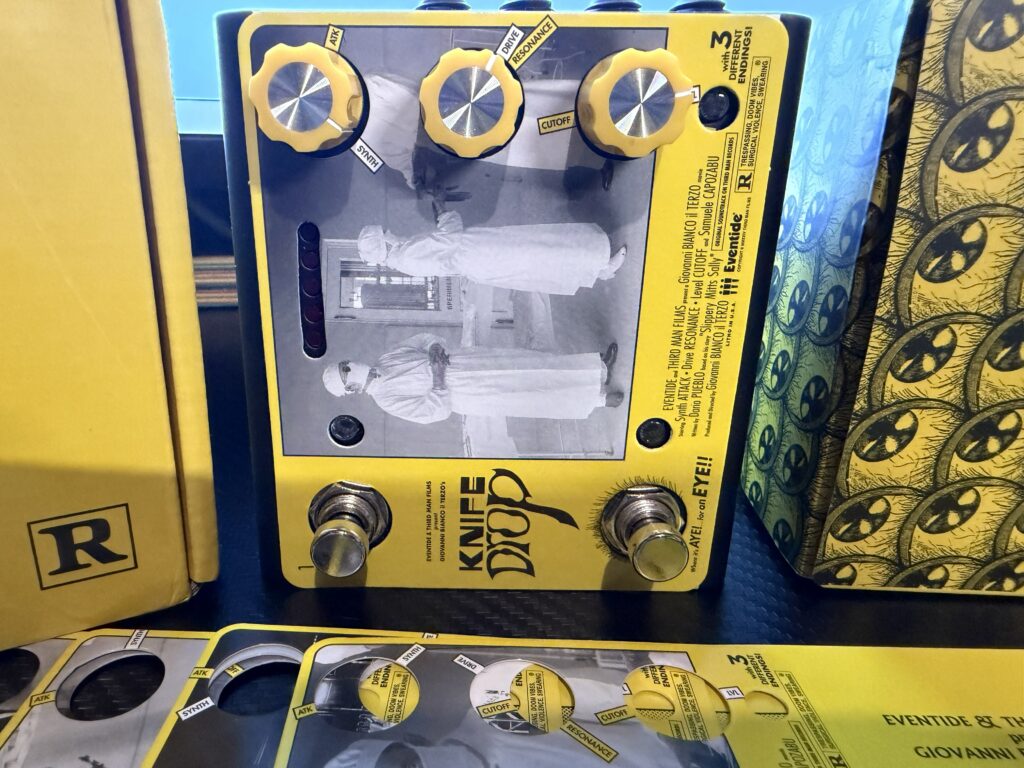
This is professional-grade hardware disguised as a toy factory.
Who Should Buy One?
Buy a Knife Drop if:
- You love experimentation
- You enjoy synth sounds
- You want fuzz plus much more
- You love octaves
- You already own several conventional pedals
- You want inspiration as much as tone
- You’re the person everybody calls “the gear guy”
Skip it if:
- You want simple operation
- You need predictable behavior at all times
- You only want traditional overdrive
- You hate menus, presets, or deeper functionality
Pros & Cons
✅ Pros
- Exceptionally creative
- Fantastic fuzz sounds
- Excellent octave effects
- Convincing synth textures
- Inspires new playing ideas
- Presets and MIDI support
- Stereo operation
- Great build quality
- Covers an enormous amount of sonic territory
- Can sound like things that shouldn’t legally come from a guitar
❌ Cons
- Learning curve
- Not always intuitive
- Monophonic synth tracking has limitations
- Chords can get weird
- Far more complex than a traditional fuzz
- May dramatically reduce your actual practice time
- Makes normal pedals seem a little boring afterward
Final Verdict
The Eventide Knife Drop isn’t a pedal you buy because you need it.
It’s a pedal you buy because you’re curious.
Then that curiosity turns into fascination.
And then somehow it’s midnight and you’ve spent four hours making sounds that range from Cream to Castlevania.
This isn’t the pedal I would recommend to every guitarist.
It’s the pedal I’d recommend to every guitarist who misses the feeling of discovery.
Because that’s what the Knife Drop does best.
Every time you step on it, there’s a chance you’ll find something you weren’t looking for.
And those are usually the best tones anyway.
Final Poop Score
💩💩 1/4 Poops
Good crap.
A fuzz pedal.
A synth pedal.
An octave pedal.
A creativity machine.
And possibly the most fun I’ve had with a little metal box since discovering that guitar pedals were a thing.
The Eventide Knife Drop proves an important truth:
Sometimes the best gear doesn’t help you sound like your heroes.
Sometimes it helps you sound like absolutely nobody else. 🎸💩👾🎮

Leave a Reply