
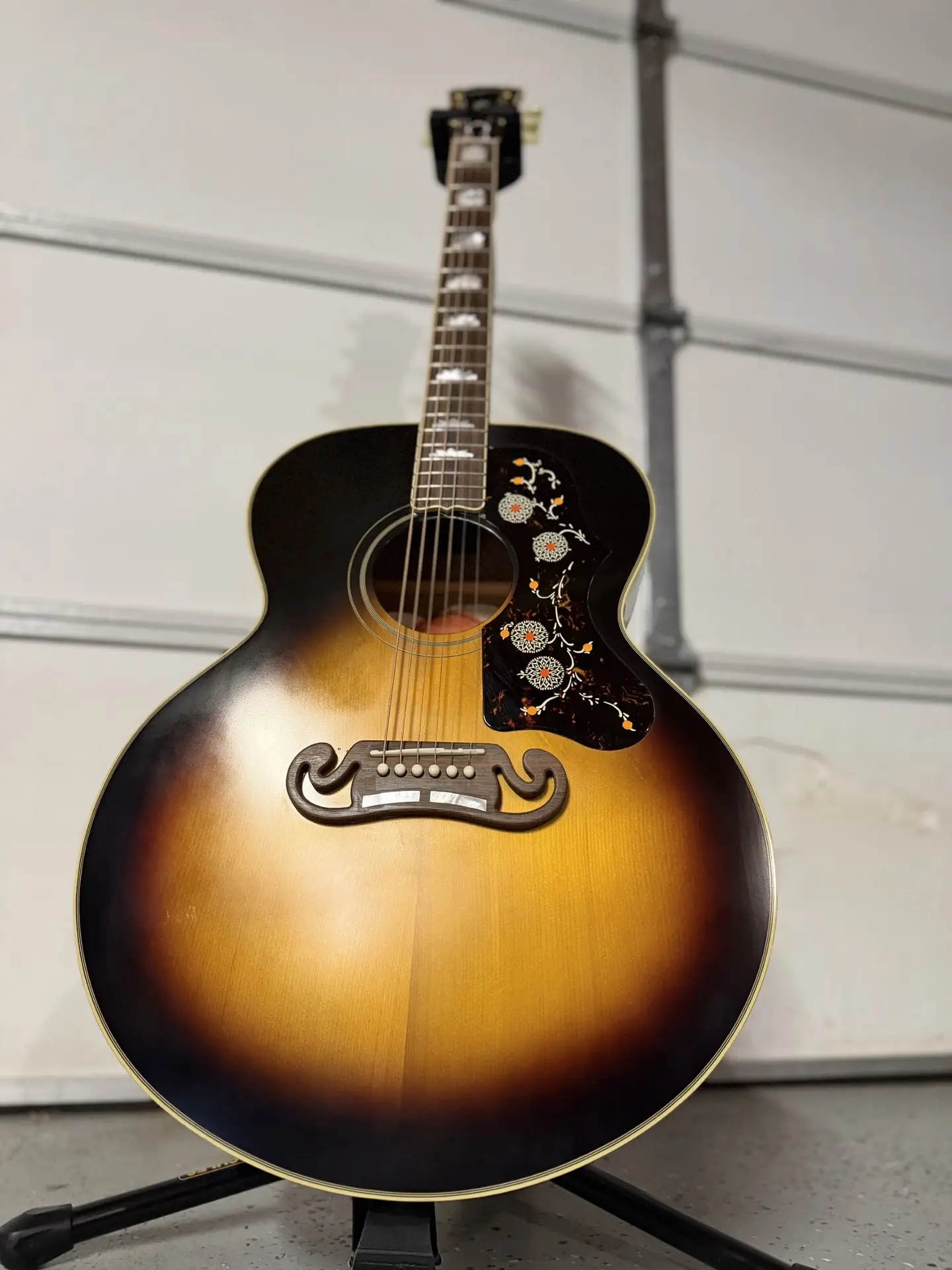
Every now and then a guitar comes along that makes you stop and ask:
“Wait… this costs HOW much?”
That was my reaction to the Epiphone Inspired by Gibson Custom 1957 SJ-200.
This isn’t one of those budget guitars that’s “good for the money.”
I hate that phrase.
Usually “good for the money” means:
“It’s not completely terrible if you squint hard enough and lower your expectations.”
The 1957 SJ-200 is different.
It’s simply a good guitar.
Period.
It looks expensive.
It feels expensive.
It sounds expensive.
Then you look at the price tag and discover it costs significantly less than the Gibson version that inspired it.
The result is one of the strongest values currently available in the acoustic guitar world.
💩 Poop Rating
💩 1 Poop
Excellent crap.
This guitar delivers so much of the SJ-200 experience that it makes you seriously question how much money you’d need to spend to gain a meaningful improvement.
Why This Review Matters
If you’re researching:
- Epiphone Inspired by Gibson Custom 1957 SJ-200 Review
- Epiphone SJ-200 vs Gibson SJ-200
- Best acoustic guitar under $2,000
- Is the Epiphone 1957 SJ-200 worth it?
- Epiphone Inspired by Gibson Custom review
- Best value jumbo acoustic guitar
this review combines research, owner experiences, and real-world impressions.
First Impressions
Let’s get the obvious thing out of the way.
This guitar is gorgeous.
Absolutely gorgeous.
The huge Super Jumbo body.
The ornate pickguard.
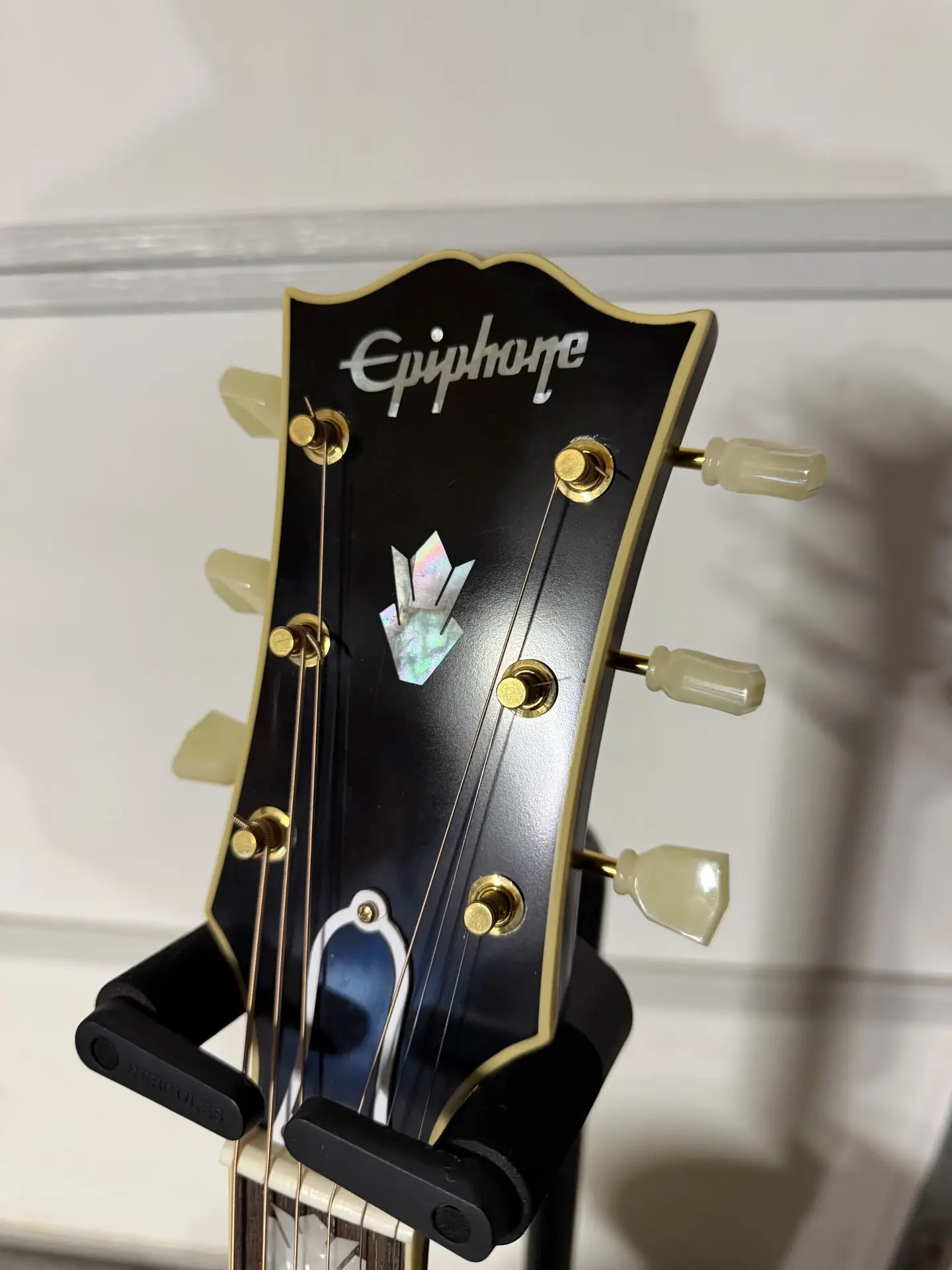
The gold hardware.
The crown inlays.
The moustache bridge.
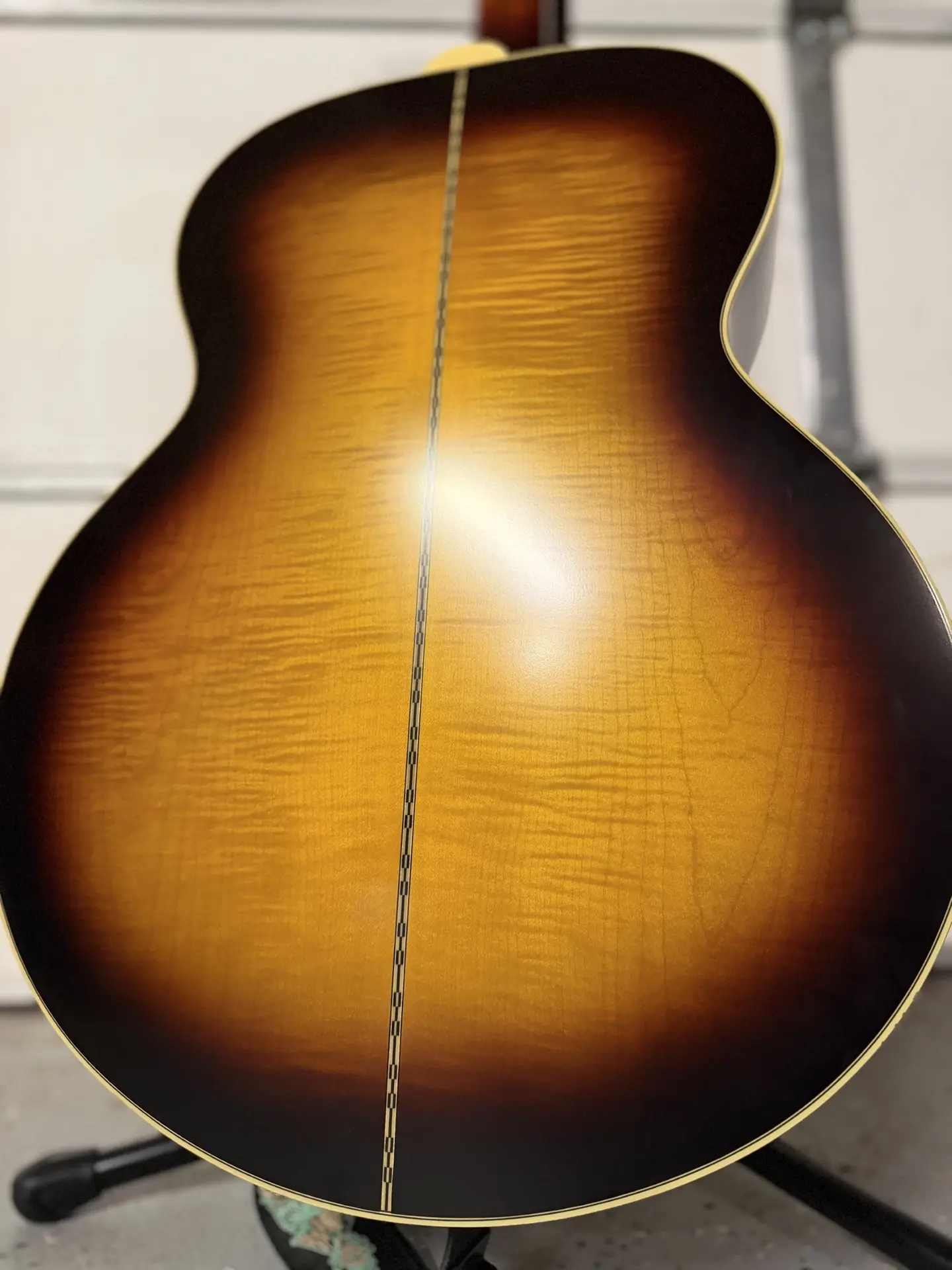
The figured maple back and sides.
This is not a subtle guitar.
This is the acoustic equivalent of showing up to a black-tie event in a classic Cadillac.
You don’t buy an SJ-200 because you’re trying to be invisible.
You buy an SJ-200 because they’re beautiful.
The Epiphone absolutely captures that vibe.
Build Quality
This isn’t a cheap plywood box wearing fancy makeup.
The 2024 model features:
- Solid thermally-aged Sitka spruce top
- Solid figured maple back and sides
- Scalloped X-bracing
- Bone nut
- Bone saddle
- Bone bridge pins
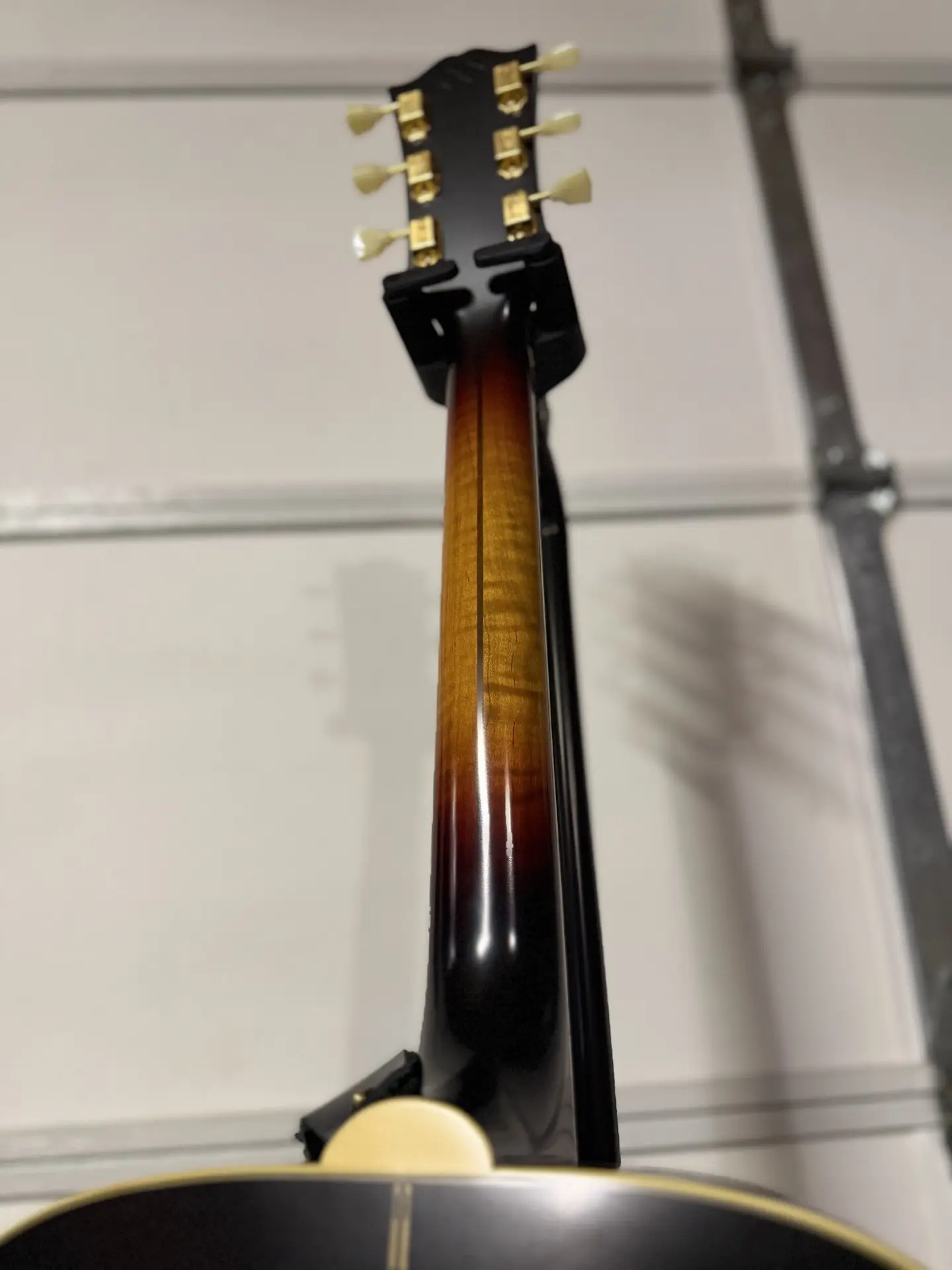
- Maple neck
- L.R. Baggs electronics
That’s an impressive specification sheet at any price.
It’s downright ridiculous at this price.
One of the biggest reasons this model has created so much excitement is because Epiphone didn’t cheap out on the important stuff.
The expensive look isn’t hiding a bargain-bin construction.
The build is genuinely serious.
Sound
This is where the guitar won me over.
Some guitars look incredible and sound disappointing.
Some sound incredible and look boring.
The SJ-200 manages both.
The best word I can use is:
Big.
Not boomy.
Not muddy.
Big.
Strumming chords fills a room.
Open chords have authority.
Flatpicking has punch.
Fingerstyle passages still maintain clarity.
It sounds like a guitar that should cost substantially more than it does.
Is it identical to a Gibson Custom SJ-200?
No.
Of course not.
The Gibson projects harder, has a little more complexity, and benefits from construction details that cost real money.
But that’s not the right question.
The right question is:
Does it sound close enough that you’ll smile every time you pick it up?
Absolutely.
Playability
The scale length is a full 25.5 inches, so there’s a little more string tension than some Gibson acoustics.
That gives notes a nice snap and clarity.
The neck profile may feel a little substantial for players who prefer thin electric-style necks.
Personally, I thought it matched the character of the instrument.
An SJ-200 isn’t supposed to feel tiny.
The biggest adjustment for some players is simply the size of the body.
This thing is enormous.
If you’re smaller in stature or spend most of your time on parlor guitars, the SJ-200 can feel like parking a school bus in your lap.
For everyone else, that’s part of the charm.
The Value Proposition
This is where the guitar becomes a superstar.
Every reviewer always wants to compare it to a Gibson SJ-200.
Which is understandable.
But here’s what matters:
You can buy this guitar without having to explain a second mortgage to your spouse.
That’s incredibly important.
The Gibson version is fantastic.
It should be.
It costs several times more.
The shocking thing is how much of the visual appeal, feel, and tonal character survived the trip down to the Epiphone price bracket.
This isn’t a budget imitation.
It’s more like getting 85–90% of the experience for a fraction of the cost.
And that’s where the value becomes extraordinary.
Long-Term Ownership
Because these weren’t released until 2024, nobody can honestly tell you what ownership looks like in twenty years.
Anyone claiming otherwise is full of crap.
What we do know is:
- Build quality appears consistently strong
- Structural complaints are very rare so far
- Electronics have a good reputation
- The included hardshell case is excellent
- Owners are overwhelmingly happy
The biggest enemy isn’t the guitar.
It’s humidity.
Like every solid-wood acoustic, this thing wants stable humidity levels.
Treat it properly and it’ll likely reward you.
Ignore humidity and you’ll eventually be posting angry messages on guitar forums blaming the factory for what your furnace did.
Maintenance
The good news?
There isn’t much to do.
Keep it humidified.
Change strings.
Clean it occasionally.
Don’t leave it in a hot car.
Don’t leave it next to a heater.
Don’t use it as a canoe paddle.
Basic acoustic guitar ownership stuff.
The included Baggs pickup system is also refreshingly simple compared to many onboard systems.
If you perform live, it’ll do its job without requiring a PhD in menu navigation.
A Brief History of the SJ-200
The SJ-200 lineage goes all the way back to 1937.
It was designed as Gibson’s flagship flat-top acoustic.
Over the decades, it became associated with artists including:
- Elvis Presley
- Bob Dylan
- George Harrison
- Jimmy Page
- Emmylou Harris
The model became famous for combining huge visual presence with huge sound.
The Epiphone version isn’t pretending to be a forensic recreation of every detail from the original.
Instead, it captures what players actually love about the SJ-200:
- The maple construction
- The giant Super Jumbo body
- The visual style
- The projection
- The feel
And honestly, that’s what most people are after anyway.
Pros & Cons
✅ Pros
- Outstanding value
- Gorgeous appearance
- All-solid wood construction
- Huge, rich acoustic sound
- High-quality Baggs electronics
- Comfortable modern playability
- Excellent hardware package
- Includes hardshell case
- Feels much more expensive than it is
- One of the best-looking guitars Epiphone has ever produced
❌ Cons
- Very large body size
- May be uncomfortable for smaller players
- Neck may feel chunky to some players
- Not a perfect Gibson Custom replacement
- Long-term durability history is still developing
- Can trigger dangerous thoughts like buying more guitars
Final Verdict
The Epiphone Inspired by Gibson Custom 1957 SJ-200 is exactly the sort of product I love reviewing.
It doesn’t rely on hype.
It doesn’t rely on gimmicks.
It simply delivers far more guitar than its price tag suggests.
It’s beautiful.
It’s fun to play.
It sounds fantastic.
And every time I pick it up, I find myself thinking:
“This thing had no business being this good for the money.”
If you’re shopping for a premium jumbo acoustic without entering financially irresponsible Gibson Custom territory, this guitar deserves a spot near the top of your list.
Final Poop Score
💩
Excellent crap.
A giant, gorgeous, room-filling acoustic guitar that sounds like it costs far more than it actually does.
In the guitar world, that’s some seriously good shit. 🎸💩




Leave a Reply