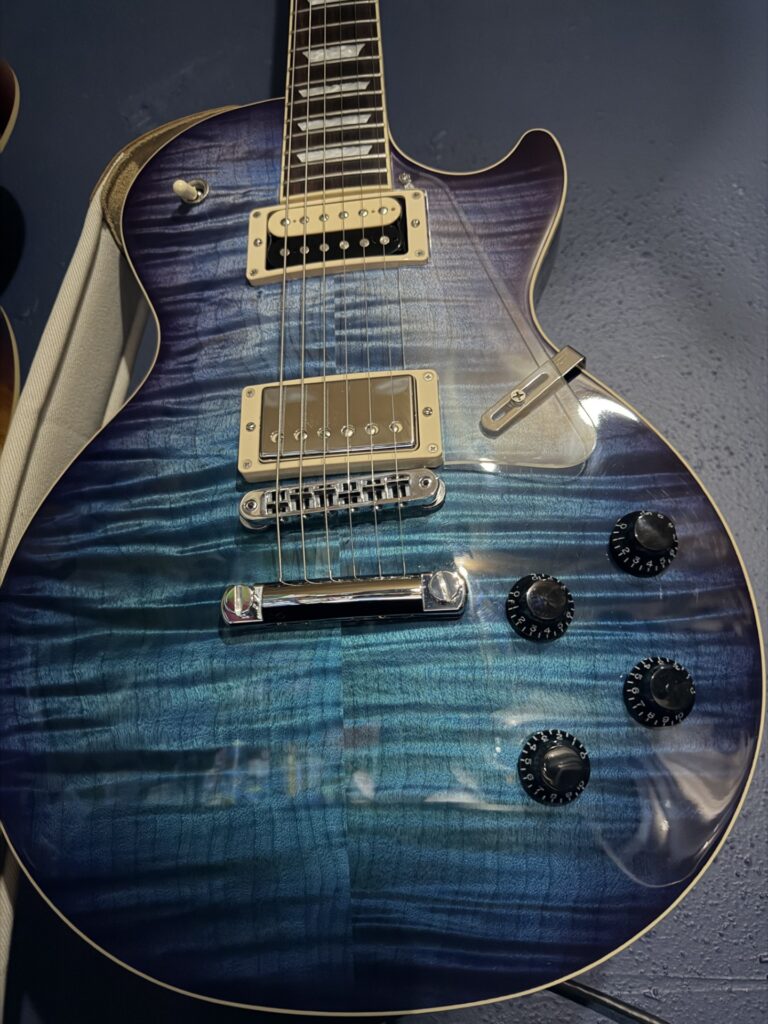
Gibson Les Paul Traditional Pro V: AAA Flame Top — Blueberry Burst
Circa-2020 Buyer’s, Owner’s, and Collector’s Background Report
Executive summary
The Gibson Les Paul Traditional Pro V AAA Flame Top in Blueberry Burst is an unusual Les Paul because its appearance is rooted firmly in the classic carved-maple-top Les Paul tradition, while much of its engineering is decidedly modern.
Introduced in late 2019 and sold through Guitar Center as the fifth generation of the Gibson/Guitar Center Traditional Pro collaboration, the Trad Pro V combines:
- A mahogany Les Paul body
- AAA figured maple top
- Blueberry Burst gloss nitrocellulose finish
- Traditional nine-hole weight relief
- Set mahogany neck
- Bound rosewood fingerboard
- Asymmetrical neck profile
- Compound-radius fingerboard
- Locking Grover tuners
- Nashville Tune-o-matic bridge
- Aluminum stopbar tailpiece
- Gibson Tradbucker pickups
- Four push/pull controls
- Five internal DIP switches
- Coil splitting, coil tapping, phase reversal, coil selection, high-pass filtering, and transient suppression
The result is essentially a high-performance Les Paul disguised as a traditional one.
Its strongest qualities are its neck and playability, attractive figured maple top, broad tonal range, solid traditional Les Paul construction, and unusually sophisticated electronics.
Its principal weaknesses are the normal vulnerabilities of a nitro-finished Les Paul—finish wear and headstock impact sensitivity—combined with variable factory setup/QC on individual examples and greater electronic complexity than a conventional Les Paul.
For someone considering a used example today, the most important advice is simple:
Evaluate the individual guitar rather than buying solely on the model name.
Top figuring, weight, nut work, setup, finish execution, and overall feel vary enough between examples that two apparently identical Trad Pro Vs can feel surprisingly different.
1. What exactly is the Traditional Pro V?
The model is properly identified as the:
Gibson Les Paul Traditional Pro V AAA Flame Top
The documented Blueberry Burst model code is:
LPTP19B9CH3
The generation appeared in late 2019, with a documented release date of
October 7, 2019, and was actively promoted by Guitar Center during 2020. Guitar Center described it as the
fifth generation of a Gibson/Guitar Center collaboration that began in 2008.
[forum.gibson.com]That distinction matters because several similarly named guitars exist.
Traditional Pro V AAA Flame Top
This is the premium gloss version associated with Blueberry Burst.
It has:
- AAA flame maple top
- Gloss nitro finish
- Mahogany body
- Nine-hole weight relief
- Tradbucker pickups
- HP-4 electronics
- Asymmetrical neck
- Compound-radius rosewood fingerboard
- Locking Grovers
Traditional Pro V Satin
A less-expensive version was offered with a plain top and satin finish.
Although much of the electronics and neck specification was shared, it should not be confused with the gloss AAA Flame Top model.
[ithinkdiff.com]Traditional Pro V Mahogany Top
A further 2020 variation used a mahogany rather than figured maple top.
Again, this is a different instrument despite carrying the Traditional Pro V name.
[applescoop.org]Earlier Traditional Pro models
The Traditional Pro family goes back to approximately 2009.
Earlier generations used different pickups, electronics, neck specifications, finishes, and hardware combinations. The original Traditional Pro, for example, used a
’57 Classic neck pickup and BurstBucker 3 bridge pickup, rather than Tradbuckers.
[stewmac.com]Consequently, specifications from a Traditional Pro II, III, or IV should not automatically be applied to a Pro V.
2. Construction and materials
Body
The Blueberry Burst AAA Flame Top version uses the classic Les Paul material combination:
Mahogany body + carved figured maple top
The maple is visually graded AAA.
The body is not completely solid internally. Gibson uses its traditional
nine-hole weight-relief pattern, in which nine large holes are drilled into the mahogany before the maple cap is attached.
[forum.gibson.com],
[inc42.com]This is important because some later advertisements incorrectly describe the model as using Ultra-Modern weight relief.
The strongest period and inspection-based evidence supports nine-hole Traditional weight relief.
That means the guitar retains considerably more internal mahogany than Gibson’s more aggressively chambered designs.
3. The AAA flame maple top
The figured maple top is one of the defining features of the Blueberry Burst version.
AAA is primarily a visual grading designation.
It does not guarantee:
- Identical flame width
- Perfect symmetry
- Perfect bookmatching
- Identical figuring from every viewing angle
- Absence of mineral streaks
- Identical flame intensity between guitars
Consequently, individual Trad Pro V tops can look dramatically different.
Some have broad, highly three-dimensional flame.
Others have tighter figuring.
Some appear extremely symmetrical from directly in front but change considerably when viewed from an angle.
This variation is normal for figured wood and is one reason buyers should inspect photographs of the actual guitar, rather than relying on catalog photography.
4. Blueberry Burst finish
The Blueberry Burst version uses a
gloss nitrocellulose lacquer finish.
[macworld.com],
[gibson.com]The finish allows the maple figure to remain visible beneath a blue/purple perimeter burst.
Unlike an opaque finish, the appearance therefore depends heavily on the individual maple top underneath it.
Nitrocellulose lacquer is also an important part of long-term ownership because it behaves differently from modern polyurethane and polyester finishes.
Over time it can develop:
- Fine scratches
- Polishing swirls
- Dulling
- Yellowing
- Edge wear
- Small dents
- Finish checking
- General patina
Gibson itself describes these characteristics as part of the way nitrocellulose ages.
[pricerunner.com]For some owners this aging is desirable.
For someone trying to preserve a pristine Blueberry Burst, however, nitro requires more care than many modern guitar finishes.
5. Neck construction
The Trad Pro V uses a
set mahogany neck glued into the body in traditional Gibson fashion.
[wccftech.com],
[inc42.com]Scale length is:
24.75 inches
Nut width is approximately:
1.69 inches / 43 mm
The neck is one of the most distinctive parts of the model.
Rather than using a symmetrical 1950s or 1960s Gibson profile, the Trad Pro V has an asymmetrical neck carve.
Guitar Center described the concept as having more material supporting the palm on one side while becoming slimmer toward the finger side. The result is a neck that feels noticeably different from a conventional Les Paul.
6. Compound-radius rosewood fingerboard
The fingerboard is bound rosewood with:
- 22 frets
- Trapezoid inlays
- Compound radius
A compound-radius board gradually becomes flatter toward the upper frets.
In practical terms, this attempts to combine:
- Comfortable chord playing lower on the neck
- Easier bending higher on the neck
- Lower upper-register action without fretting out
This feature, combined with the asymmetrical neck, is one of the reasons owners frequently describe the Trad Pro V as unusually easy-playing for a Les Paul.
Exact published starting and ending radius figures are difficult to establish from reliable period documentation, so claims assigning precise compound-radius numbers should be treated cautiously.
7. Frets and factory fretwork
The guitar has 22 frets generally described as
modern or medium-jumbo-class fretwire.
[forum.gibson.com],
[inc42.com]Gibson’s Nashville production process during this period included Plek fret leveling.
Gibson documented the process at its USA factory in 2020, showing instruments being machine-measured and leveled before final setup.
[notebookcheck.net]Plek processing does not guarantee that every guitar leaves a retailer perfectly adjusted.
Final playability still depends on:
- Nut slot depth
- Neck relief
- Bridge height
- Fret finishing
- Climate
- Shipping conditions
- Dealer setup
This distinction helps explain why some owners report excellent factory fretwork while others report fret buzz or setup issues.
8. Nut
The exact nut material is one area where documentation is inconsistent.
A documented 2020 Gibson MOD evaluation identifies:
Tektoid
while a later professional Trad Pro V review lists:
GraphTech NuBone
This could represent:
- A production change
- Supplier variation
- Different terminology
- Specification changes later in the model run
Therefore, the safest conclusion for a circa-2020 guitar is:
The model used a synthetic self-lubricating-style nut material, but the exact material should be verified on the individual instrument rather than assumed from later specifications.
Nut workmanship is more important to actual performance than the brand name of the material.
9. Tradbucker pickups
The Trad Pro V introduced proprietary Gibson Tradbucker pickups.
These are not BurstBucker Pros, despite some later used-guitar listings incorrectly identifying them that way.
Both pickups use Alnico V magnets.
The neck pickup is deliberately underwound.
The bridge pickup is deliberately overwound.
Guitar Center’s 2020 feature explains that Gibson developed several pickup versions before selecting the final Tradbucker combination. Measured examples have been approximately:
| Pickup |
Approximate measured resistance |
| Neck |
7.5 kΩ |
| Bridge |
8.3–8.4 kΩ |
These should be treated as representative measurements rather than exact factory targets.
10. Why the pickups were originally uncovered
The factory Trad Pro V presentation used open zebra-coil Tradbuckers.
Guitar Center specifically noted that uncovered zebra pickups had become a visual theme of the Traditional Pro series. This gives the guitar a slightly more aggressive appearance than a conventional covered-humbucker Les Paul.
Pickup covers can be fitted later, but a covered pickup should not automatically be assumed to be factory original when evaluating a used Trad Pro V.
11. The HP-4 electronics system
This is arguably the most unusual feature of the guitar.
At first glance the controls look like a normal Les Paul:
- Two volume knobs
- Two tone knobs
- Three-way pickup selector
But all four knobs are push/pull controls.
Inside the control cavity is a bank of five DIP switches.
The system is commonly referred to as Gibson’s
HP-4 High Performance circuit.
[applescoop.org],
[apfeltalk.de]
12. What the controls actually do
The two volume controls can operate their respective pickups as either:
or
depending on the internal DIP-switch configuration.
The neck/rhythm tone push-pull provides:
Phase reversal
The bridge/treble tone push-pull can select:
Inner or outer coils
when operating in split mode.
The internal DIP switches configure:
- Neck pickup — tap or split
- Bridge pickup — tap or split
- Neck volume — high-pass filter on/off
- Bridge volume — high-pass filter on/off
- Transient suppression on/off
This makes the Trad Pro V one of the most electronically configurable production Les Pauls.
13. Coil split versus coil tap
These terms are often incorrectly used interchangeably.
A coil split disables one coil of a humbucker.
A coil tap accesses a different point in the pickup winding.
The Trad Pro V allows the player to configure which behavior the push/pull volume controls perform.
That is considerably more sophisticated than the simple coil-split circuit found on many guitars.
14. Phase switching
The phase function becomes particularly noticeable when both pickups are selected.
Reversing the electrical phase relationship causes frequencies common to both pickups to partially cancel.
The resulting sound is typically:
- Thinner
- More nasal
- Hollow
- Mid-focused
It recalls the famous accidental out-of-phase sound associated with certain vintage Les Pauls.
15. Inner and outer coil selection
When the pickups are split, the Trad Pro V can determine which coils remain active.
This allows combinations involving:
- Inner coils
- Outer coils
- Mixed coil relationships
This produces noticeably different attack and frequency balance.
It is one reason the guitar can cover a much broader tonal range than its traditional appearance suggests.
16. High-pass filters
Two DIP switches control high-pass filtering associated with the volume controls.
Their purpose is to retain more high-frequency information as volume is reduced.
Without such a circuit, rolling down a passive guitar volume control often darkens the sound.
The high-pass option allows the Trad Pro V to maintain more clarity at reduced volume.
17. Transient suppression
The fifth DIP switch controls a transient-suppression circuit.
This should not be confused with an active boost.
The circuit reduces extreme signal peaks somewhat like a mild limiter, which can be useful when recording directly into digital equipment.
[inc42.com]No battery is required for normal operation.
18. Electronics construction
The Trad Pro V uses a printed circuit board and quick-connect wiring system rather than completely traditional point-to-point Les Paul wiring.
Surviving HP harnesses show:
- Four long-shaft push/pull potentiometers
- PCB construction
- Quick-connect pickup wiring
- Five-position DIP block
Some documented harnesses identify CTS potentiometers.
[apfeltalk.de]Advantage
The system allows an enormous number of switching functions in a relatively organized package.
Disadvantage
It is more complicated to troubleshoot or modify than a conventional four-pot Les Paul harness.
A traditional Les Paul circuit can often be repaired with generic pots, capacitors, wire, and a soldering iron.
The HP-4 system contains more specialized components.
19. Bridge and tailpiece
The guitar uses a:
Nashville Tune-o-matic bridge
with an:
Aluminum stopbar tailpiece
The Tune-o-matic provides individual saddle adjustment for intonation.
The aluminum tailpiece reduces some mass compared with heavier zinc-based tailpieces.
Both are conventional, proven Gibson hardware designs.
20. Tuners
Factory tuners are
locking Grovers with tulip-style buttons.
[forum.gibson.com],
[inc42.com]Locking tuners primarily make restringing faster and reduce the amount of string wrapped around the tuner post.
They do not automatically solve tuning problems.
On a Les Paul, tuning instability is frequently associated with:
- Nut-slot friction
- Improper string installation
- Poor setup
- String stretching
- Saddle problems
rather than tuner failure.
21. Weight
Despite weight relief, the Trad Pro V should not automatically be considered a lightweight guitar.
Documented 2020 Blueberry Burst examples include approximately:
Other examples can fall outside that range.
Wood density varies naturally, so two guitars built to identical specifications can differ noticeably in weight.
This is another reason buyers should obtain the actual weight of a used guitar rather than relying on catalog specifications.
22. Workmanship and factory quality
Gibson’s Nashville manufacturing process combines machine operations with substantial handwork.
Documented factory processes include:
- Rough body milling
- Neck shaping
- Fingerboard installation
- Fret installation
- Neck fitting
- Gluing the neck into the body
- Plek fret leveling
- Hand binding scraping
- Nitrocellulose spraying
- Buffing
- Pickup winding
- Hardware installation
- Electronics installation
- Final setup
This means two guitars built to the same specification can still show small differences.
23. Quality-control experience
The evidence suggests that Trad Pro V workmanship can be excellent, but individual inspection remains worthwhile.
A professional review found generally excellent construction and setup, while noting only very minor cosmetic imperfections such as a small binding ledge and slight finish texture near the heel.
[inc42.com]Owner reports also include examples with:
- Excellent fretwork
- Excellent nut work
- Very good factory setup
- Strong resonance
- Clean finish execution
But recurring complaints include occasional:
- Poorly cut nuts
- Fret buzz
- Setup problems
- Finish blemishes
- Hardware alignment issues
Guitar Center’s review aggregation lists
craftsmanship as the most frequently selected negative category, although positive reviews greatly outnumber negative ones.
[forum.gibson.com]The correct interpretation is not that Trad Pro Vs have poor quality control.
Rather:
Factory consistency is not perfect, so the individual instrument matters.
24. Long-term owner experience
The most consistent long-term praise concerns the neck.
Owners frequently describe the asymmetrical profile and compound-radius board as unusually comfortable.
Other recurring positives include:
- Strong full-humbucker tones
- Excellent versatility
- Comfortable upper-register playing
- Good tuning performance after proper setup
- Attractive figured tops
- Useful locking tuners
- Good sustain
- Broad recording usefulness
The electronics are particularly appreciated by players who want one guitar capable of covering many sounds.
25. Recurring owner complaints
The most common reservations are:
Weight
Even with nine-hole relief, many examples remain around nine pounds or more.
Setup variation
Some guitars require nut or setup work before performing at their best.
Electronics complexity
Some owners love the HP-4 system.
Others eventually settle on one configuration and rarely touch the DIP switches again.
Too many options
The guitar can encourage constant experimentation rather than simply playing.
A professional reviewer specifically identified this as the potential downside of having so many switching possibilities.
[inc42.com]Traditional in name only
Some Les Paul enthusiasts dislike the model name because the guitar contains numerous modern features.
That criticism is understandable.
The Trad Pro V is arguably better described as a modern player’s Les Paul wearing traditional clothing.
26. Nitrocellulose finish aging
The gloss Blueberry Burst finish deserves special attention.
Gibson uses nitrocellulose lacquer, which ages differently from thick polyurethane finishes.
Over time it may develop:
- Fine checking
- Yellowing
- Polishing swirls
- Small dents
- Edge wear
- Dulling
- Hand-contact wear
- General patina
These changes do not necessarily indicate poor workmanship.
They are characteristic of the finish system.
27. Guitar stands can damage the finish
This is one of the most important ownership warnings.
Gibson specifically cautions that some rubber and synthetic materials used on guitar stands can react chemically with nitrocellulose lacquer.
Possible results include:
- Softening
- Discoloration
- Permanent staining
- Finish damage
Gibson recommends covering questionable stand-contact surfaces with soft cotton and using stands primarily for temporary storage.
[gibson.com]Nitro-safe stands are preferable.
28. Temperature changes and finish checking
Rapid temperature changes can cause nitrocellulose lacquer to crack.
A classic example is bringing a very cold guitar indoors during winter and immediately opening the case.
The wood and lacquer expand at different rates.
Gibson recommends allowing a cold instrument to warm gradually
inside its closed case before exposing it to warm room air.
[gibson.com],
[guitarelec…ronics.com]Finish checking generally does not indicate structural damage, but it permanently changes the appearance.
29. Hardware aging
Chrome hardware is relatively durable but not immune to wear.
Perspiration contains salts and acids that can eventually affect:
- Bridge
- Tailpiece
- Pickup covers if fitted
- Screws
- Tuner surfaces
Gibson recommends wiping the instrument and hardware after playing.
[gibson.com]Players with particularly acidic perspiration may see hardware aging much faster than others.
30. Fret durability
There is no convincing evidence of a Trad Pro V-specific fret-wear problem.
Fret life depends primarily on:
- Playing hours
- String material
- String gauge
- Fretting pressure
- Bending technique
Used examples show everything from minimal fret wear to ordinary player wear.
That variation is expected.
31. Electronics durability
No convincing evidence emerged of a widespread Trad Pro V electronics failure problem.
However, the HP-4 system contains more components than a conventional Les Paul.
Potential service points include:
- Four push/pull pots
- PCB
- Quick-connect plugs
- DIP switches
- Pickup selector
- Output jack
The disadvantage is therefore not necessarily poor reliability.
It is repair complexity.
A conventional Les Paul harness is simpler to diagnose and rebuild.
32. The Les Paul headstock issue
The most important structural vulnerability is not unique to the Trad Pro V.
It is inherent to traditional Gibson construction.
The guitar uses:
- Mahogany neck
- Angled headstock
- Truss-rod access cavity
A hard impact behind the headstock can produce a fracture near the nut/truss-rod area.
Professional repair shops report Gibson headstock repairs frequently, and Gibson itself warns owners to protect the headstock from impacts.
[Re: 603402…576A9.jpeg | Outlook],
[gibson.com]This does not mean the neck spontaneously breaks.
Under normal use it is perfectly durable.
The danger is impact.
A Les Paul falling backward from a stand is considerably more serious than an ordinary cosmetic bump.
33. Strap security
Because a Les Paul is relatively heavy and vulnerable to headstock impact, strap security deserves attention.
Check periodically that:
- Strap buttons remain tight
- Strap holes are not badly stretched
- Screws remain secure
A strap-retaining system can be sensible for stage use.
34. Where was it made?
The Traditional Pro V was built by Gibson USA in Nashville, Tennessee.
Gibson has manufactured instruments in Nashville since 1975.
[etsy.com]The Nashville factory performs major operations including:
- Body construction
- Neck work
- Neck fitting
- Binding
- Finishing
- Fret processing
- Electronics installation
- Hardware installation
- Setup
Gibson also documents pickup winding at Gibson USA.
[forums.macrumors.com]
35. Where did the materials come from?
This is much harder to establish accurately.
The model documentation identifies:
- Mahogany
- Maple
- Rosewood
- Aluminum
- Chrome-plated hardware
- Alnico V pickup magnets
But it does not provide serial-number-level sourcing information for the wood.
Therefore it is unsafe to claim that every 2020 Trad Pro V used mahogany, maple, or rosewood from one particular country.
Wood sourcing can change between production batches.
Likewise, the exact manufacturing origin of:
- Grover tuner components
- Bridge components
- Tailpiece
- Plastics
- Capacitors
- PCB components
cannot reliably be determined from the model specification alone.
36. Serial numbers and dating
Gibson changed its USA serial-number format again in 2019.
Gibson’s official serial-number guide states that Gibson USA returned to a post-2005-style production-number system beginning in 2019.
[applescoop.org]Because Gibson model years and actual production dates do not always align perfectly, a guitar advertised as a “2020 model” should ideally be evaluated using:
- Serial number
- Original sales receipt
- Factory paperwork
- Model code
- Pot/component dates where relevant
rather than relying solely on a seller’s description.
37. History of the Les Paul
The Gibson Les Paul Model debuted in 1952.
Its development was not the work of one person alone.
Les Paul had experimented extensively with solidbody electric guitars, most famously his homemade “Log.”
Gibson, under president Ted McCarty, developed the commercial instrument using Gibson’s carved-top design language.
The resulting construction combined:
Mahogany body + carved maple top
Gibson’s own historical account says Les Paul favored the maple/mahogany combination as a compromise between sustain and weight.
[gibson.com],
[youtube.com]
38. The humbucker connection
Gibson engineer Seth Lover developed Gibson’s humbucking pickup.
Humbuckers appeared on Les Pauls in 1957.
Their two-coil design reduces electromagnetic hum while producing the powerful midrange-rich sound that became strongly associated with rock guitar.
[gibson.com]The Tradbuckers in the Trad Pro V are descendants of that basic Gibson humbucker architecture, but with modern four-conductor wiring that enables the Pro V’s switching system.
39. Why “Burst” matters
The famous Les Paul sunburst appeared on the Standard beginning in 1958.
Those 1958–60 instruments later became some of the most valuable electric guitars ever produced.
[youtube.com]Blueberry Burst takes the same basic visual idea—
transparent color surrounding visible figured maple
—and interprets it using blue and purple rather than the traditional cherry/red/amber palette.
It is therefore visually connected to the historic Les Paul Burst tradition without pretending to be a vintage reproduction.
40. Traditional Pro history
The Traditional Pro concept began as a collaboration between Gibson and Guitar Center around 2008–09.
The idea was essentially to retain recognizable Les Paul construction while adding player-oriented features.
By the fifth generation, the concept had evolved considerably.
The Trad Pro V added:
- Proprietary Tradbuckers
- Asymmetrical neck
- Compound-radius board
- Locking tuners
- Extensive push/pull switching
- Internal DIP configuration
Ironically, the fifth-generation model is arguably one of the least traditionally specified guitars ever to carry the Traditional Pro name.
41. What to inspect when buying a used one
A prospective buyer should check the following.
Headstock
Look carefully around:
- Back of headstock
- Nut area
- Truss-rod cavity
- Neck/headstock transition
Check for repaired cracks or finish lines.
A professionally repaired Gibson headstock can be structurally sound, but it should always be disclosed.
Nut
Check:
- String spacing
- Slot depth
- Tuning after bends
- Ping noises while tuning
Poor nut work is one of the more credible recurring setup complaints.
Frets
Check for:
- Excessive wear
- High frets
- Buzz
- Dead notes
- Poor fret-end finishing
Neck
Verify that the truss rod functions normally and that reasonable relief can be achieved.
Electronics
Test every push/pull control.
Then remove the control cover and verify that the DIP-switch block is present.
At least one documented 2020 guitar apparently left the factory without the expected DIP-switch assembly.
[tecnobits.com]Pickups
Original Tradbuckers should be four-conductor Gibson pickups compatible with the HP-4 system.
Factory appearance was uncovered zebra coils.
Hardware
Check:
- Locking Grovers
- Nashville bridge
- Aluminum stopbar
- Strap buttons
Finish
Look for:
- Stand burns
- Chemical reactions
- Checking
- Buckle rash
- Neck wear
- Overspray
- Repair evidence
Weight
Ask for the actual weight.
Do not assume that nine-hole relief means the guitar will be light.
Top
Evaluate the actual guitar rather than the catalog photograph.
AAA grading does not make every flame top visually identical.
42. Overall strengths
Excellent neck design
The asymmetrical carve and compound-radius board are among the most consistently praised features.
Very broad tonal range
Few Les Pauls offer this much passive switching flexibility.
Strong traditional foundation
Despite the electronics, it remains fundamentally a mahogany/maple, set-neck, dual-humbucker Les Paul.
Distinctive appearance
Blueberry Burst over AAA figured maple is immediately recognizable.
Good hardware package
Locking Grovers, Nashville bridge, and aluminum stopbar are practical upgrades.
Useful weight relief
Nine-hole relief removes some mass without turning the body into a heavily chambered structure.
Recording versatility
Phase, split, tap, coil selection, high-pass filtering, and transient suppression make the guitar unusually adaptable in a studio.
43. Overall weaknesses
Weight can still be substantial
Many examples remain around nine pounds or more.
Factory consistency varies
Nut work, setup, finish details, and cosmetic execution should be inspected individually.
Electronics are complicated
The HP-4 system is powerful but less straightforward to repair or modify.
Nitro requires care
Stand reactions, checking, scratches, and aging are realistic ownership considerations.
Headstock impact vulnerability
The traditional Gibson angled mahogany headstock requires sensible handling.
Not ideal for strict vintage purists
The compound board, asymmetrical neck, locking tuners, PCB, DIP switches, and extensive switching are deliberately modern.
44. Evidence-quality caveats
High-confidence specifications
Strong period or manufacturer/retailer evidence supports:
- Late-2019 introduction
- Blueberry Burst model code
- AAA flame maple top
- Mahogany body
- Nine-hole weight relief
- Mahogany neck
- Rosewood fingerboard
- Compound radius
- Asymmetrical neck
- Tradbucker pickups
- Alnico V magnets
- HP-4 electronics
- Five DIP switches
- Locking Grovers
- Nashville bridge
- Aluminum stopbar
- Gloss nitro finish
- USA manufacture
- Hardshell case
Moderate-confidence details
Documentation is less consistent regarding:
- Exact nut material during every production period
- Exact fret dimensions
- Exact compound-radius measurements
- Knob variations
- Truss-rod-cover variations
- Some hardware-finish terminology
These details may have changed during the production run.
Information that should not be stated as fact without inspecting the individual guitar
- Exact wood species/subspecies
- Country where its particular wood was harvested
- Exact component suppliers
- Exact pickup resistance
- Exact weight
- Exact neck thickness
- Exact top-matching quality
- Exact production date based solely on seller description
Final assessment
The circa-2020 Gibson Les Paul Traditional Pro V AAA Flame Top Blueberry Burst occupies an interesting place in Gibson history.
It looks immediately recognizable as a Les Paul, but underneath the figured maple and traditional four-knob layout is one of Gibson’s more ambitious attempts to modernize the instrument without radically changing its appearance.
Its identity can almost be summarized as:
1950s Les Paul architecture, modern ergonomic neck design, and unusually sophisticated passive electronics.
For players, its greatest strengths are the neck, Tradbuckers, tonal flexibility, figured maple top, and familiar Les Paul foundation.
For collectors and long-term owners, the important considerations are nitro aging, originality of the specialized electronics, factory configuration, headstock condition, and the considerable variation that naturally exists between individual examples.
For prospective buyers, the Trad Pro V is therefore a model where buying the individual guitar matters more than buying the specification sheet.
A particularly good example—with a strong top, well-cut nut, clean fretwork, comfortable weight, healthy HP-4 electronics, and no structural repairs—can be an unusually capable Les Paul: traditional enough to deliver the fundamental character people expect from the design, but modern enough to cover territory that a conventional Les Paul simply cannot